







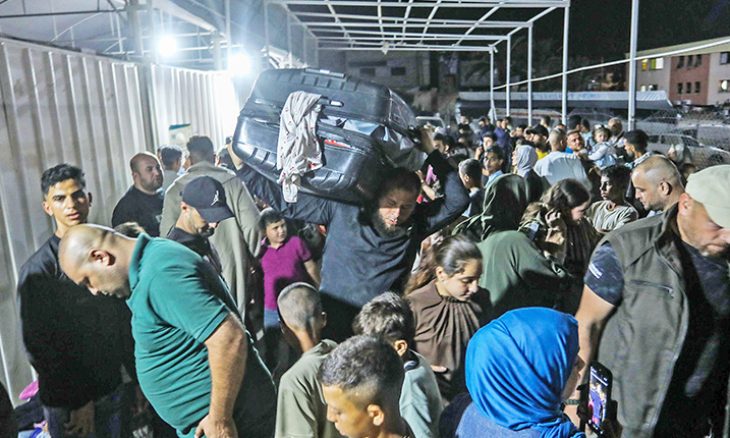
The Rafah border crossing is witnessing moving humanitarian scenes as Palestinians stranded abroad continue to flock to the Gaza Strip, a move that reflects popular determination to return despite the massive destruction left by the war. Since the reopening of the crossing on February 2nd, stories of families who were not deterred by years of genocide or loss of homes from returning to their roots have been unfolding, dealing a strong blow to the displacement and settlement plans promoted by Israeli parties.
Citizen Fida Omran describes her arrival in Gaza as a restoration of the soul, as she was reunited with her father in Nasser Hospital in Khan Yunis after a long treatment journey abroad. Omran affirmed that the services available abroad could not compensate her for the warmth of her homeland, advising Palestinians to hold on to their land and not to think of leaving, stressing that 'there is no better place than Gaza' despite the harsh current conditions.
For its part, government sources in Gaza revealed the existence of deliberate Israeli obstacles aimed at slowing down movement through the crossing, as the occupation did not adhere to the agreed-upon numbers under the ceasefire understandings. The sources explained that the occupation practices a policy of procrastination and harassment against returnees, in a desperate attempt to deter them from returning to the Strip and keep them in a state of forced diaspora.
Field data indicates that about 80,000 Palestinians abroad have officially registered their names to return to the Gaza Strip, a number that sends clear political messages to decision-makers in Tel Aviv. Observers believe that this massive turnout for return, even in the absence of basic necessities of life, represents a frustration of Israeli efforts aimed at emptying the Strip of its inhabitants and turning it into a buffer zone or settlements.
Returnee Tahani Omran recounted harsh details about the treatment returnees received from the occupation army at the crossing, where she was subjected to abuse and interrogation for hours while handcuffed and blindfolded. Tahani affirmed that these repressive measures aim to intimidate Palestinians, but she stressed that the will to stay is stronger than the machine of oppression, saying: 'We were born in Gaza and we will die in it.'
In a related context, young Hossam Al-Mansi expressed his immense joy at meeting his seven children after a treatment journey in Egypt, affirming that the soil of Gaza is worth the world and everything in it for him. Despite praising the medical care he received in Egyptian hospitals, he stressed that the feeling of belonging to the homeland cannot be compensated, calling on everyone to stand firm on the soil of the Strip no matter the sacrifices.
Political analyst Iyad Al-Qara considered that the arrival of the first batch of returnees represents a 'practical failure' of the displacement project adopted by the occupation government with the support of international parties. Al-Qara explained that the decision to return has two dimensions; one humanitarian related to reuniting fragmented families, and the other national political reflecting a deep popular awareness of the necessity of confronting ethnic cleansing plans.
Al-Qara pointed out that Palestinian national upbringing proved its effectiveness during the war, as displaced people insisted on returning to their destroyed homes in the northern Strip immediately after the truce came into effect. This collective behavior reflects the failure of the occupation to break the will of Palestinians, which explains the state of annoyance and violations practiced by the army against returnees through the Rafah crossing at present.
Reports indicate that the occupation authorities tried to entice some returnees with money in exchange for returning to Egypt or security cooperation, but these attempts were met with outright rejection. These testimonies confirm that the occupation uses all means, from intimidation to enticement, to reduce the population in Gaza, but it clashes every time with the nature of the Palestinian person clinging to his land.
Statistically, sources stated that the occupation's adherence to the number of travelers through the crossing did not exceed 29% during the past two weeks, which hinders the return of thousands of stranded people. Out of 2,800 travelers who were supposed to cross, only 811 people were able to move, which puts the international community before its responsibilities regarding the occupation's continuous violations of agreements.
In light of this catastrophic reality, there are still more than 22,000 wounded and sick people in the Gaza Strip waiting for the opportunity to travel to receive necessary life-saving treatment. This crisis is exacerbated by the continued destruction of 90% of the health and civilian infrastructure, making the Rafah crossing the only lifeline that the occupation is trying to choke by all means and methods.
The emergency Arab summit had adopted a plan for the reconstruction of Gaza at a cost of 53 billion dollars, aimed at stabilizing Palestinians in their land and preventing any attempts at forced displacement. The plan includes comprehensive development and housing projects extending for five years, but its implementation remains dependent on the permanent opening of crossings and the cessation of Israeli restrictions imposed on the entry of basic materials.
The scenes of hugs and tears at the gate of the crossing summarize the story of a people who refuse to be broken, as Palestinians prefer to live in tents on the ruins of their homes over a life of exile. This popular determination represents the first and strongest barrier against any international or regional projects aimed at liquidating the Palestinian issue through the gateway of displacement or alternative settlement.
In conclusion, the Rafah crossing file remains a real test of the extent of international parties' commitment to ensuring freedom of movement for Palestinians, especially in light of statistics that confirm the scale of the humanitarian catastrophe. With the continued flow of returnees, Palestinians prove day after day that the land belongs to its owners, and that all attempts at uprooting will only increase their attachment to their identity and their legitimate right to live on their national soil.
Upon our arrival in Gaza, our souls were restored and our breaths returned, and nothing compares to the feeling of being among family and loved ones despite all the suffering.


Share your opinion
Determination to Return: Thousands of Palestinians Disrupt Displacement Plans via Rafah Crossing