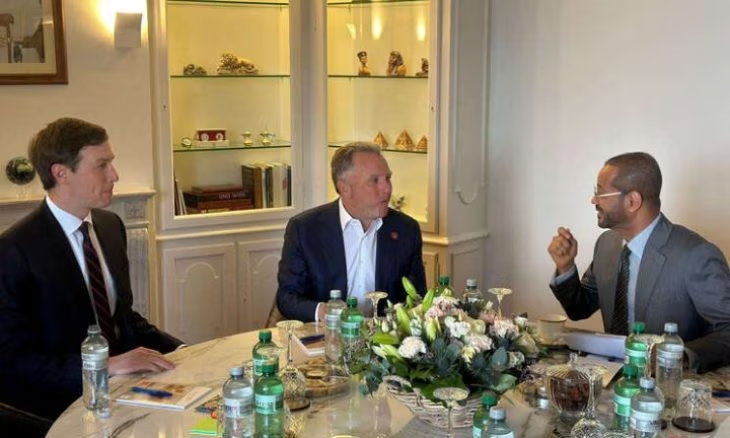







Recent diplomatic moves by US President Donald Trump, entrusting his favored envoys, Steve Witkoff and Jared Kushner, have sparked controversy in international political circles. The Swiss city of Geneva witnessed intensive shuttle rounds led by the duo, navigating two of the most complex global crises in one day: the Iranian nuclear file and the Russian-Ukrainian war.
Observers believe that this approach reflects Trump's penchant for striking major deals and his persistent pursuit of rapid diplomatic achievements that could qualify him for the Nobel Peace Prize. However, the simultaneous negotiations in one location and at a close timing have raised questions about the ability to focus and achieve tangible results in issues that have been protracted and complicated.
Diplomatic activities in Geneva began with a focus on the Iranian file, where indirect talks lasting about three and a half hours took place between the American team and Iranian Foreign Minister Abbas Araghchi. These discussions were mediated by Oman and under strict security measures, with participants indicating slight progress without reaching an imminent final agreement.
According to informed sources, the continuation of the diplomatic path gives Washington room for maneuver, as Trump continues to bolster military mobilization near Iran to send a message that the military option is still on the table. This ongoing tension keeps the Middle East in a state of anticipation, amid fears of things escalating into a comprehensive regional confrontation.
The American delegation had barely finished its meetings concerning Iran before moving directly to the Intercontinental Hotel to begin another round of negotiations related to the Ukrainian crisis. These talks, scheduled to last for two days, aim to find a formula to end the war, which Trump promised to extinguish in record time during his election campaign.
Despite the media buzz surrounding these meetings, expectations of a major breakthrough in the Ukrainian file remain low among many analysts. This war is the largest in the European continent since the end of World War II, making a quick settlement extremely difficult and complex.
Foreign policy experts, including former advisors in the Obama administration, criticized this approach, describing it as focusing on quantity rather than diplomatic quality. They pointed out that addressing two issues the size of Iran and Ukraine simultaneously could lead to a dispersion of efforts and weaken the American negotiating position against seasoned adversaries.
In a related context, regional sources close to Tehran expressed their doubts about the sincerity of American intentions, likening the situation to an emergency room trying to treat two critically ill patients with one doctor. This analogy reflects the concern that the lack of continuous care for each file separately could lead to a dismal failure on both tracks.
Analysts also drew attention to the background of envoys Witkoff and Kushner, who belong to the New York real estate world, considering that they lack the necessary political depth to face professional negotiators. The absence of Secretary of State Marco Rubio from these talks was notably observed, despite his extensive experience in international political affairs.
For its part, the White House, through spokeswoman Anna Kelly, defended this approach, affirming that Trump and his team are making extraordinary efforts to bridge viewpoints and stop the bloodshed. Kelly rejected the criticism directed at the team, emphasizing that the ultimate goal is to conclude lasting peace agreements that end raging conflicts.
Defenders of Witkoff and Kushner rely on their past successes in striking unconventional deals, such as the Abraham Accords and mediation efforts in the Gaza war. They believe that the absolute trust the President places in them gives them decision-making authority that transcends the traditional bureaucracy that has failed to resolve these crises for many years.
However, the reduction of State Department and National Security Council staff under Trump's administration has raised additional concerns about the technical and logistical support available to these envoys. Successful diplomacy requires an army of experts and advisors to draft the precise details of agreements, which the current team may lack given the new structure.
The question remains whether this 'shuttle diplomacy' will succeed in breaking the international stalemate, or if it will be merely a political show that ends without real results. The coming days in Geneva will be crucial in determining the course of American relations with both Moscow and Tehran in the next phase.
In conclusion, the international community awaits the results of these meetings with extreme caution, as any failure in Geneva could lead to military escalation in Ukraine or a nuclear confrontation with Iran. The ability of Trump's 'dealmakers' to tame these major crises remains under the microscope of a true test before the entire world.
Entrusting a team consisting of Witkoff and Kushner to solve all the world's problems is, frankly, a shocking reality.




Share your opinion
Shuttle Diplomacy in Geneva: Witkoff and Kushner Lead Simultaneous Negotiations on Iran and Ukraine Files