







Written by: Shira Efron
She is the Distinguished Chair of Israeli Policy and a Senior Fellow at the RAND Corporation.
The Middle East is not without its upheavals. In the wake of protests in Iran, Washington has threatened a military strike; violence continues in Gaza despite a ceasefire; Hezbollah is rearming itself in Lebanon; and factional conflicts destabilize Syria. But the next front that could erupt might be one that decision-makers consistently neglect: the West Bank.
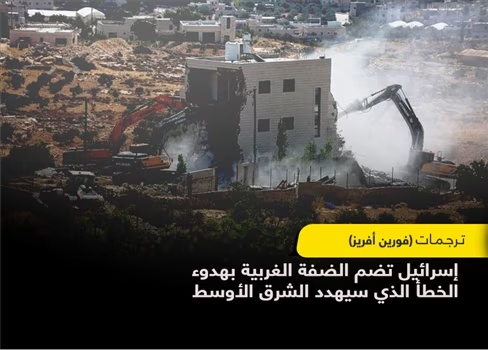
Since October 7, 2023, and the Israeli military offensive in Gaza, the Israeli government has launched a de facto annexation campaign, intensifying its military presence in the West Bank, exerting continuous pressure on the Palestinian Authority to weaken it, accelerating the approval of Jewish settlements, and retroactively legalizing outposts. Acts of violence by settlers have become almost daily occurrences.
Then, on Sunday, the Security Cabinet, headed by Israeli Prime Minister Benjamin Netanyahu, approved an exceptional set of measures that transform the de facto annexation of the West Bank into legal policy. The timing of this move was extremely bold, preceding Netanyahu's visit to the White House. Israel will ease restrictions on land sales to settlers and will assume authority to determine how land is used in Areas A and B, which were officially under Palestinian Authority rule. Israeli Finance Minister Bezalel Smotrich stated that the goal is to "eliminate the idea of a Palestinian state."
This move is but the latest development in a situation that has brought the West Bank to the brink of a real crisis. The Palestinian Authority may be unable to pay its debts within months, which would lead to a halt in essential services for millions of Palestinians and undermine security cooperation efforts with Israel that have so far prevented widespread unrest. Ramadan begins next week, a historical event that fuels tensions around the Al-Aqsa Mosque in East Jerusalem, known to Muslims as Al-Haram Al-Sharif and to Jews as the Temple Mount. Changes in Israeli police methods that weaken restrictions on provocative behavior, coupled with the absence of effective external mediation channels to help de-escalate tensions, pose a real risk that incidents at holy sites could spark wider unrest.
These hotspots are not accidental; they are an Israeli strategy. Influential Israeli ministers have long argued for the annexation of the West Bank into Israel's political and administrative sphere. A 2017 statement by Smotrich titled "The Decisive Plan" laid out a roadmap for this strategy: Israel should create an irreversible reality on the ground, eliminating any possibility of a Palestinian state, and forcing Palestinians to accept a status of permanent dependency or leave the West Bank.
Since October 7, Smotrich and other Israeli right-wing leaders have exploited the fog of war to turn this vision into policy. While Netanyahu's stance is more ambiguous – he has repeatedly insisted that Israel does not wish to assume full governance over Palestinian territories – his political survival depends on religious nationalist voters, limiting his ability and incentive to rein in leaders seeking annexation. Many Israeli moderates and international actors cling to the comforting assumption that upcoming Israeli elections later this year can reset the country's approach to the West Bank. But relying on such a reset is extremely risky. Many changes over the past two years are irreversible, especially since the Israeli opposition has not offered a clear alternative to the vision of annexation proponents.
Settler attacks against Palestinians and Israeli security forces in the West Bank increased by 27% between 2024 and 2025. The number of serious incidents classified as terrorism also increased by more than 50%.
Settler attacks against Palestinians and Israeli security forces in the West Bank increased by 27% between 2024 and 2025. The number of serious incidents classified as terrorism also increased by more than 50%.
If annexation proponents are not curbed soon, their cumulative actions will increase the likelihood of renewed unrest, necessitate continuous mobilization of the IDF, deepen Israel's diplomatic isolation, and force it to bear the burdens of civil governance in the West Bank, no matter how much Netanyahu claims otherwise. This will also seriously undermine the implementation of the 20-point peace plan for Gaza proposed by US President Donald Trump, which relies on the return of a reformed Palestinian Authority to administer that area. The conditions on the ground already make the stability of the Strip impossible and create the necessary conditions for it to become a permanent, irreversible insurgency zone.
According to the research institution "Tamror Politography," which collects data on Israeli control over Palestinian territories, this Israeli government has seen a massive surge in settlement expansion in the West Bank since 2023. In 2025 alone, it issued nearly double the number of approvals for housing units compared to 2019 and 2020. This recent surge far exceeds the usual multi-year totals of the previous decade and indicates a clear acceleration in both new settlement approvals and the retroactive legalization of illegal outposts.
"E1" Project
These moves are not only increasing the number of Israelis residing in the West Bank but are also weakening the Palestinian Authority day by day and fundamentally changing the face of the region. The Israeli government has begun establishing strategic control corridors by expanding administrative boundaries, creating bypass roads, and connecting infrastructure between settlements, making it difficult for Palestinian security forces and their political leaders to exercise their authority in the short term, and undermining any long-term opportunity for a geographically contiguous Palestinian state.
Rarely is there a clearer example of this process than the efforts to connect East Jerusalem to the large existing Ma'ale Adumim settlement, located 4.5 miles to the east, through the construction of thousands of housing units, as well as tourism and industrial infrastructure. Previous prime ministers, under international pressure, refrained from significantly advancing the development project – first proposed in the late 1960s and now known as "E1" – recognizing that it would effectively separate the West Bank and eliminate any chance for Palestinians to exercise their authority over a geographically contiguous area there. However, over the past year, the government has accelerated the implementation of the E1 project; in August, Smotrich officially approved the construction of 3,400 homes in the corridor, openly boasting that "the Palestinian state is being removed from the negotiating table not by slogans, but by actions. Every settlement, every neighborhood, every housing unit, is another nail in the coffin" of the two-state solution.
The E1 project is not an exception, but a adopted model. Similar logic underpins new construction projects and zoning plans around Gush Etzion, Ariel, and Ma'ale Adumim: they aim to strengthen Israeli control areas and fragment Palestinian territories. At the same time, small outposts are spreading throughout the West Bank. Some outwardly appear as pastures, but they serve a clear political function by seizing land and making Palestinian Authority over valuable areas impossible.
The Israeli government has even changed its rhetoric to legitimize outposts that were previously considered illegal. It is increasingly promoting the necessity of establishing "security farms," a rebranding process that transforms unlicensed outposts into alleged strategic assets. Just last week, in a video address at an "Appreciation Conference" for illegal agricultural outposts, attended by Smotrich and Settlement Minister Orit Strock, Defense Minister Yisrael Katz announced that he would legalize approximately 140 unlicensed agricultural outposts in the West Bank; he praised the illegal settlers as "pioneers of our era," "weakening Palestinian efforts to establish their presence in the area." Netanyahu himself recently indicated his support for official recognition of these sites. This type of land seizure may be less dramatic than annexation, but it is no less effective.
My Written Work
Palestinians are also facing a sharp escalation in violence committed directly by Israeli settlers, a type of violence implicitly endorsed by the Israeli government. In 2024 and 2025, settlers committed an unprecedented number of arson attacks, acts of vandalism, and physical assaults. According to statistics published by the Israeli army and the Shin Bet (internal security service) last month, settler attacks against Palestinians and Israeli security forces in the West Bank increased by 27% between 2024 and 2025. The number of serious incidents classified as terrorism also increased by more than 50%, mostly concentrated in hotspots such as Nablus, Hebron, and Ramallah.
However, the most significant characteristic of these attacks is not their frequency, but rather the Israeli government's allowance of them. Enforcement of laws prohibiting settler violence has been intermittent, often absent. Investigations are often minimal or non-existent. Prosecutions are rare, and the conviction rate is extremely low. The Israeli army does not believe its mission is to arrest Jewish extremists, and the police – controlled by Itamar Ben-Gvir, the controversial far-right National Security Minister – turn a blind eye. Last month, for the first time in Israel's history, the Israeli defense establishment reported more Jewish terrorist acts against Palestinians in the West Bank than Palestinian terrorist acts against Jews there and within Israel itself.
Decisions made at the highest levels of the Israeli government have given these perpetrators greater authority. In November 2024, Katz announced that his office would stop using administrative detention, a preventative measure allowing detention without charge, often used against Palestinians, against Jewish settlers, signaling the government's acceptance of settler violence at a time when Israel desperately needed to demonstrate more deterrence. In an interview with Fox News in late December, Netanyahu claimed that the international press exaggerated its coverage of settler violence, attributing it to the misconduct of "about 70 young people" who came from "broken families" outside the West Bank. Netanyahu did not clarify the source of his data, but his implication that most settlers do not support this violence is incorrect: in a poll conducted by Reichman University in June 2025, nearly half of respondents agreed that "violent resistance by Jews against Palestinians may be justified at this time," while slightly more than a third believed that such violence should be punished.
Hostile Takeover
Despite his political opportunism, Netanyahu has historically avoided pushing the Palestinian Authority to complete collapse. He understands that any short-term ideological gains such a move might achieve would come at a prohibitive long-term cost. Without the Palestinian Authority, Israel would be forced to assume responsibility for providing civil services – salaries, health, education, and security – to millions of Palestinians.
However, with Netanyahu prioritizing his political survival, he no longer has full control over the West Bank file; it is managed by Smotrich and his partners. They have deliberately sought to stifle the region's economy and undermine the Palestinian Authority's ability to function effectively, slowing its approval of Palestinian construction projects and restricting Palestinians' ability to earn a living in Israel. Since May 2025, the Israeli government has halted the transfer of customs and tax revenues to the Palestinian Authority; some – but not all – of these transfers are legally restricted due to the Palestinian Authority's practice of providing so-called "martyr payments" to prisoners, fighters, and their families.
The Public Works Authority can now only pay partial salaries to its 150,000 employees, in addition to a larger number of retirees and contractors. Schools have shifted to a four-day school week, limiting parents' ability to work. Healthcare and waste collection services have also been curtailed, leading to a deterioration in living standards.
The Israeli executive is leading the annexation efforts, but the Israeli parliament has contributed to the attempt to strangle the West Bank, making it even harder to reverse. Over the past two years, the Knesset has sought to enact legislation that tightens its financial, economic, and legal grip on the West Bank and directly weakens the Palestinian Authority. Additionally, lawmakers recently introduced proposals that would allow Israeli victims to retroactively file civil lawsuits against the Palestinian Authority for past terrorist attacks, which would overwhelm the Palestinian Authority to the point of collapse if passed.
Palestinian Authority Reform
The Palestinian Authority suffers from serious flaws and extreme fragility. Years of corruption, administrative failures, and inability to negotiate a state with Israel have eroded its credibility among Palestinians. But Israel needs a more effective Palestinian Authority, not a more fragile one. The same applies to Trump: his 20-point peace plan for Gaza states that an improved Palestinian Authority will eventually regain its authority over Gaza. The peace process cannot continue unless Palestinians have legitimate, competent, and stable political representation, which currently depends on the institutions of the Palestinian Authority, if not its current leadership. Arab and European donors, who are supposed to bear the responsibility for Gaza's reconstruction, have demanded a path towards a two-state solution, a path that only passes through the Palestinian Authority. There is currently no credible alternative with legal legitimacy and operational capacity. Burning down the Palestinian Authority in the West Bank undermines Gaza's recovery process before it even begins.
For this reason, immediate steps must be taken to halt the destructive Israeli approach towards the West Bank. Avoiding an explosion in the West Bank does not require resolving the entire Israeli-Palestinian conflict, but rather taking immediate steps to prevent the deliberate destruction of Palestinian institutions.
The only entity the Israeli government cannot refuse is Trump. If Washington wants to prevent another front from opening in the Middle East while on the verge of confrontation with Iran, it must also do more to ensure that Israel does not destroy the Palestinian Authority. This means working with Israel to restore revenue transfers, demanding that it stop enacting anti-Palestinian Authority legislation, and obliging it to enforce its laws against violent settlers. These concrete measures would remove immediate threats to the Palestinian Authority's existence.
The far-right in Israel seems to believe that destroying Palestinian governance will give Israel more power. Quite the opposite, it is a grave mistake that will become costly, bloody, and self-destructive, accelerating resentment and violence. Washington will also lose much by ignoring the situation in the West Bank: the collapse of the Palestinian Authority will remove any possible path towards regional stability and effective post-war settlement, which the Trump administration has relied on for much of its foreign policy legacy.
Share your opinion
Israel Quietly Annexes the West Bank.. The Mistake That Will Threaten the Middle East