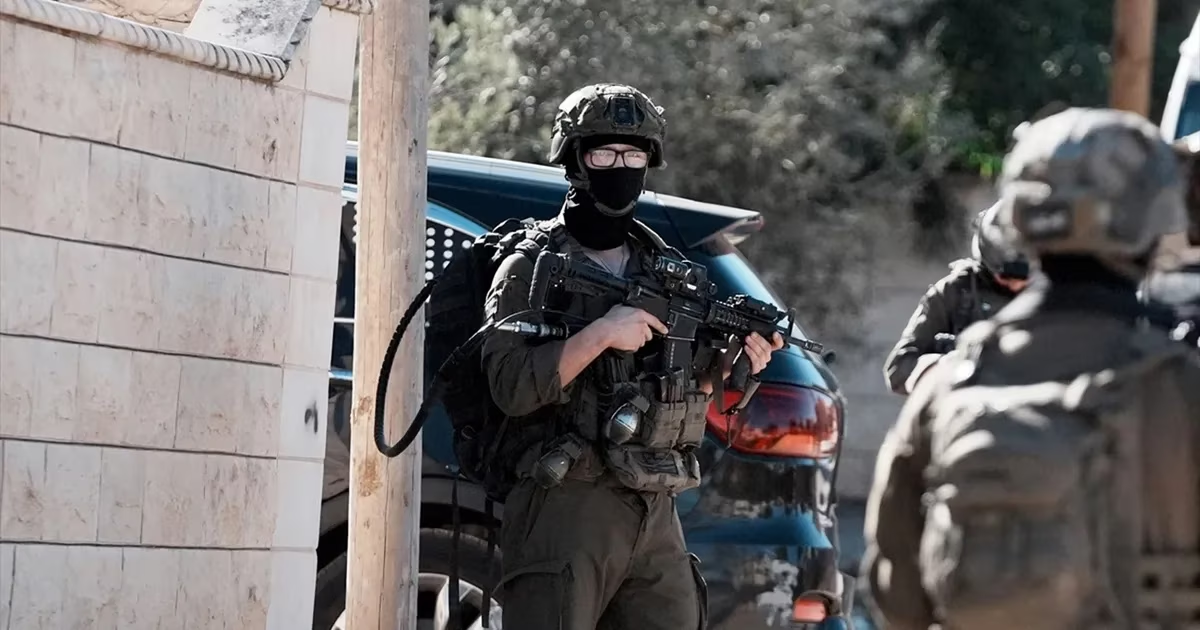







Anxiety is escalating within the Israeli security establishment as the holy month of Ramadan approaches, with serious fears of a resurgence of Palestinian armed operations. This Ramadan is the first to come after the war on the Gaza Strip, which gives it a special character and doubles the security sensitivity for the occupation authorities.
Media sources reported that experts in Tel Aviv view the holy month as a permanent hotbed of tension in the Middle East, where it historically turns into fertile ground for what they describe as incitement to resistance. Security agencies are preparing to confront this scenario by reinforcing the presence of army and police forces in various hot spots to try to thwart any potential escalation.
Israeli propaganda expert, Gadi Ezra, stated that the current preparations are taking place amidst a continuous flow of intelligence warnings indicating intentions to carry out attacks. He explained that the Israeli army is monitoring the situation with extreme caution, emphasizing that the military establishment will not stand idly by in the face of attempts to ignite the situation on the ground.
Ezra pointed out in an analysis published by Hebrew newspapers that the countries of the region are currently preoccupied with shaping the features of the political reality for the day after the war. Despite this regional preoccupation, internal incitement and attempts to carry out operations still pose the most prominent challenge to the security decision-maker in Israel.
The analysis touched upon the fact that condemnations related to changing the status quo in Al-Aqsa Mosque no longer dominate the scene with the same previous force, due to the high level of media noise about other issues. Current discussions are now focusing more on the possibilities of a comprehensive regional war or arrangements for the return of the Palestinian Authority to the Gaza Strip.
Israeli observers believe that the coincidence of Ramadan with a crowded political agenda represents an opportunity to redefine security and political concepts towards Palestinians. The issue is no longer limited to geographical arrangements, but rather relates to how each party perceives the other and the nature of the ongoing existential conflict in the region.
Experts warned that the continuation of what they described as the 'cultural normalization' of resistance work among Palestinians makes armed confrontations legitimate in their eyes during Ramadan. Israeli circles fear that these operations will gain greater legitimacy in the Palestinian street, especially after the bloody events witnessed in Gaza recently.
Israeli analyses called for the necessity of addressing the roots of the problem instead of merely relying on temporary security solutions taken every year. It considered that confronting the cultural factors that fuel Palestinian resistance should become a long-term strategic political goal for the Israeli establishment.
Reports indicate that narratives encouraging the escalation of resistance in Ramadan are widely spread in curricula, media, and social media platforms. The Israeli side believes that monitoring these narratives and trying to neutralize them is a difficult and complex task, but necessary to break the annual cycle of violence.
Ezra stressed that the occupation cannot be content with curbing operations seasonally, but must engage in a 'public awareness' process that imposes clear red lines. This requires a systematic policy that goes beyond the coming month to include careful and continuous monitoring of changes in Palestinian society.
Analysts believe that the first Ramadan after the war has the potential to set a new tone in the conflict if Israel succeeds in achieving its security goals. However, field expectations remain open to all possibilities in light of the boiling situation in the occupied Palestinian territories.
In a related context, Israeli intelligence agencies continue to monitor the protocols of the October 7 attack and its psychological effects on the motivation to carry out new operations. This data is considered an essential part of the emergency plan being prepared to welcome the holy month and secure settlements and major cities.
The sources confirm that the biggest challenge lies in individual operations that are difficult to predict or thwart in advance through traditional technological means. Therefore, intensive military deployment remains the preferred option for the occupation to reduce the chances of success of any armed attack that may target its soldiers or settlers.
In conclusion, the month of Ramadan remains a real test of the occupation's ability to impose calm in the aftermath of the major war on Gaza. While Israel seeks to impose a new reality, the will of the Palestinian resistance remains the variable that disrupts all Israeli security calculations and estimations.
The coming Ramadan seems different; it is the first after the war, intelligence warnings are flowing, and the army is anticipating its arrival with concern and is not standing idly by.



Share your opinion
Israeli security concerns about armed escalation in the first Ramadan after the Gaza war