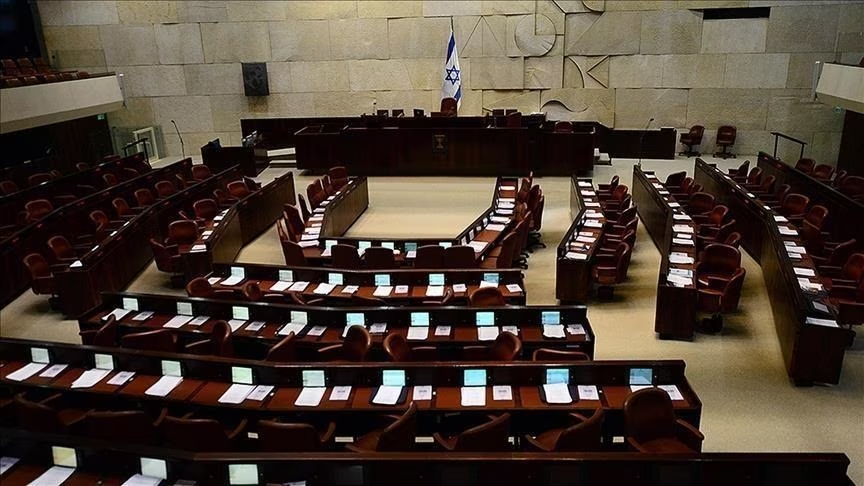







With the leaders of 4 parties representing Palestinians inside Israel signing a pledge to form a joint list to contest the upcoming elections, attention is turning to the Arab vote as a key factor in redrawing the balance of power within the Knesset and determining the features of the government.
The step taken by the four parties, according to two experts on Israeli affairs, will make the Arab vote decisive in the Knesset (parliament) elections, which has led officials in the Israeli right to anxiously monitor the movements of the Arab parties ahead of the elections.
The two experts believe that the decision by the leaders of 4 Arab parties to form a joint list to contest the elections carries significant implications that could increase the voting rate of Arabs, who constitute 21 percent of Israel's 10 million population.
However, they point out that it is too early to definitively say that unity will actually happen, given the need to agree on many details, most notably the political program, the stance on Jewish opposition parties, and who will lead the Arab list.
Under popular pressure, the leaders of the Democratic Front for Peace and Equality (secular) Ayman Odeh, the Arab List for Change (nationalist) Ahmed Tibi, the National Democratic Assembly (nationalist) Sami Abu Shehadeh, and the United Arab List (Islamist) Mansour Abbas, signed a pledge on Thursday to form a joint list to contest the elections.
Unless early elections are held in Israel, the general elections will take place as scheduled next October.
The pledge by the four parties came in the city of Sakhnin in northern Israel on Thursday evening, after intensive efforts in recent months to bring the leaders of these parties to unity proved futile.
But the unprecedented scene of tens of thousands of Arab citizens participating in a march against the spread of crime in the Arab community contributed to a significant step towards this unity.
The leaders of the aforementioned parties still need to finalize the details of this unity in preparation for the Israeli general elections.
While public opinion polls indicate that Arab parties would win 10 of the 120 Knesset seats, the unity of the Arab parties could raise the Arab voting rate, potentially increasing the number of Arab representatives to 15.
The same Arab parties had previously united in a single list called the "Joint List" in 2015, winning 13 seats, and this was repeated in the 2019 elections. In the 2020 elections, the Joint List won 15 seats.
However, the Joint List soon dissolved in 2021, with the Democratic Front for Peace and Equality and the Arab List for Change contesting the elections as a single list, and the United Arab List and the National Democratic Assembly running separately.
In the 2022 elections, the alliance of the Democratic Front for Peace and the Arab List for Change won 5 seats, while the United Arab List won 5 seats, and the National Democratic Assembly failed to win any seats.
Wadie Abu Nassar, an expert on Israeli affairs, says that the announcement of the intention to form a joint list is a first step, but there are many details that need to be agreed upon before a joint list is actually formed.
He explains: "There are many details that need to be agreed upon, such as the political program, the distribution of seats among the parties, taking into account the political weight of each party, who will lead the list, and the stance on a Jewish opposition government – will it be supported if it requests it or not? There are differing views among the Arab parties themselves on this matter."
According to Abu Nassar, "the devil is in the details, and the parties must agree on all these details before we can say that there is actually a joint Arab list."
He asks: "Will it be a technical alliance to garner the largest number of votes on election day, and then each party will work independently in the Knesset after the elections? This is an important question."
He pointed out that "there is widespread popular pressure in the Arab street to form a joint Arab list."
The speaker believes that "if the Arab parties unite, it would increase the voting rate of Arab citizens, and therefore we can expect the Arab parties to win 15 or perhaps 17 seats if the Arab voting rate is high."
Despite all the previous data, Abu Nassar believes that Arab votes "will be decisive in the upcoming elections in determining who will form the next Israeli government."
He adds: "The higher the voting rate of Arab citizens, the lower the chances of small right-wing parties succeeding, because they will have to cross the electoral threshold of 3.25 percent of the total number of voters."
He continues: "An example of this is the Religious Zionist party led by Finance Minister Bezalel Smotrich, which opinion polls say will not be able to cross the threshold, let alone if the Arab voting rate is high?"
However, Abu Nassar notes that the unity of the Arab parties and the estimates of an increase in the Arab voting rate could lead to an increase in the voting rate among Israeli religious and right-wing parties.
"Israeli religious and right-wing parties have a very large reserve of votes, and they may be motivated to vote. In this case, Arabs need to significantly increase their voting rate in order to compete," he explains.
He adds: "Also, Israeli Prime Minister Benjamin Netanyahu may push right-wing parties to unite to ensure their victory, as happened in the last elections when the Jewish Power party led by Itamar Ben-Gvir contested the elections in an alliance with Religious Zionism and then separated after the elections."
According to the political analyst, "the higher the Arab voting rate, the lower Netanyahu's chances of forming a government."
He says: "If the Arab alliance actually happens and the voting rate of Arab citizens is high, then Netanyahu will be in a difficult position."
Agreeing with Abu Nassar, expert Mohammed Halasa believes that Israeli right-wing parties are looking with great concern at the Arab parties' move towards unity and hope these efforts fail.
He says that "the Israeli view is that the chances of Arab parties uniting in a single list are still low."
Halasa points out that Arab parties could form a blocking bloc if they actually unite and succeed in raising the Arab voting rate.
He says: "Raising the voting rate of Arab citizens will make it difficult for Netanyahu to form a new government. Opinion polls indicate that Arab parties would win 10 seats if elections were held today, but if Arab parties unite and the Arab voting rate increases, Arabs could win 15-16 seats, and perhaps more, in the elections."
On the other hand, he mentions that the vast majority of Israeli Jewish opposition parties refuse to rely on an Arab party to form a government, thereby preventing Prime Minister and Likud party leader Netanyahu from forming a government.
He continues: "As an indicator of this, the leader of the opposition Blue and White party, Benny Gantz, published a propaganda video for his party in which he incited against Arabs by calling for a government that does not rely on Arabs."
He adds: "Some in Israel also bet on the failure of the unity effort due to disagreements between the parties regarding the possibility of supporting a government that replaces Netanyahu's government, and they specifically refer to the United Arab List led by Mansour Abbas, who previously supported the Naftali Bennett-Yair Lapid government from outside."
He notes: "Nevertheless, there is significant Arab pressure for the parties to unite in a joint list, which constitutes a driving factor for them to move forward with unity."
He points out that Israeli Jewish opposition parties will likely need the support of at least one Arab party to form a government and prevent Netanyahu from forming one.
According to Halasa, "public opinion polls indicate that the Jewish opposition will need the support of at least one Arab party to reach the 61 votes required to form a government."
He asks: "Will Jewish parties accept Arab support to form a government, especially after the rising voices against such an alliance following the October 7, 2023 attack? And will Arab parties, or at least one of them, agree to provide support to Jewish opposition parties to prevent Netanyahu from forming a government? And if this happens, what will be the fate of the Joint List if it is actually established?"
He concludes by saying: "The possibilities are open, and the scene is still hazy. Developments in the coming weeks and months need to be followed."
The higher the Arab voting rate, the lower Netanyahu's chances of forming a government.




Share your opinion
After its unity.. Arab parties and their chances of winning in the Israeli elections