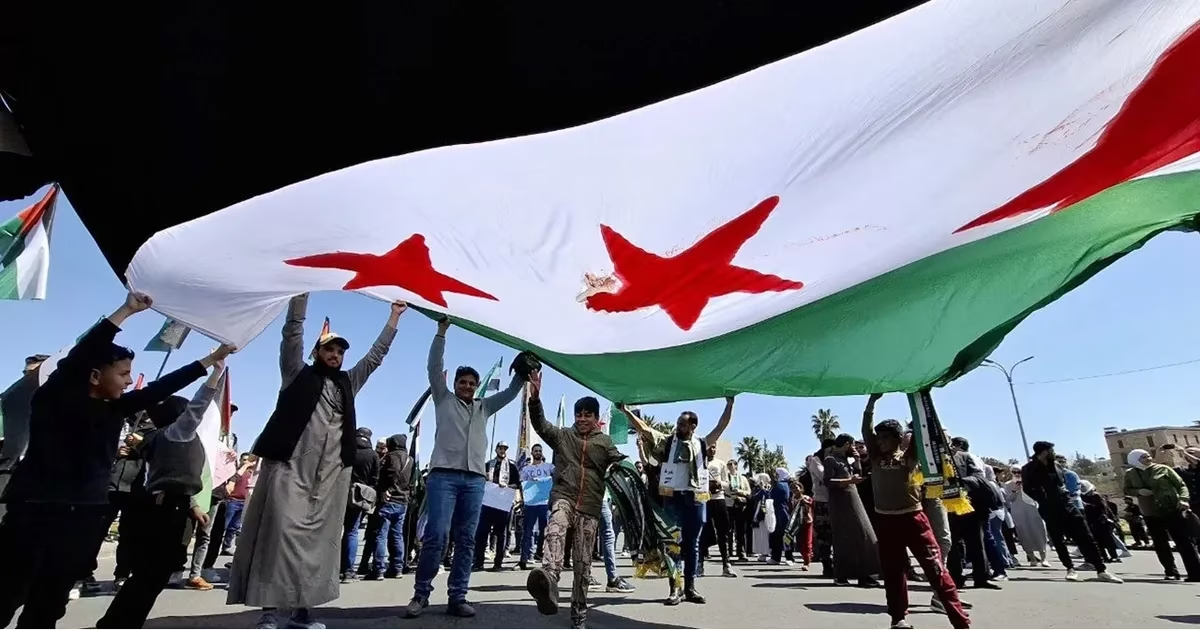







While the occupation continues its aggression against Syria, Israeli voices are emerging calling for a new reading of what they consider "common interests with the new regime," and advocating for placing them at the forefront of political action in the future relationship between Damascus and Tel Aviv.
The former head of the National Security Council, Tzachi Hanegbi, affirmed in an article published by the "Yedioth Ahronoth" newspaper that "the Israeli political and security agenda revolves around important developments in two areas: in Gaza, where the second phase of the 'Twenty Points' plan launched by US President Donald Trump has begun; and in Iran, where a phase of anticipation has begun, characterized by ambiguity regarding the future of the protests and its policy towards them."
Hanegbi added that "in both areas, Israel's ability to influence events seems limited. Therefore, I propose starting a political move in another area, which is the Syrian area, with the aim of quickly reaching a comprehensive security agreement with it, after the previous agreement with it for the separation of forces signed in 1974 after the October War lasted fifty years, which is the longest duration for any other agreement with an Arab country, despite the many challenges that threatened its validity."
He explained that "the fall of Bashar al-Assad's regime in December 2024 effectively ended this agreement, as the Israeli army, under the guidance of the political leadership, launched 'Operation Bashan Arrow,' moving quickly and decisively, and took control of areas adjacent to the Syrian border with the Golan Heights, including Mount Hermon. At the same time, Israel launched widespread attacks throughout Syria to destroy strategically important weapons caches and prevent them from falling into the hands of the new regime."
He affirmed that "during the period since then, Israel has strived to achieve two ambitious political goals in the north: first, to exploit the ceasefire agreement signed in November 2024 to promote Lebanon's accession to the normalization and peace process; and in Syria, the goal is to formulate a two-stage process that begins with organizing security arrangements on the common border, and continues with Syria's accession to the normalization agreements."
He pointed out that "without effective American participation, it is impossible to make progress on these two axes, and therefore the US President appointed his ambassador to Turkey, Tom Barrack, as his personal envoy to promote this vision, who showed diligence and initiative, and made great efforts, working in full harmony with Minister Ron Dermer, seeking to resolve disputes with Lebanon and Syria. However, the current situation shows a complex picture."
He explained that "the situation in Lebanon is characterized by portraying President Joseph Aoun as a leader committed to the future of his country, not to external interests, especially Iranian ones, which brought him to the brink of the abyss. Despite his good intentions, he failed in his attempts to implement the central clause in the agreement signed with Israel, which is the disarmament of Hezbollah throughout Lebanon, and there are many reasons for this, the most important of which is the inherent weakness of the Lebanese army, and Aoun and his government's fear of an escalation of the civil war."
He added that this "coincides with the severe blows Hezbollah has already suffered during a year of fighting with Israel, and is evident in its decision to refrain from responding to hundreds of assassinations and violent attacks launched against it as part of its policy of imposing sanctions for violations of the agreement by force. However, thanks to its clear military superiority, it deters its opponents from taking any bold political moves, and the result is no practical progress in the tripartite dialogue led by the United States on the issues of the dispute on the Israeli-Lebanese border."
He noted that "Israel has made it clear that its forward military deployment in southern Lebanon will not change as long as Hezbollah poses a threat to northern settlers; and an escalation of the conflict now seems more likely than reaching understandings, and as reported, a continuous political dialogue has been ongoing between Tel Aviv and the new regime in Syria for some time, and I participated in it, and I saw that common interests outweigh divisive interests."
He revealed that "as part of my mission as head of the National Security Council, I held a series of secret meetings on the Syrian issue, and Israel's main concern is that Syria becomes a Turkish protectorate on its northern border, and given President Erdogan's hostile rhetoric, this concern is not unfounded, because the most effective way to thwart this scenario is to maximize Syria's expected gains from joining the Middle East peace initiative launched by Trump, because it was and still is the American strategy."
He affirmed that "in the absence of American influence, finding a balance between the interests of Tel Aviv and Damascus becomes more difficult, but it is possible, because in negotiations aimed at establishing new security arrangements, the Syrians are likely to demand an Israeli withdrawal from the new areas that the Israeli army has been preparing to defend since the end of 202, and the solution to this issue may be based on finding the optimal balance between the Israeli presence on Syrian territory, and the actual implementation of measures that guarantee the vital security interests of the occupation, which will increase Israel's margin of flexibility."
Common interests outweigh divisive interests.



Share your opinion
Israeli calls for a security agreement and normalization with Syria