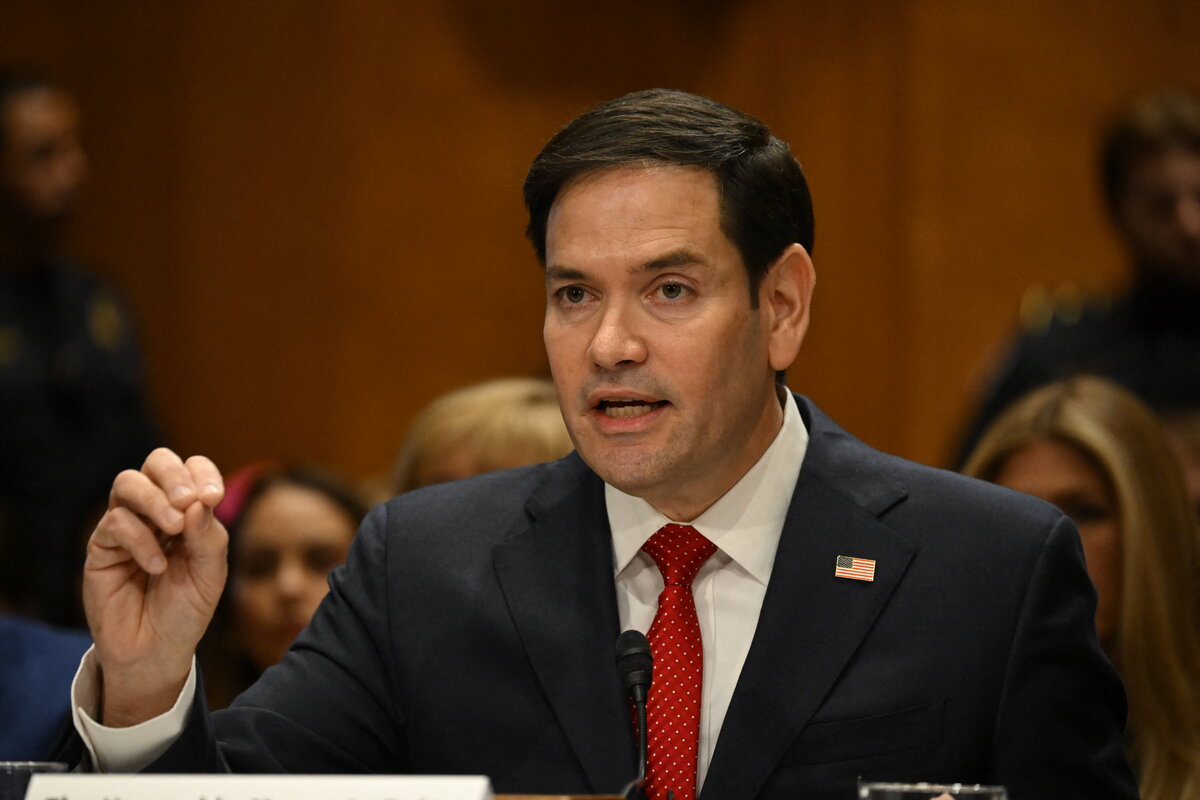







The New York Times revealed, based on internal government documents declassified by court order on Friday, that last year, US Secretary of State Marco Rubio personally approved the deportation decisions of five foreign students and activists, following their participation in pro-Palestinian university protests and their writings critical of the Israeli war on the Gaza Strip. These documents offer a rare glimpse into how the administration of President Donald Trump handled freedom of expression in American universities when it intersected with foreign policy and bias towards Israel.
The documents, spanning hundreds of pages, were unsealed after Federal Judge William G. Young, appointed by former President Ronald Reagan, approved a request submitted by the New York Times and other media organizations, deeming their publication to be in the public interest. The government had previously sought to seal these files, claiming they contained details related to sensitive federal investigations.
The case concerns five foreign students: Mahmoud Khalil (Palestinian), Rumeysa Ozturk (Turkish), Mohsen Mahdavi (Palestinian), Badar Khan Suri (Indian), and Yunsu Chung (Chinese). All of them were legally residing in the United States and were prominent in university protests condemning the Israeli aggression on Gaza. Nevertheless, they were arrested last spring and faced a direct threat of deportation.
The documents show that the Department of Homeland Security submitted official memos to the State Department recommending the deportation of the five students, mostly based on their protest activities and public writings. The memos indicate that the administration considered these activities, in their political context, to be an expression of "support for terrorism" or "anti-Semitic rhetoric," despite internal acknowledgment that these descriptions might not withstand judicial scrutiny.
In one of the most significant points, a memo specifically concerning Mohsen Mahdavi, a university student at Columbia University and a green card holder, warned that the judiciary might view his actions as protected expression under the First Amendment of the US Constitution. The memo stated that "the courts are likely to scrutinize the legal basis for this decision very closely."
Judge Young, who reviewed the documents and heard witness testimonies during a trial held in Massachusetts last July, concluded that the Trump administration unlawfully targeted the students because of their political views. He considered what happened to constitute a clear violation of freedom of expression, especially when it concerned opposition to the Israeli government's policies and military operations in Gaza.
In a remarkably worded ruling, the judge described the conduct of Secretary of State Marco Rubio and Secretary of Homeland Security Kirstjen Nielsen as an "unconstitutional conspiracy" aimed at "hunting down" a limited number of students to send a message of intimidation to thousands of non-American researchers and academics. He stated from the bench: "These secretaries failed in their constitutional duty to protect freedom of expression."
For its part, the State Department defended its decisions, considering Rubio's actions to be within the framework of protecting national security. A spokesperson for the department affirmed that "a visa is a privilege, not a right," and that the United States would not, in his words, allow the harboring of those suspected of supporting terrorism.
However, the documents reveal a stark contradiction in the government's position, as Homeland Security officials admitted that in most cases, they found no clear legal basis for deportation, except by relying on a rarely used 1952 law that grants the Secretary of State the authority to deem foreigners deportable for foreign policy reasons. The memos explicitly confirmed that the agency "did not identify any other basis for removal," including charges of material support for designated terrorist organizations.
In the case of researcher Rumeysa Ozturk from Tufts University, investigators admitted there was no evidence of her involvement in anti-Semitic or terrorism-supporting activities. Nevertheless, they recommended revoking her visa based on the "totality of circumstances," which in reality revolved around an opinion piece she wrote in a student newspaper calling for a boycott of investments linked to Israel.
As for the files concerning Mahmoud Khalil and Yunsu Chung, both from Columbia University, they focused on their participation in protests during which leaflets containing phrases attributed to Hamas were distributed, without any evidence that they were responsible for preparing or distributing them.
The documents also reveal that a special team within Immigration and Customs Enforcement, known as the "Tiger Team," reviewed the files of more than five thousand students linked to pro-Palestinian protests, using information from websites such as "Canary Mission" and "Betar US," two Israeli agencies known for tracking and publishing personal data about pro-Palestinian activists.
In conclusion of the case, Judge Young issued a ruling allowing immediate challenge to any future attempt to deport members of the academic organizations that filed the lawsuit, placing a legal burden on the government to prove that its actions do not involve retaliation based on opinion or academic activity.
Thus, this case not only reveals the targeting of specific students but also places the Trump administration before a broader accusation: using immigration and national security tools to suppress freedom of expression when it conflicts with the official US political line towards Israel, setting a dangerous precedent that threatens the core of academic freedoms in universities.
Share your opinion
Marco Rubio Personally Approved the Deportation of Students Due to Their Pro-Palestinian Stances