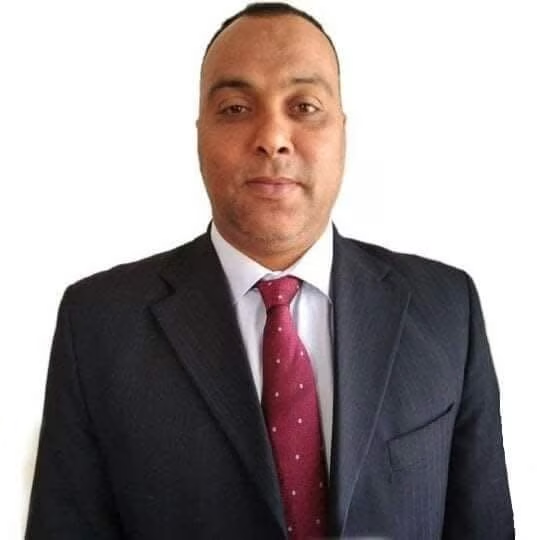







The speech by Palestinian Prime Minister Dr. Mohammad Mustafa at the Davos Economic Forum 2026 came at a pivotal political and economic moment, not only for Palestine but also for an international system that appeared exhausted by accumulated crises and hesitant to bear the cost of radical solutions. From this perspective, the speech cannot be read as a mere protocol address at an economic forum, but rather as a conscious attempt to reposition the Palestinian issue within the global consciousness, by shifting it from a discourse of conflict and abstract rights to a discourse of stability, governance, and long-term economic risks.
What distinguished Mustafa's speech was his understanding of the Davos audience: heads of state, financial policymakers, leaders of international institutions, and investors who are not driven by moral sympathy, but by calculations of stability, risks, and returns. Therefore, he did not begin his speech with the narrative of Palestinian oppression, despite its legitimacy, but with a question that at first glance seems technical: How can a world striving for growth and stability ignore an open hotbed of instability in the heart of the Middle East? In this sense, Mustafa redefined the Palestinian issue as an international system issue, not a deferred local conflict file.
In this context, the two-state solution in his speech appeared not as a traditional political slogan, but as a functional necessity for regional stability. Occupation, as he presented it, is not only a violation of international law but also a structural impediment to development, a constant source of market disruption, supply chain fragmentation, and growing security risks. This link between the political and the economic reflects the transition of Palestinian discourse from the stage of moral demands to the stage of building a rational argument directed at global decision-making centers.
When Mustafa emphasized the necessity of empowering the Palestinian Authority and extending its jurisdiction over all Palestinian land, it was not merely an affirmation of political legitimacy, but a proactive attempt to paint a picture of a workable partner in the post-war phase. The implicit message here is that a political vacuum is more dangerous than the conflict itself, and that any project for reconstruction or economic recovery will not be possible without a unified political address, capable of administration, accountability, and fulfilling international obligations. In this context, Mustafa presented the Palestinian Authority as a governing structure that does not seek sympathy, but practical authorization.
Economically, the speech carried a striking shift in language. Instead of talking about aid, Mustafa used terms like planning, investment, and sustainable reconstruction. He tried to move Palestine from the image of an emergency humanitarian economy to the horizon of a post-shock economy, where the reconstruction of Gaza and the West Bank becomes a long-term project, conditioned by political stability and good governance. This approach clearly aligns with the logic of international financial institutions, which are no longer willing to inject money into unstable or unaccountable environments.
However, one of the most significant dimensions of the speech was its shifting of the moral burden from Palestinians to the international community. Mustafa did not ask the world to feel the suffering of Palestinians, but to bear its responsibility towards an international system that claims to respect law and human rights. Here, the discourse shifted from a language of pleading to a language of quiet accountability, as if the Prime Minister was implicitly saying: the failure of the solution is not a result of the absence of a Palestinian vision, but a result of the hesitation of international will.
At its core, the speech can be read as part of building a new Palestinian narrative for the post-war phase, a narrative that does not deny the magnitude of the tragedy, but refuses to remain captive to it; a narrative that seeks to redefine the Palestinian not as a perpetual victim, but as a political and economic actor capable of managing their state if the imposed restrictions are removed. This narrative shift is extremely important because it addresses the world in its own language and breaks the stereotype that has confined Palestinian discourse for decades.
Nevertheless, the speech is not without structural challenges. It relies heavily on an international community that has repeatedly demonstrated the limited extent of its willingness to move from words to actions. Furthermore, the success of the proposed vision remains contingent on complex internal Palestinian factors, primarily political unity and rebuilding trust between citizens and governing institutions. Despite this, the value of the speech lies not only in its direct results but in its serious attempt to reframe Palestine's position in the world's mental map.
Dr. Mohammad Mustafa's speech in Davos 2026 was not merely a Palestinian participation in a global economic forum, but an attempt to reintroduce the Palestinian issue into the heart of global discussion through the gateway of economics, stability, and governance. It is a speech that reflects the transition of the Palestinian leadership at the discourse level from crisis management to thinking about post-crisis management, and from addressing conscience to addressing interests, presenting the world with a clear choice: either invest in a just and sustainable solution, or continue to pay the cost of open chaos.
Share your opinion
Speech by Palestinian Prime Minister Dr. Mohammad Mustafa at the Davos Economic Forum 2026