





Dr. Omar Rahal: Netanyahu will use facilitating the committee's entry as an additional bargaining chip on the table, as part of a policy of turning details into negotiation files.
Jihad Harb: The presence of the technocrat committee in Gaza and the actual start of its work will open the door to implementing the second phase, which Netanyahu does not want.
Nizar Nazzal: The committee is being prevented because it does not align with Israeli conditions, foremost among them disarmament and ending Hamas's organizational, political, and administrative presence.
Dr. Reham Odeh: Preventing the entry of the technocrat committee into Gaza is not related to the committee's work mechanism, but to lifting the siege on the Strip and the symbolism of opening the Rafah crossing.
Firas Yaghi: Israel seeks to send a message that everything happening in the Strip is subject to American-Israeli consensus and that it controls the scene.
Nu'man Tawfiq Al-Abed: Preventing the technocrat committee from entering Gaza clearly reflects the Netanyahu government's unwillingness to move to the second phase.
Ramallah – Exclusive to "Al-Quds"-
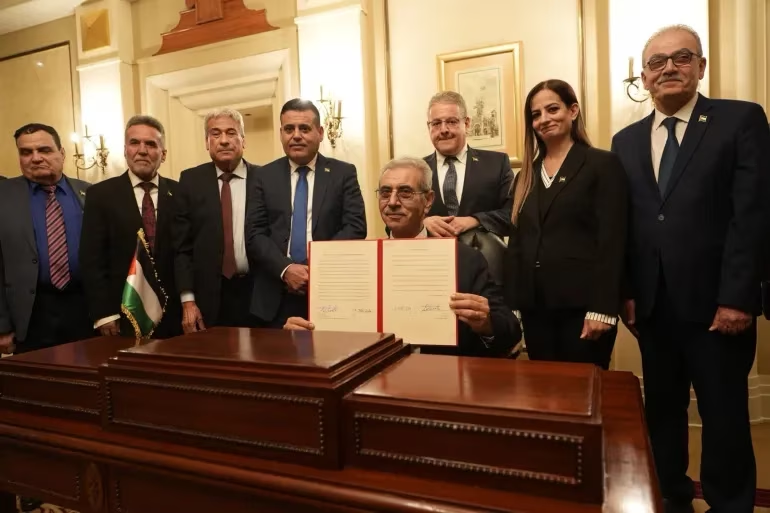
The prevention of the Palestinian National Committee for the Administration of the Gaza Strip, the "Technocrat Committee," from entering the Strip, as political analysts confirm, comes within the context of an escalating Israeli political move that goes beyond procedural or security dimensions. It reflects a systematic policy aimed at keeping the keys to movement and work within the Strip in the hands of the occupation, and in an attempt to obstruct the start of the second phase of the ceasefire agreement in the Gaza Strip.
According to writers, political analysts, and specialists, in separate interviews with "Al-Quds," this step shows that any administrative, humanitarian, or political path in Gaza remains conditional on direct Israeli will, in the absence of a real commitment to move to subsequent stages of the proposed understandings.
Writers, analysts, and specialists indicate that the occupation uses the issue of the committee's entry as a pressure and bargaining chip, by linking it to broader negotiation files, including the second phase, the cessation of war, and the opening of crossings, especially the Rafah crossing. This approach reflects an Israeli desire to obstruct any Palestinian administration, even if it is technocratic in nature, for fear that its work will establish a new political and humanitarian reality in the Strip.
Systematic Israeli Policy
Writer and political analyst Dr. Omar Rahal confirms that Israel's prevention of the technocrat committee from entering the Gaza Strip is not a new step in the occupation's behavior, but rather falls within a systematic Israeli policy based on controlling movement and transit and obstructing any path that could lead to real political or field changes.
He points out that the occupation previously prevented the late President Yasser Arafat and President Mahmoud Abbas from moving, leaving, and entering, in a similar context of restriction and control.
Rahal explains that this prevention carries a clear political message that the head of the occupation government, Benjamin Netanyahu, is the ultimate decision-maker, and he is the one who grants or denies permits, whether for the technocrat committee or others, as he controls all the details.
A Tool of Pressure and Obstruction of the Committee's Work
Rahal considers this step not merely a security measure, but a tool of pressure and obstruction of the committee's work, and a message directed to all concerned parties, stating that any progress in subsequent stages, whether in terms of reconstruction or the field reality in Gaza, will remain subject to Israeli will.
He points out that Netanyahu will use this issue as a bargaining chip in future political and diplomatic negotiations, so that facilitating the committee's entry becomes an additional item on the negotiating table, rather than a given, but rather part of a historical Israeli policy of turning details into negotiation files.
Rahal notes that the formation of the committee itself does not necessarily mean its ability to work, as its entry into Gaza may be subject to a new series of negotiations, procrastination, and Israeli conditions.
Agreements with Israel Lack International Authority
On the internal Israeli level, Rahal believes that this policy also represents a message directed to Netanyahu's partners in the current or future government coalition, stating that he is the guarantor of maintaining the status quo, and not allowing the committee's work to succeed or the situation to move to advanced stages related to reconstruction or direct observation of the extent of destruction in the Strip.
He stresses that the occupation does not respect agreements and does not adhere to deadlines or charters, due to the absence of real pressure tools and mechanisms that force it to comply, noting that the agreements signed with Israel lack a binding international authority, which allows the occupation to interpret and implement them only in its own interests.
Rahal refers to what media outlets have reported about the head of the technocrat committee, Dr. Ali Shaath, being delayed for about seven hours at the Karama Bridge before being allowed to leave for Jordan and then to Egypt, considering this incident to reflect the nature of humiliation and political blackmail.
Rahal believes that Dr. Ali Shaath should have announced his resignation after that incident and put international parties, especially the United States, in front of their responsibilities to pressure Israel to respect the agreements.
The Committee Will Eventually Enter
Rahal expects the committee to eventually enter Gaza, but after Israeli procrastination and the imposition of strict conditions, including controlling entry and exit times, and specifying the areas the committee is allowed to visit, which will prevent it from a comprehensive view of the extent of destruction in the Strip.
Rahal points out that any movement of the committee will remain subject to Israeli instructions, with the possibility of international interventions later to facilitate entry and exit, but without guaranteeing real freedom of movement.
The Second Phase That Netanyahu Does Not Want
Writer and political analyst Jihad Harb confirms that Israel's prevention of the technocrat committee from entering the Gaza Strip falls within its clear attempts to obstruct the transition to the second phase of understandings, due to the political and field implications of this phase that would undermine the occupation's pretexts for continuing the war and military control. Harb explains that the presence of the technocrat committee in Gaza and the actual start of its work will open the door to implementing the second phase, especially regarding the introduction of broader aid under the supervision of an independent body, which would end repeated Israeli pretexts about Hamas seizing aid, and the start of the second phase is not desired by the head of the occupation government, Benjamin Netanyahu.
Harb explains that the second phase goes beyond the issue of humanitarian aid, to include a complete cessation of the war, despite the possibility of continued limited Israeli violations through assassinations or sporadic military operations.
He points out that this phase includes preparations for two basic issues: the first relates to the formation of an international stabilization force and its entry into the Strip, and the second is the start of the disarmament process of the Hamas movement, which would strip Israel of its justifications for military presence in the Gaza Strip or in what is known as the Yellow Zone, in addition to stopping military operations against Palestinian citizens.
Harb explains that the opening of the Rafah crossing is one of the essential outcomes of the second phase, as it will bring about a qualitative shift in the mechanism of introducing aid into the Gaza Strip, and break Israel's almost complete control over the crossings, which will reflect on the humanitarian and economic situation in the Strip.
Maintaining the Stalemate
Regarding the possible scenarios, Harb indicates that the first and worst scenario is not moving to the second phase, and maintaining the stalemate, so that the technocrat committee cannot actually take over its tasks, with the continued Israeli military presence in the eastern areas for a longer period.
Harb believes that this option serves the head of the occupation government, Benjamin Netanyahu, politically and electorally, in light of his move towards elections at the end of this year, and his endeavor to use the war in his internal political battle, and to remain until the end of the current Knesset term with an extremist right-wing coalition.
As for the second scenario, according to Harb, it is based on allowing the technocrat committee to enter and begin its work, which opens the way for managing the affairs of the Gaza Strip and governing it, and leads to an escalation of international demands to launch a reconstruction process, in parallel with disarmament and a gradual Israeli withdrawal from the Yellow Zone.
Harb refers to a third, less likely scenario, which is the implementation of a reconstruction plan only in the eastern areas, according to previous American-Israeli perceptions, based on isolating Palestinian residents or Hamas's administration in the western areas, considering that this possibility has become weak in light of current indicators, foremost among them the formation of the technocrat committee and the executive council to administer the Gaza Strip and the beginning of the formation of a US-led peace council.
Multiple Messages
Researcher specializing in Israeli affairs and conflict issues, Nizar Nazzal, explains that the Israeli occupation's prevention of the Palestinian National Committee for the Administration of the Gaza Strip, the "Technocrat Committee," cannot be understood as a technical or security measure, but rather comes within a clear political context that carries multiple messages reflecting the Israeli vision for the future of the Strip and the nature of the control imposed on it.
Nazzal points out that the first message Israel seeks to establish is the delegitimization of any Palestinian administration that does not comply with its preconditions, noting that Israel wants to confirm the saying that "there is no authority in Gaza without full Israeli approval."
He believes that the refusal to allow the committee to enter the Gaza Strip, despite its technocratic nature, is due to its incompatibility with Israeli conditions, foremost among them the actual disarmament of the Hamas movement and the Palestinian resistance, working under an Israeli security umbrella, and ending Hamas's organizational, political, and administrative presence within the Strip.
Nazzal explains that the second message relates to the failure of the "gray administration," where the technocrat committee represents a compromise solution that is not subject to Hamas or the Palestinian National Authority, a model that Israel rejects because it keeps Gaza Palestinian in identity, and prevents the imposition of a long-term security arrangement.
Nazzal believes that through this prevention, Israel sends a message that the available options are limited to either a complete Israeli model or a vacuum controlled by force.
He points out that the third message is directed to international and regional mediators, foremost among them the United States, Egypt, and Qatar, as Israel seeks to raise its conditions and pressure Washington to impose arrangements that are consistent with the Israeli vision.
As for the fourth message, according to Nazzal, it is to prevent the establishment of any Palestinian authority in Gaza, even if it has no political color or program, while the fifth message targets the Israeli interior, by emphasizing the policy of "no concessions, no Palestinian administration, and no return to past experiences."
Possibility of Limiting to Limited Relief Administration
Regarding the expected scenarios, Nazzal suggests a scenario of continued prevention with a de facto administration, meaning the absence of the technocrat committee and the authority, and limiting to a limited relief administration and undeclared security control, warning that this path will lead to a long attrition and a potential explosion that will return the Strip to the square of war.
He talks about a second scenario based on modifying the committee according to strict Israeli conditions, which would turn it into a formal service committee without sovereign powers, with expected failure in the medium term. As for the third scenario, according to Nazzal, it is the imposition of an international transitional security administration or guardianship, a scenario that carries the risks of popular rejection, field clashes, and the reproduction of chaos.
Nazzal stresses that Israel does not seek to administer Gaza as much as it wants to control its fate without bearing responsibility, emphasizing that the Strip is no longer a service arena, but has become an arena of conflict over sovereignty and a real test of the will of the international community and a turning point in the future of the Palestinian issue.
Symbolism of the Rafah Crossing and Lifting the Siege
Writer and political analyst Dr. Reham Odeh believes that preventing the entry of technocrat committee members into the Gaza Strip is not related to Israeli observations on the committee's work mechanism or its composition and personalities, but rather is fundamentally connected to the symbolism of opening the Rafah crossing and lifting the siege on the Strip.
She explains that all committee members had previously obtained Israeli security approvals before the official announcement of its formation, stressing that the American administration cannot announce the committee without prior coordination with Israel.
Odeh explains that so far no official Israeli objections related to the committee have been issued, which reinforces the hypothesis that the reason for the prevention is primarily logistical, and lies in the mechanism of entry into Gaza through the Rafah crossing.
Odeh points out that Israel still objects to opening the crossing in both directions, under the pretext of not receiving the last body, noting that the occupation refuses to open the crossing exceptionally to committee members, for fear that this will turn into political and humanitarian pressure that forces its continued opening to the residents of the Gaza Strip.
Regarding the possible scenarios, Odeh expects in the first scenario that a solution will be reached for the Rafah crossing problem, allowing committee members to enter Gaza and begin their work from within the Strip, in coordination with Hamas.
Odeh points out that the committee's work in this case will be limited to humanitarian and relief files without security aspects, with an attempt to absorb Hamas government employees within the committee's administration.
Continued Targeting of "Hamas" Elements
Odeh suggests the continued Israeli targeting of Hamas elements, as part of a gradual attrition policy, while Hamas remains responsible for managing the security situation temporarily, until Arab and foreign countries agree to send forces for security supervision in coordination with the technocrat committee, with Hamas seeking to maintain a political and military situation similar to the Hezbollah model in Lebanon if Israeli operations against it stop.
As for the second scenario, according to Odeh, it is the continued closure of the Rafah crossing, and the technocrat committee's work remaining remotely from Egypt, with its tasks delegated to its deputies inside Gaza who coordinate with Hamas to restructure the government sector.
Odeh warns that this scenario may be accompanied by an Israeli announcement of its intention to disarm "Hamas" by force if it refuses voluntarily, which could lead to a return of the war on the Gaza Strip, even partially.
Initial Acceptance with Conditions
Writer and political analyst Firas Yaghi explains that the formation of the National Committee for the Administration of the Gaza Strip, the "Technocrat Committee," came after a long gestation and had previously received approvals from the United States and Israel, meaning that it had initial acceptance from the beginning, but this approval was not absolute, but rather linked to broader political and security conditions related to the second phase of the American plan.
He explains that the understandings that took place between the head of the occupation government, Benjamin Netanyahu, and US President Donald Trump regarding the frameworks of the second phase, confirmed that what has been done so far falls within the framework of formal procedures that do not affect fundamental issues.
Yaghi points out that any practical steps within the Gaza Strip, including the start of the National Committee's work, require a new and direct agreement between Washington and Tel Aviv, stressing that the formation of the committee does not practically mean the start of implementing the second phase of Trump's plan.
A Message from Israel of its Control over the Strip
Yaghi explains that through preventing the committee from entering Gaza, Israel seeks to send a clear message that everything happening in the Strip is subject to American-Israeli consensus, and that it is the party controlling the scene militarily and politically.
He cites the occupation's refusal to open the Rafah crossing except under conditions, most notably finding the body of the Israeli prisoner Rani Goili, in addition to security conditions related to inspection mechanisms and the number of entrants and exits through the crossing, so that the number of departures is greater than the number of arrivals.
Yaghi explains that Israel has put forward proposals that include establishing an electronic monitoring point between the Palestinian and Egyptian sides of the Rafah crossing for remote monitoring, and opening an additional lane after the Palestinian side of the crossing that is under its direct supervision, in addition to stipulating that the number of departures from Gaza be greater than the number of arrivals to it.
Yaghi believes that these conditions reflect the occupation's insistence on establishing its full control, and keeping the technocrat committee within the framework of an administrative service committee without actual powers.
Prolonging the Crisis and Preparing for Displacement
Yaghi confirms that Israeli procrastination in moving to the second phase aims to prolong the humanitarian crisis in the Gaza Strip, and prepare the ground for a displacement scenario.
He points out that Israel is still talking about potential military plans, if the Hamas movement is not disarmed within a specified period, according to what is being circulated about the "Peace Council" that Trump is expected to announce.
Regarding the possible scenarios, Yaghi stresses that the future of Gaza is now linked to the American vision for the region as a whole, which intersects with the Israeli vision on the issue of disarmament and the re-engineering of geography and demography.
Yaghi refers to Trump's statements in which he spoke about the desire of large numbers of Gaza residents to leave it, considering this part of a broader political project aimed at creating a new Palestinian entity without sovereignty, and a Palestinian leadership that is not linked to either Hamas or the Palestinian Authority, within the framework of what Netanyahu described as "de-radicalization," which makes displacement the most prominent scenario in the next phase.
Absence of Real Intention to Implement Commitments
Writer and political researcher specializing in international relations, Nu'man Tawfiq Al-Abed, confirms that the government of Israeli Prime Minister Benjamin Netanyahu has at no stage been concerned with stopping the aggression against the Palestinian people in the Gaza Strip, nor with ending the war or abandoning plans for re-occupation and settlement, and ideas of displacement, ethnic cleansing, and liquidating the Palestinian issue, noting that any path that leads to a ceasefire fundamentally contradicts the doctrine of this government and its political goals.
He explains that this position explains Netanyahu's continuous attempts to obstruct any political or field movement that leads to ending the aggression, noting that the occupation's failure to implement the first phase of the agreement, despite it being the easiest phase in terms of releasing Israeli prisoners and their bodies, reflects the absence of a real intention on the part of the Israeli government to implement its commitments as stipulated in the agreements.
Al-Abed explains that the second phase of the agreement carries commitments that completely contradict the approach of the Netanyahu government, foremost among them the withdrawal from the Gaza Strip from the Yellow Line to the Red Line, which the Israeli government rejects, in addition to establishing the Palestinian people in their land by confronting displacement plans, and launching a reconstruction and economic recovery process through donor conferences, as well as the role of the Palestinian technocrat committee, which the occupation believes contradicts its goals.
Rejection of Any Form of Palestinian Rule
Al-Abed points out that the Netanyahu government does not want any form of Palestinian rule in Gaza, regardless of the party in charge of the administration, explaining that its opposition is not limited to the Hamas movement or the Palestinian National Authority, but extends to a principled rejection of any Palestinian sovereignty or administration over the Strip.
He stresses that international intervention, whether through support or supervision of the technocrat committee, or through the intermediary executive council, or even through the presence of international forces, is considered by the Netanyahu government to be a threat to its approach based on monopolizing Palestinian decision-making, and seeking to impose its vision through the American administration.
Al-Abed warns of Palestinian and Arab fears that some of the proposed frameworks, foremost among them the Peace Council, will turn into an alternative to international bodies, which could harm the Palestinian issue.
A New Phase of Procrastination
Al-Abed confirms that preventing the Palestinian technocrat committee from entering Gaza clearly reflects the Netanyahu government's unwillingness to move to the second phase, and its failure to implement the outcomes of the Sharm El Sheikh summit, warning that this will lead to a new phase of procrastination and delay, and the obstruction of subsequent entitlements.
Al-Abed links this behavior to the internal political crisis Netanyahu is experiencing, and his endeavor to use toughness towards the Palestinian issue as an electoral propaganda tool as Israeli elections approach.
Al-Abed points out that the most likely scenario in the next phase is the Netanyahu government's attempt to keep the situation in Gaza as it is, and continue control and division, until after the Israeli elections, unless real international pressure occurs, especially from the American administration and Arab mediators and guarantors and influential countries, to enforce the implementation of the agreements as agreed upon.

PALESTINE
Thu 22 Jan 2026 10:00 am - Jerusalem Time
Preventing the Entry of "Technocrats"... A Desperate Attempt to Obstruct the Second Phase
Tags
MORE FROM PALESTINE

Thorough Inspection and Forced Confiscations.. Harsh Testimonies of Palestinians Returning to Gaza via Rafah Crossing

Targeting Palestinian Children.. A Recurring Israeli Pattern Beyond the Limits of 'Military Errors'
Between the Drums of War in Tel Aviv and Cairo Negotiations: Hamas Accepts 'Weapon Confinement' with Conditions, and the Occupation Prepares for a Wide-Scale Operation


Share your opinion
Preventing the Entry of "Technocrats"... A Desperate Attempt to Obstruct the Second Phase