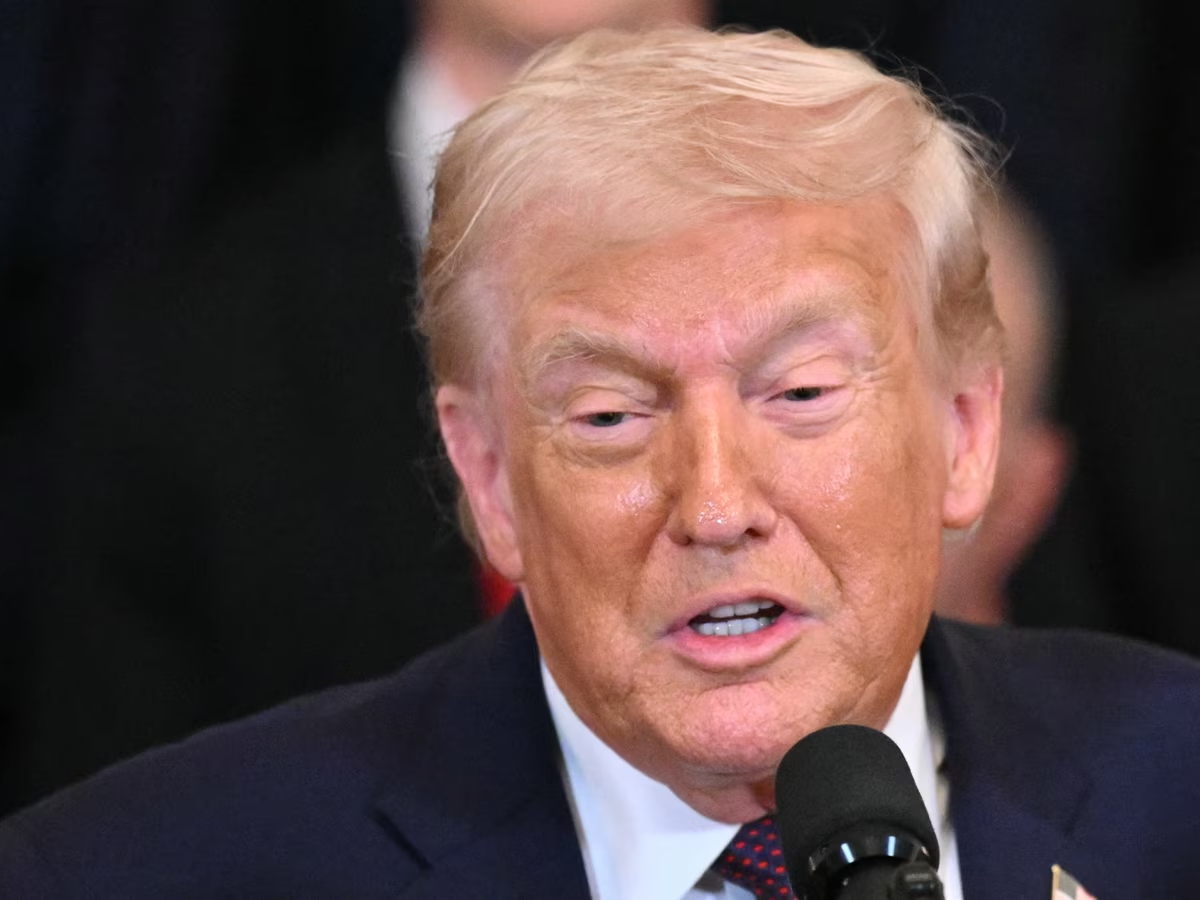







In a remarkable political development concerning the future administration of the Gaza Strip, US President Donald Trump announced on Thursday his support for what he described as the "newly formed Palestinian technocratic government," in a move reflecting an American attempt to rearrange the administrative and political landscape in the Strip during a complex transitional phase. Trump affirmed, via the Truth Social platform, that he supports the National Committee for the Administration of Gaza, as a technocratic body operating under the supervision of an international peace council personally chaired by him, aiming to "manage the affairs of the Strip away from factional polarization."
This announcement comes at a time when the National Committee for the Administration of the Gaza Strip held its first meeting in Cairo, with the participation of its fifteen members of Palestinian technocrats. The committee is headed by Ali Shaath, a former deputy minister in the Palestinian Authority, while Nikolay Mladenov, who oversees its work on behalf of the Peace Council, has joined it. This formation is seen as an attempt to combine Palestinian expertise with international oversight, thereby giving the new administration a degree of political legitimacy and external support.
The committee consists of Dr. Ali Shaath, who serves as the head of the committee and handles the energy and transport portfolios, while Dr. Bashir Al-Rayes handles the financial portfolio, Dr. Jabr Al-Daour the education portfolio, and Dr. Ayed Yaghi the health portfolio. Rami Helles is responsible for religious affairs, Dr. Ali Barhoum for water and municipalities, Adnan Abu Wardeh for justice and judiciary, Hana Tarazi for social affairs, Osama Al-Sidawi for land and housing, and Abdul Karim Ashour for agriculture, in addition to Dr. Ali Shaath temporarily overseeing the energy and transport portfolios, Omar Shamali for communications, and Ayed Abu Ramadan for economy, trade, and industry, while Husni Al-Mughni handles tribal affairs, and Major General Sami Nesman handles internal affairs.
Concurrently, Trump officially announced the formation of the Peace Council, noting that the names of the participating world leaders would be announced soon. The Council is supposed to oversee the transitional phase in Gaza and coordinate international efforts aimed at alleviating the humanitarian crisis and rebuilding administrative structures. According to diplomatic data, Mladenov is working with regional and international parties to prepare a package of urgent humanitarian measures, intended to support the committee from its inception and enhance its ability to operate in a highly complex environment.
However, this path faces significant obstacles, most notably the opposing Israeli stance. According to diplomatic estimates, Israel objects to allowing the technocratic committee to use civilian employees from either Hamas or the Palestinian Authority, which creates a real administrative vacuum. This objection also extends to the police force, as Israel rejects any role for elements linked to the Palestinian Authority, placing the committee before an operational dilemma that could undermine its ability to effectively manage the Strip.
This intransigence comes amid a highly tense relationship between Benjamin Netanyahu's government and the Palestinian Authority, where Tel Aviv treats the Authority as a hostile entity not fundamentally different from Hamas, and withholds billions of dollars of its funds under the pretext of incitement. This reality makes any role for the Authority, even if limited or technical, subject to widespread Israeli rejection.
In contrast, American officials acknowledge Israeli opposition even to low-level Palestinian Authority participation in Gaza's administration, but they believe this issue can be addressed in the coming weeks. They emphasize that the Cairo meeting was primarily preparatory, aiming to lay the general foundations for future work, rather than resolving all contentious details.
Washington believes that the available margin of optimism is linked to the possibility of achieving tangible progress in disarming Hamas, as it believes that any such progress could prompt Israel to show greater flexibility regarding the Palestinian Authority's involvement in Gaza's administration. However, American officials simultaneously acknowledge that communications related to this issue are still in their early stages, and they face complex political and security challenges that make their path long and uncertain in outcomes.
The initiative to form a technocratic government in Gaza also reflects an American attempt to produce an administrative solution that transcends the traditional Palestinian division, but it clashes with a highly complex political and security reality. Technocrats, no matter how competent, need a stable operational environment and supportive political will. In light of Israeli rejection and the absence of a comprehensive Palestinian consensus, this government appears threatened with becoming a mere formality unless international promises are translated into clear practical commitments.
On a broader international level, data indicates that the National Committee for the Administration of Gaza may have a wider margin for action after the official announcement of the Peace Council. The United States seeks to reveal its composition next week on the sidelines of the World Economic Forum in Davos. Names of major and regional countries are being put forward to join the Council, with an American tendency to fill some seats with leading figures from international financial institutions, in an attempt to give the Council political and economic weight.
Despite talk of a positive response from a number of invited countries, American efforts to expand the Council's membership have not yet achieved the desired success. Nevertheless, American officials confirm that Trump personally participated in selecting the members, and that the invitation process received an encouraging response, reflecting an American determination to move forward on this path.
The success of any new administration in Gaza remains contingent on its ability to gain the trust of the population before achieving international recognition. Gaza suffers from a long legacy of crises, and changing administrative structures is not enough without addressing the root causes of economic and security problems. If the technocratic committee is not given real powers and sufficient resources, it may turn into another fleeting experiment, added to a series of initiatives that have not touched the essence of the Strip's suffering.


Share your opinion
Trump announces support for Palestinian technocratic government