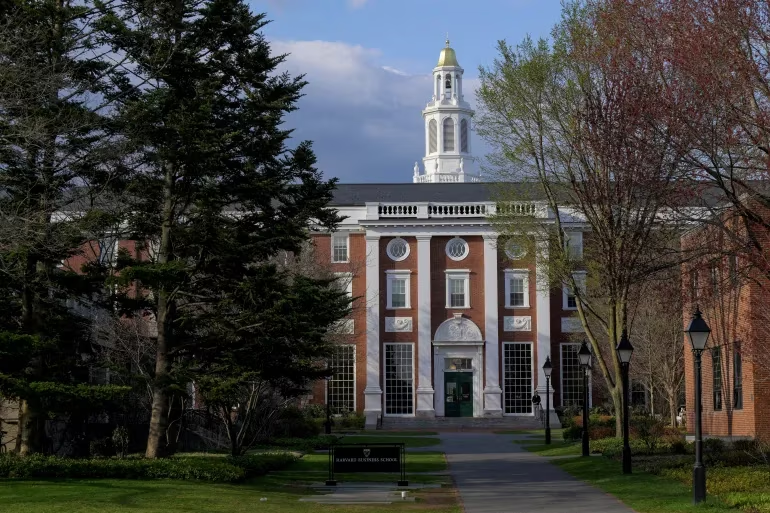







Harvard University in the United States has fallen to third place in a global list measuring the volume of academic output, and other American universities have also seen a significant decline in that ranking compared to Chinese universities, which have made remarkable progress in the field of research output.
Until recently, Harvard was the most productive research university in the world, according to a global ranking based on academic publications, but it has declined, similar to other American universities, while Chinese universities have risen in rankings that focus on the volume and quality of research they produce.
Commenting on this, the New York Times said it is the latest evidence of the decline that American academic institutions have been experiencing for several years, and it appears that the administration of President Donald Trump may accelerate it due to its decision to cut research funding provided to American universities that rely heavily on the federal government to fund their scientific projects.
In the early 2000s, 7 American universities were among the top 10 universities, led by Harvard University, in the global university ranking based on scientific output, such as articles published in scientific journals.
At that time, there was only one Chinese university (Zhejiang University) among the top 25 universities, but that university is now at the top of the ranking issued by the Centre for Science and Technology Studies at Leiden University in the Netherlands, and the current list also includes 7 other Chinese universities among the top 10 universities.
The New York Times report clarified that Harvard University currently produces significantly more research than it did 20 years ago, yet it has fallen to third place, but it still holds the first place in Leiden's rankings for the most cited scientific publications.
According to the aforementioned report, the problem of leading American universities is not a decline in research output, but rather a much greater increase in the research output of Chinese universities. Leiden University statistics indicate that 6 prominent American universities, including the Universities of Michigan, California, Johns Hopkins, and Stanford, now produce more research than they did two decades ago, but it remains less than what their Chinese counterparts produce.
Although global university rankings do not receive much attention in the United States, some prominent American academics note the increasing growth in Chinese research output reflected in these rankings, and warn that the United States is falling behind.
The former president of the Massachusetts Institute of Technology, Rafael Reif, admitted in a press statement last year that "the number and quality of research papers from China are truly remarkable and far superior to what we do in the United States."
Academic circles in other countries monitor global rankings and consider them a measure of academic efficiency and the ability to compete with the United States. Zhejiang University prominently displays its rankings on its website, and Chinese state media have celebrated the rise of the country's universities in global rankings.
Leiden Centre began preparing an alternative ranking based on a different academic database called "OpenAlex." Harvard University ranks first in this ranking, but China's progress continues, as among the 13 universities in the alternative list, 12 are Chinese universities.
On the other hand, Harvard University tops the global university ranking in terms of academic performance, which is prepared by the Informatics Institute of the Middle East Technical University in the Turkish capital, Ankara.
In another ranking, the Nature Index, Harvard University ranks first, followed by 10 Chinese universities.
Harvard University and other leading American universities are currently facing a new set of challenges against the backdrop of the Trump administration's decision to cut scientific research grants, as well as travel bans and an anti-immigration campaign that has affected international students and researchers.
As a result, the number of international students arriving in America in August 2025 decreased by 19% compared to the previous year, which negatively affects the status and rankings of American universities, as outstanding students are forced to study and work elsewhere.
In contrast, China is investing billions of dollars in universities and striving to make them attractive to foreign researchers. A few months ago, China began offering a special visa for graduates of prestigious universities in science and technology fields to travel to China for study or business.
Chinese President Xi Jinping defended his country's decision to increase spending on universities by emphasizing that the strength of any country on the global stage depends on its scientific superiority.
In contrast, the Trump administration took the opposite approach, seeking to cut billions of dollars from scientific research grants allocated to American universities. University leaders in the United States warned throughout 2025 that cuts in federal research grants could have devastating effects, and the American Association of University Professors and several legal entities filed a lawsuit to challenge some of these cuts.
A federal judge issued an order for the federal government to resume funding Harvard University, after the Trump administration cut billions of dollars in research funds in the spring, but the administration appears insistent that it will reduce future grants allocated to the university.
The number and quality of research papers from China are truly remarkable and far superior to what we do in the United States.






Share your opinion
Harvard and its peers are declining globally against Chinese universities