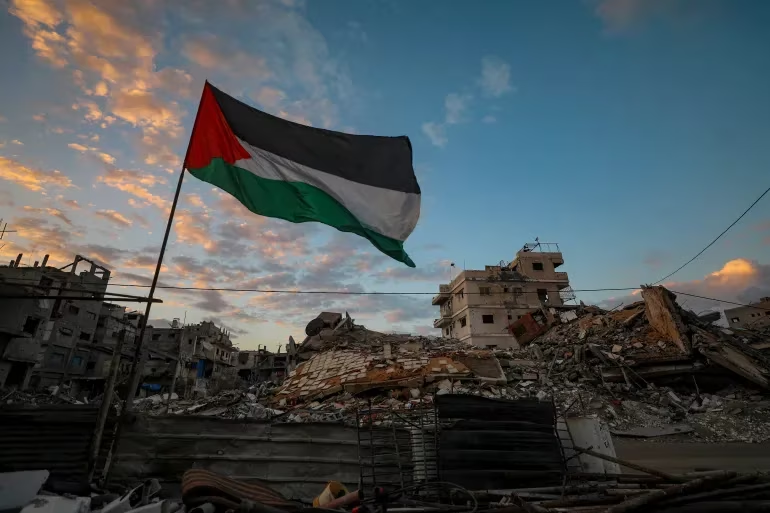







Ramallah - Palestinian factions in Cairo, in coordination with mediators, are preparing to enter the second phase of the ceasefire agreement in Gaza, including the formation of a technocratic committee to administer the Strip. While Fatah has set parameters for any committee formed to administer the Strip, Hamas has expressed its readiness to hand over all administrations and institutions to the newly formed committee and work to ensure its success. Despite Fatah's announcement that it would not attend the factions' meetings in Cairo, mediators, especially Egypt, are making efforts to involve the movement in the ongoing consultations, leading to an agreed-upon committee before the end of the week, according to an analyst.
On November 18th, the UN Security Council adopted a US draft resolution regarding ending the Israeli war in Gaza, among its provisions was the administration of the Strip through a transitional Palestinian technocratic government (competencies), operating under the supervision of an executive "Peace Council" led by US President Donald Trump, according to his plan, announced on September 29th, which entered its first phase of implementation on October 10th, while Israel is procrastinating in moving to its second phase.
Cairo Meetings In a press statement, Hazem Qassem, spokesman for the Islamic Resistance Movement (Hamas), said that the movement presented "advanced positive positions, within the framework of arranging the Palestinian situation," after Egypt invited factions to meet in Cairo to discuss the second phase of the ceasefire agreement in Gaza and the formation of a technocratic committee to administer the Strip.
On Sunday, sources said that a Hamas delegation headed to the Egyptian capital, Cairo, to discuss political and field developments in the Gaza Strip starting Monday. They added that on the delegation's agenda were meetings with Palestinian factions and forces, in addition to meetings with official Egyptian bodies, to discuss a number of files related to the agreement, including the formation of a Palestinian "technocratic" committee to administer the Gaza Strip.
She said that the committee "was agreed upon in principle between the Palestinian factions and the Egyptian authorities, but it faced reservations from the Palestinian Authority and Israel," noting attempts to overcome obstacles to the formation of the committee and to make it purely Palestinian.
In contrast, the Palestinian National Liberation Movement (Fatah) announced on Sunday that any committee to administer the Gaza Strip derives its legitimacy from its connection to the legitimate authority of the sovereign institutions of the State of Palestine, declaring that it would not participate in the factions' meeting and had informed Cairo of its position.
In its statement, through its spokesman Abdel Fattah Doula, it said that "the Gaza Strip is an integral part and cannot be separated from the Palestinian state and its political and legal system in Gaza and the occupied West Bank, including Jerusalem."
Al-Tamimi expects the announcement of the formation of the Gaza administration committee headed by Health Minister Majed Abu Ramadan at the end of the week or early next week (social media) Imminent announcement In the opinion of political analyst Bassem Al-Tamimi - in his speech - there is a red line for the Fatah movement regarding the community support committee, which all factions emphasized its importance and informed the Egyptian sponsor, which is that the head of the committee should be a minister in the government of the State of Palestine.
He added that Fatah's goal is to ensure the unity of the Palestinian territories between the West Bank, including Jerusalem and Gaza, and to ensure the unity of the Palestinian political system and the laws implemented between the West Bank and the Strip.
Sources say that the information available to them indicates that Health Minister Dr. Majed Abu Ramadan is the Palestinian figure nominated to head the committee by the Palestinian National Authority, expecting agreement on him from all parties, including Hamas.
Regarding the reason for Fatah's apology for attending the factions' meetings, the Palestinian analyst said that "contacts are ongoing, mainly through the Egyptian brothers sponsoring the factions' dialogues," adding that he sees no impediment for Fatah to attend the meetings.
He pointed to meetings held weeks ago between leaders of the Hamas movement on the one hand, and Palestinian Vice President Hussein Al-Sheikh and intelligence chief Majed Faraj on the other, confirming the existence of "understandings between all factions, including Fatah and Hamas, and through the Egyptian brothers."
He expressed hope that - soon - a breakthrough would be achieved in the file of comprehensive national reconciliation among all Palestinians, and the announcement of the community support committee from Cairo at the end of this week or next week.
Messages and Promises As for political analyst Alaa Al-Rimawi, he believes that Fatah's absence from the Cairo meetings stems from its reading of the political scene, as Israel does not want an authority in partnership with Hamas, neither in the Palestinian file nor in the Strip, explaining that "the Authority realizes that any approaches with Hamas mean a complete Israeli rejection and a partial American one, and thus the loss of what the Authority aspires to in the Strip."
He continued in his speech that the Fatah movement relies on monopolizing the management of the Palestinian scene, through promises and messages it received about its inevitable role in the Strip without passing through or partnering with Hamas.
However, Al-Rimawi says that Israel's vision in dealing with the Strip - regarding its administration - is for it to be a civil administration affiliated with the Peace Council, isolated from the political relationship with the Authority and Hamas. "In short, it is managed by the United States and Israel together, meaning creating a new political environment and greenhouse outside the Authority's system and outside Hamas."
Nevertheless, he expected an approach to the Palestinian Authority's presence in Gaza, even if in an unapparent way, considering at the same time Fatah's absence from the Cairo meetings as "a reflection of the absence of a collective Palestinian awareness that realizes the dangers of the next stage in the event of forming a political vision specific to the Strip, according to compulsory approaches that will not be in the interest of the Palestinian people, which is the formation of a technocratic committee whose formal reference is the Peace Council, and whose real reference is Israel through the American gateway."
Al-Rimawi warns against the American side going to a composition of the scene according to compulsory approaches as an alternative to Fatah. According to Al-Rimawi's information, there are attempts by Hamas to empower the Palestinian government in the Strip and to have an agreed-upon political reference at the minimum between the factions and the Authority, and for that purpose, it offered facilities.
But he says that Fatah stands at two points: the first is that Fatah or the Authority will not be a gateway to facilitate the retention of weapons by Hamas, but rather to resolve this file completely in line with the American vision, and the second is that Hamas should be far from any composition in the political scene, "whether in the upcoming or local elections or in the political vision."
Nevertheless, Al-Rimawi says that what the factions and mediators in Cairo are working on is finding a formula for Fatah's presence even if it is absent, pointing to strenuous attempts for Fatah figures to attend, without ruling out the possibility of the dismissed leader from the movement, Mohammed Dahlan, benefiting from that absence, especially since there are already voices emerging in the Strip demanding representation for his current if President Mahmoud Abbas turns his back on the dialogues.
Sources confirmed that Fatah's goal is to ensure the unity of the Palestinian territories between the West Bank, including Jerusalem and Gaza, and to ensure the unity of the Palestinian political system and the laws implemented between the West Bank and the Strip.
Share your opinion
What's new in the factions' meetings in Cairo? And who will head the Gaza administration committee?