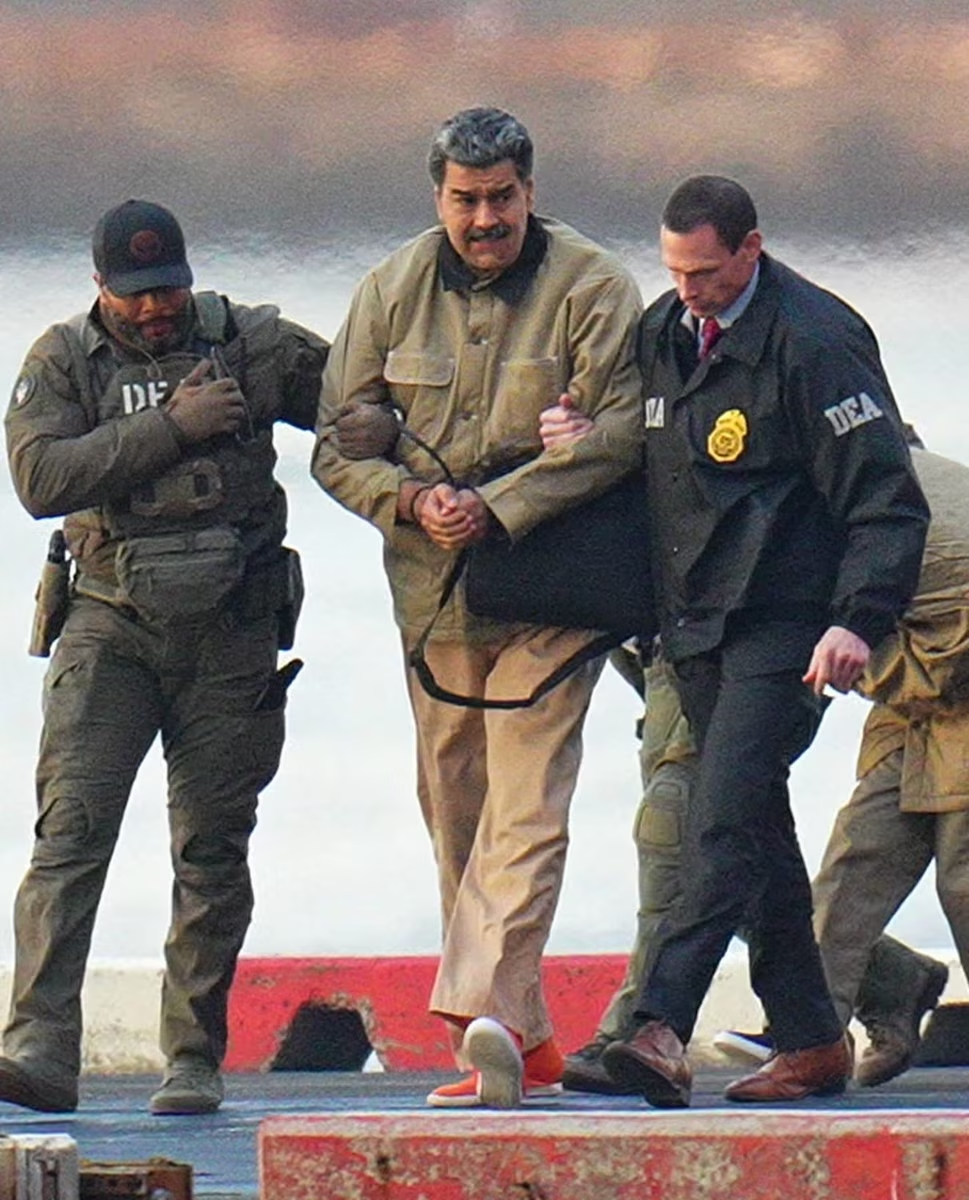







In an unprecedented development, the United States has carried out a direct operation on Venezuelan soil, culminating in the kidnapping of President Nicolás Maduro and his wife Cilia Flores, and their transfer abroad in a shocking public spectacle that shook regional and international public opinion. The operation, conducted without any UN authorization or declared international judicial process, represented a dangerous escalation in the American approach to Venezuela, and opened wide the door to questioning the limits of power, respect for sovereignty, and the status of international law in contemporary American policies.
This step cannot be separated from a entrenched approach in American foreign policy, based on imposing will by force, bypassing international legitimacy, and prioritizing strategic interests over any ethical or legal commitment. Despite the slogans promoted about "democracy" and "human rights," the practical reality reveals a different approach, where international crises are managed by the logic of military force, not by the logic of law or international consensus.
Legally, any military intervention outside the framework of the United Nations is considered a clear violation of its charter, which prohibits the use of force against the sovereignty of states except in exceptional and specified cases. Targeting a head of state and his wife outside any recognized international judicial process falls only within the framework of political punishment, and reflects blatant disregard for the rules of international law. Moreover, involving Cilia Flores in this conflict and using her as a pressure card expands the circle of punishment to include the family, and reveals Washington's readiness to bypass the values it claims to defend.
Politically, these policies expose a chronic failure to understand the nature of targeted societies. Recent experiences confirm that external intervention rarely produces democracy, but rather often strengthens authoritarianism, and gives existing regimes justification to intensify repression under the slogan of "confronting foreign aggression." In the Venezuelan case, where citizens live in a suffocating economic crisis, American intervention is not seen as a lever for change, but as a direct assault on national sovereignty, which empties any discourse on human rights or democracy of its content.
Regionally, this behavior brings back to the forefront a long history of American interventions in Latin America, from externally supported coups, to economic sanctions and blockades. Targeting Maduro and his family is read within this historical context, and explains the extent of regional rejection of such policies. Instead of enhancing stability, these practices sow doubt and suspicion, and push regional countries to seek alternative alliances that protect them from similar scenarios, contributing to the erosion of American influence rather than its consolidation.
Internationally, these steps provide Washington's adversaries with free gains. Russia and China, for example, can easily portray the United States as a power that raises the slogan of "a rules-based international order," then violates it whenever it conflicts with its interests. Thus, Washington does not weaken its adversaries, but accelerates the shift toward a more multipolar international system, less willing to accept American hegemony.
Domestically, these interventions reflect a clear crisis in American decision-making mechanisms. The repeated recourse to military force without explicit legislative authorization, and without a comprehensive political strategy, indicates a worrying expansion in executive powers, and an inability to learn lessons from historical failures, from Vietnam to Iraq and Afghanistan. Moreover, prioritizing military solutions over political approaches increases the level of risks, and perpetuates a pattern of repeated mistakes.
The most dangerous thing is that such policies leave behind political and security vacuums that are difficult to contain. Previous experiences confirm that forcibly overthrowing leaders does not necessarily mean building stable institutions, but rather often opens the door to chaos, the rise of militias, and the growth of illicit economies. In Venezuela, where politics intertwines with a complex social and economic structure, any coercive intervention could lead to the disintegration of the state and its transformation into an open battlefield, where the ordinary citizen pays the price first and foremost, as happened in Afghanistan, Libya, and Yemen.
Targeting Maduro and his wife Cilia Flores adds a highly dangerous dimension: using the family as a political pressure tool. This behavior does not serve any democratic project, but deepens internal divisions, and strengthens the existing authority's pretext to justify further repression under the title of "confronting foreign intervention." It is a glaring model of the results of managing international conflicts by the logic of force alone.
In conclusion, American intervention in Venezuela is nothing but a new link in a chain of policies whose failure has been proven. Policies that ignore state sovereignty, undermine international law, and empty the discourse on democracy and human rights of its true content. The expected result is not stability or positive change, but wider chaos, deeper loss of trust, and a more fragile international system. Thus, targeting Maduro and his family, and what is marketed as a political or security achievement, turns into additional evidence of the shortcomings of strategic vision, and of repercussions that may extend to Washington itself, leaving behind crises that are difficult to contain.
Share your opinion
US Intervention in Venezuela: Policy of Force and Its Repercussions