






Washington – Saeed Arikat
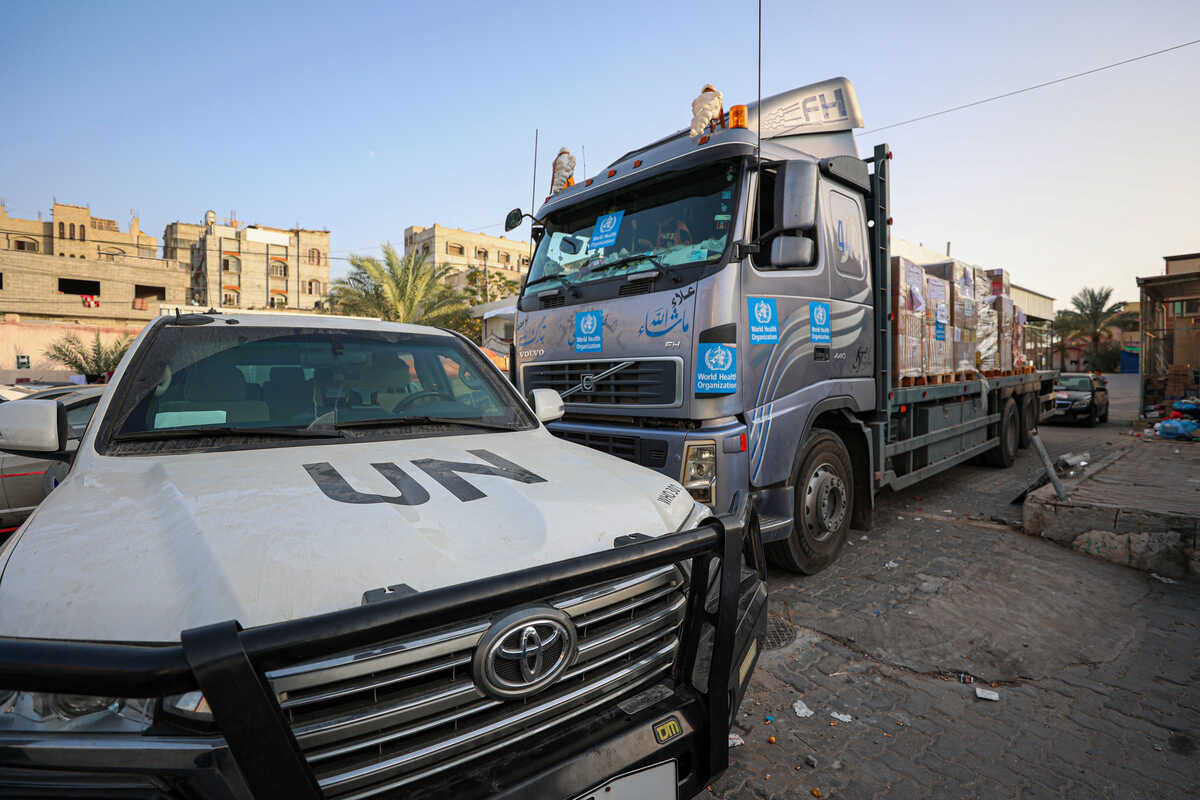
The UN Secretary-General, António Guterres, called on Israel to end the ban imposed on 37 international humanitarian agencies that were providing vital aid to the residents of the Gaza Strip, expressing his deep concern over the serious humanitarian repercussions of this decision. This call comes amid highly complex humanitarian conditions in the sector, where residents suffer from acute shortages of food, medicine, and basic services, due to the ongoing restrictions on the movement of aid.
The official spokesperson for the Secretary-General, Stéphane Dujarric, stated in an official statement that Guterres demanded an immediate reversal of this measure, emphasizing that international non-governmental organizations are an indispensable element in life-saving relief operations. He added that suspending the work of these organizations threatens to undermine the limited and fragile progress achieved during periods of ceasefire, and undermines international efforts aimed at alleviating the suffering of civilians.
The statement indicated that this decision does not come in isolation from a broader context of previously imposed restrictions, which have already led to delays in the entry of vital shipments of food, medicines, hygiene supplies, and shelter materials. According to the United Nations, the recent measure is likely to exacerbate the existing humanitarian crisis and increase the fragility of the health and living conditions for hundreds of thousands of Palestinians in Gaza.
The Gaza Strip, home to more than two million people, heavily relies on external humanitarian aid to meet its basic needs, amid deteriorating infrastructure, rising poverty and unemployment rates, and recurring military operations. International humanitarian agencies have played a pivotal role in providing healthcare services, distributing food, supporting water and sanitation networks, in addition to providing shelter for the displaced.
Relief organizations warn that reducing their presence or suspending their operations will lead to a dangerous humanitarian vacuum, which could have long-term consequences, especially for the most vulnerable groups such as children, women, the elderly, and people with disabilities. Moreover, the deterioration of humanitarian conditions may contribute to increased tension and instability, which negatively impacts opportunities for calm and peace.
Guterres' call reflects a growing international awareness that the crisis in Gaza is no longer just a political or security issue, but a compounded humanitarian catastrophe. The ban on humanitarian agencies does not target institutions as much as it directly affects civilians. From the perspective of international humanitarian law, ensuring access to aid is a fundamental duty, and any arbitrary restrictions on it undermine the credibility of international commitments to protect civilians in conflicts.
The United Nations affirms that the continuation of restrictions on humanitarian work contradicts the principles of neutrality and independence upon which international relief operations are based. UN officials also emphasized that humanitarian organizations do not participate in the conflict, but work exclusively to alleviate human suffering, and targeting or restricting them creates a dangerous precedent in other conflict zones around the world.
Human rights organizations, for their part, urge the international community to exert effective political and diplomatic pressure to ensure the lifting of the ban and allow the resumption of humanitarian work without obstacles. These organizations believe that international silence or mere statements of concern may encourage further measures that violate the basic rights of civilians.
The danger of the decision lies in its timing, as it comes at a stage that should witness the strengthening of humanitarian efforts, not their reduction. Ceasefires, if not translated into tangible improvements in people's lives, lose their practical meaning. Suspending the agencies' work drains any calm of its humanitarian content, turning it into a mere temporary security measure that does not address the roots of the daily suffering of the residents.
In this context, the future of humanitarian work in Gaza remains contingent on the extent to which the concerned parties respond to international appeals. Guterres affirms that the United Nations will continue to use all available channels to defend the right of civilians to receive assistance and protection, stressing that respect for international humanitarian law is not an option, but a legal and ethical commitment.
This crisis highlights a deeper issue related to the politicization of humanitarian work. When aid is used as a pressure tool, civilians become hostages to conflicts. Protecting the independent humanitarian space is essential to maintain the minimum of human dignity in conflict zones, and any breach of that threatens the entire international humanitarian system, not just the Gaza case.
Share your opinion
UN Secretary-General Calls for Lifting Ban on Humanitarian Agencies in Gaza