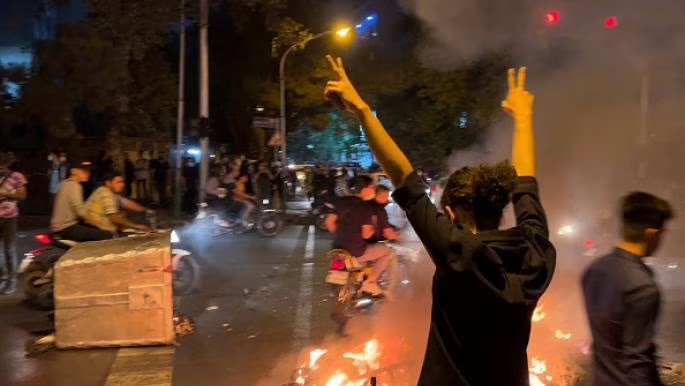







Iran has been witnessing protests since last Sunday due to the deteriorating living conditions and worsening economic crisis, starting from the Grand Bazaar of Tehran through a strike by several commercial shops, then extending to other cities, while Israel and America entered the scene by announcing support for the protesters and urging them to continue the protest and strengthen its momentum.
The protests have so far resulted in six deaths, one of them from the Basij Popular Forces affiliated with the Iranian Revolutionary Guard in Kuhdasht in Lorestan province in western Iran, and three protesters in the city of Azna in the province during an attack on a police headquarters, in addition to two protesters in the city of Lordegan in Chaharmahal and Bakhtiari province in central Iran.
During the protests, chants supporting the monarchy and its leader Reza Pahlavi, residing in the United States, emerged. There has also been limited participation so far from Tehran university students, who organized protest gatherings last Tuesday, and a number of them were arrested before being released later, while the Iranian Minister of Science, Research and Technology (Higher Education) Hossein Simayi Sarraf isolated security officials in three universities in an attempt to calm the students, noting that Iranian universities are on the verge of semester exams, where student attendance is disrupted, which could negatively affect students' involvement in the protests.
Meanwhile, while the reformist Iranian government and its president Masoud Pezeshkian tried to contain the crisis by acknowledging the right to demonstrate and dialogue with representatives of the bazaar and markets, traditional rhetoric in dealing with protests did not disappear, describing them in conservative media and figures as "riots", in addition to turning them into violent events in some cities, attacking government headquarters, institutions, and banks, resulting in at least six deaths and about 40 injuries according to media reports, and arresting dozens, 20 of them in the city of Lordegan and seven in the city of Kermanshah, on charges of links to opposition groups abroad, but no official figures yet on the number of deaths, injuries, and detainees.
The Iranian Attorney General Mohammad Mohammadi Asad threatened on Wednesday to confront "the diversion of protests", saying that "any attempt to turn economic protests into a tool for undermining security, or sabotaging public property, or executing pre-prepared foreign scenarios, will certainly be met with a proportionate and decisive legal response".
Furthermore, Ali Hasanzand, the Attorney General of Lorestan province in western Iran, which is witnessing protests, warned today, Friday, that the judiciary will deal firmly and without any leniency with those he described as "instigators of riots and anyone who harms public security", confirming that "participation in illegal gatherings and acts of disrupting order, sabotage, incitement, or threats are crimes that require judicial prosecution". He called on families to prevent their children from engaging in these gatherings.
The Iranian writer Salahuddin Khodiyu says that the map of protests reflects the integration of economic pressures with class transformations, adding that "it is still too early to reach a final conclusion regarding the composition of the ongoing protests in Iran, in terms of the social classes participating in them or their geographical scope", considering that the protests are still ongoing, making any definitive conclusion premature.
Khodiyu explained that the general pattern of participation in the current protests can be understood as a mix between the November 2019 protests over fuel price hikes, and the "Mahsa Amini" movement in 2022 over the hijab issue, noting the difficulty in formulating a precise sociological model that definitively determines the nature of participation, or the social classes, or the class backgrounds of the protesters. He added that the Mahsa Amini protests, which occurred after her death days after her arrest on the street for not complying with hijab rules, although initially classified as a middle-class movement due to the nature of its demands, especially regarding freedom of dress and women's rights and general freedoms, but when it expanded geographically and turned into mass protests in some cities, it acquired a protest character closer to a popular uprising, with a noticeable increase in the participation of lower social classes and the involvement of poor areas.
Khodiyu pointed out that the 2019 protests, which erupted over fuel price increases, were in turn of deeper economic and labor roots compared to previous protest movements, such as 1999 (student) and 2009 (protests over presidential election results), considering that the general path of protests since 2009 reflects a gradual deterioration in the economic structure of Iranian society.
Khodiyu explained that the disintegration of families' financial capacity, amid the ongoing economic crisis, led to a gradual fall of the middle class, where broad segments of this class, and even higher-income segments, slid towards lower classes. He pointed to the emergence of a new social phenomenon that can be called "the poor middle class", a category that includes individuals with higher education, carrying the culture and values of the middle class, who previously enjoyed a better standard of living, but today have regressed to the lowest economic ladder. The same speaker considered that the social base of each of the protests of the past years, and the current ongoing protests, can be interpreted as a mixture of the regressing middle class, and the poor segments, with hybrid categories such as "the poor middle class".
The Iranian expert clarified that the essential difference between the current protests and the 2022 protests lies in the fact that the main driver of the demonstrations in recent days is inflation and high cost of living and the economic crisis, confirming that the government's hand appears "completely tied", and it does not seem capable of providing quick and convincing solutions to calm the street.
Regarding the future of the protests, Khodiyu said that their continuation or retreat is linked to the extent of the disappearance or persistence of the structural drivers that produced them, predicting the persistence of these factors. He added that the United States and Israel have provided unprecedented support to the protesters compared to the past, considering that "the current economic pressures are the fruit of a maximum economic, political, and diplomatic pressure campaign, aimed at pushing Iran to change its behavior, or reaching, in case of failure, a regime change scenario".
He confirmed that the Iranian government faces an extremely difficult task in containing these protests, explaining that "even if their intensity temporarily subsides, they are likely to erupt again in the coming months, because their structural causes are deep and insoluble in the face of continuing sanctions and the absence of foreign investments, which seems unlikely given the internal and external political deadlock".
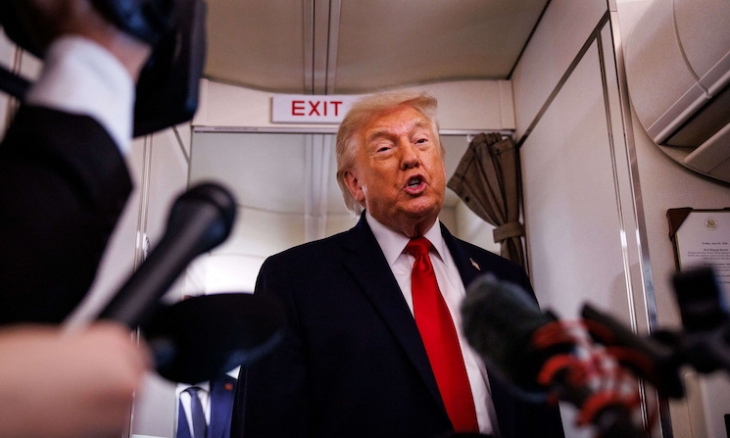
US President Donald Trump entered the line of demonstrations in Iran in an unprecedented way today, Friday, saying in a post on his social media platform "Truth Social": "If Iran shoots at peaceful protesters and kills them, the United States will intervene to save them", adding: "We are on alert and ready to launch".
The writer and political analyst Ahmad Zeidabadi said that "Trump's statements always need to be decoded, as he often takes positions then returns to soften them, or even reverses them sometimes". Zeidabadi wondered whether Trump's latest statement "is just an empty threat, or falls within the framework of psychological warfare, or if Trump actually carries a plan and program for intervention in Iranian affairs".
The Iranian writer also considered that military intervention aimed at "regime change" is the last thing Trump could think of, noting that the US National Security Strategy document classifies any action aimed at changing regimes as costly, ineffective, and rejected. He recalled that Trump emphasized, during his recent press conference with Benjamin Netanyahu in Florida, that "regime change in Iran is not something he should talk about, let alone that the spread of US forces in the region does not indicate readiness for rapid and imminent intervention in Iran". Based on that, Zeidabadi considered that military intervention in the short term is unlikely.
The same speaker explained that Trump's current policy is based on exercising "maximum pressure" on Iran to change its behavior, considering that "Trump views the ongoing protests as an opportunity to escalate pressure and threats, and may proceed in this path, in stages, to the point of attempting to delegitimize the regime". He pointed out that the impact of Trump's statements on the ongoing protests in Iran is of great importance, wondering whether US threats of intervention will lead to escalation of the protests or their retreat. He saw that these threats have a dual effect, as they may push a segment of protesters to caution and withdraw from the scene, while they may encourage other categories to continue the movement.
Following Trump's statements on Iran, Iranian authorities warned against any foreign interference in the country's internal affairs, confirming that they distinguish between demand protests and attempts to exploit them for destructive goals, emphasizing that any US move in this framework will contribute to escalating tension and threatening regional stability.
In the context, Ali Larijani, Secretary of the Supreme National Security Council of Iran, warned that any US intervention in internal protests will lead to destabilizing the region and destroying US interests, noting that US statements accompanied by Israeli positions reveal the backgrounds of what is happening.
For his part, Ali Shamkhani, political advisor to the Iranian Supreme Leader, emphasized that Iran's national security is a red line, warning that "any interfering hand approaching Iran's security will be met with a painful response", considering that US threats are nothing but "adventures".
In turn, Ismail Baghaei, spokesperson for the Iranian Ministry of Foreign Affairs, said that the US record exposes the falsity of its claims of sympathy with the Iranian people, reminding of the 1953 coup, the downing of a civilian plane in 1988, support for Iraq in the war, and maximum sanctions, considering that Washington's threats represent a blatant violation of international law, and confirming that "Iranians will not allow any foreign interference".
Any attempt to turn economic protests into a tool for undermining security, or sabotaging public property, or executing pre-prepared foreign scenarios, will certainly be met with a proportionate and decisive legal response.
Share your opinion
Iran Protests: Deaths and US-Israeli Intervention and Judicial Escalation