





- Dr. Hussein Al-Dik: The meeting showed near-complete agreement on major issues, especially the Gaza Strip file and the transition to the second phase..
- Khalil Shahin: The coming phase may witness showy steps by Trump without implementation that changes the reality in the Gaza Strip..
- Dr. Ahmed Rafiq Awad: The American administration has retreated from the seriousness of implementing "Trump's plan" and Netanyahu succeeded in relieving the pressure to push the agreement path..
- Muhammad Al-Rajoub: The meeting confirms the strength of the alliance between Washington and Tel Aviv, but it revealed deep strategic contradictions regarding the future of the West Bank..
- Dr. Qasi Hamed: The most complex file is the West Bank file, and Trump does not want to reach the collapse of the Authority or the outbreak of a broad confrontation..
- Dr. Raed Abu Badawiya: The most dangerous in the meeting is turning the West Bank into the direct political price for the understanding between Netanyahu and Trump..
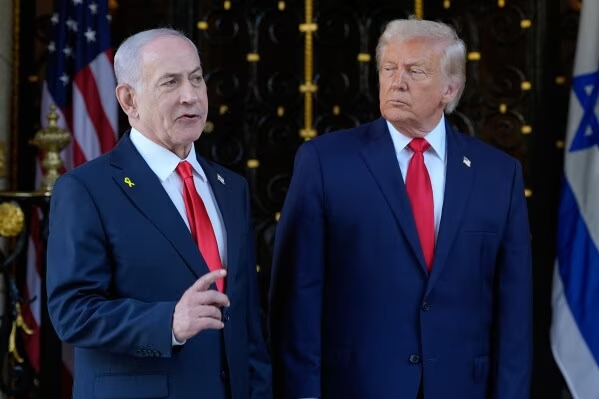
The recent meeting between US President Donald Trump and Israeli Prime Minister Benjamin Netanyahu represents a clear strengthening towards Israeli influence in the Middle East region and a deliberate disregard for Palestinian rights, where Trump fully adopted the Israeli vision.
According to writers and political analysts and specialists and university professors in separate interviews with "Al-Quds", the meeting revealed Trump's open support for Netanyahu, which strengthened his political position internally and allowed him to manage Palestinian files in a way that serves his electoral interests without offering any real concessions, as well as strengthening Israeli influence in the region.
The writers and specialists and university professors believe that despite talk of steps towards the second phase in the Gaza Strip and reconstruction, the field reality has not changed, as Israeli control over the crossings and control of aid remained in place, without pressure on the occupation to change its policies, leaving room for Netanyahu to exploit Trump's statements to enhance his image before the Israeli public.
A pivotal station and a political victory for Netanyahu..
Professor of Political Science and International Relations and specialist in American affairs Dr. Hussein Al-Dik confirms that the meeting between US President Donald Trump and Israeli Prime Minister Benjamin Netanyahu in Mar-a-Lago resort in Florida constituted a pivotal station in drawing the map of the coming Middle East, and represents in essence a clear political victory for Netanyahu, who came out of the meeting achieving most of what he aspires to, both regionally and at the level of the domestic Israeli political scene.
And Al-Dik explains that Netanyahu, who is suffering from a sharp decline in opinion polls and his inability to ensure a future majority for him and his right-wing allies, greatly benefited from the unprecedented praise that Trump gave him, when he described him as "the great man and war hero", considering that these statements fall within an early electoral propaganda campaign directed at the Israeli public and society.
And Al-Dik points out that these statements have a profound impact internally in Israel, in light of the great confidence that the Israeli society has in Trump, as the president whose name is associated with the release of Israeli prisoners from the Gaza Strip, and the special and exceptional relationship between Washington and Tel Aviv.
And Al-Dik clarifies that Netanyahu, known for his political cunning, succeeded in managing the meeting and tailoring its outputs to his benefit, benefiting from prior moves made by the Zionist lobby and its allies in the United States, including those with financial, economic, and extensive relations with Congress and the American administration.
And Al-Dik points out that Israel, whose standing within the American society has declined in the past two years, has reactivated its organizations and lobbies, in addition to Christian evangelicals and "MAGA" groups, to influence American public opinion and re-image its image.
On the external level, Al-Dik confirms that the meeting showed near-complete agreement on major issues, especially the Gaza Strip file and the transition to the second phase of the American plan.
"Sunrise Plan" scenario as an alternative to the second phase..
And Al-Dik explains that Trump's talk of imminent reconstruction is linked to activating a clause in the American plan that allows reconstruction in areas controlled by the Israeli army in case of delay in transitioning to the second phase, in reference to what is known as the "Sunrise Plan" that is expected to start from Rafah, which sends a message that Trump's plan is still going ahead, and that Netanyahu has not been an obstacle to it.
And Al-Dik points out that the possibility of reopening the Rafah crossing, and entering humanitarian aid according to the agreed mechanisms, could constitute tangible achievements if realized, and give Trump an opportunity to market a political success domestically and internationally.
And Al-Dik excludes in contrast, the realization of a scenario of disarming Hamas quickly, considering that this path needs a long time, and perhaps years, as shown by previous international experiences, noting the existence of differences between Israeli, Egyptian, and American estimates regarding the time frame for this process.
Regarding managing the Gaza Strip, Al-Dik explains that the talk of a Palestinian technocratic committee still faces major obstacles, in light of the lack of a clear reference, and Israeli and American rejection of its connection to the Palestinian Authority, in addition to security complexities and the existence of armed militias and a suffocating humanitarian crisis, which makes the work of any technocratic government fraught with risks.
As for the West Bank file, Al-Dik sees that there is a difference between Trump and Netanyahu, with American pressure to stop settler attacks, while files on Iran, Lebanon, and Syria saw broad consensus, with giving Netanyahu a green light for possible military action against Iran, albeit postponed due to internal Iranian conditions, fearing that any attack would unite the Iranian street behind the regime.
Slowing the transitional path towards the second phase..
The writer and political analyst Khalil Shahin confirms that the results of the meetings held by Israeli Prime Minister Benjamin Netanyahu with US President Donald Trump, in addition to his meetings with the Secretary of State and Trump's close advisors, clearly indicate Netanyahu's success in slowing the transitional path towards implementing the issues related to the second phase of Trump's plan for the Gaza Strip.
And Shahin explains that this slowdown was one of Netanyahu's main goals, who realizes the difficulty of convincing Trump to retreat from a plan that carries his name, and enjoyed broad international support, including a resolution issued by the Security Council and the holding of international summits supporting it.
Nevertheless, Trump – according to Shahin – needs to show some progress in transitioning to the second phase, even if it is a formal progress that fits the slow pace preferred by Netanyahu.
Promotion linked to an election year in Israel..
And Shahin points out that Netanyahu's strategy revolves around exploiting all elements of regional tension, including the continuation of military escalation in Gaza, operations in Lebanon and Syria, in addition to the looming threat of war against Iran, for internal political purposes linked to an election year that has practically begun in Israel.
And Shahin notes that Netanyahu may resort to advancing the date of elections, perhaps to mid-2026, which means he needs a period of no less than six months to exploit the atmosphere of war and tension to enhance his electoral chances.
And Shahin clarifies that Netanyahu is keen not to take any steps that can be interpreted internally, whether from his partners in the ruling coalition or from his more extreme electoral base, as concessions that align with Trump's plan.
And Shahin gives as an example the Rafah crossing file, explaining that any step of this kind will be limited and reversible at any time, because it requires withdrawals from around the crossing, which is politically difficult for Netanyahu to undertake.
And Shahin sees that Netanyahu achieved an important gain by refocusing on the condition of disarming Hamas and all weapons in the Gaza Strip, citing Trump's statements in which he emphasized the necessity of Hamas agreeing to disarm, or resorting to imposing it by force even by the countries supporting the plan.
And Shahin expects that the coming phase will witness steps of a showy nature by Trump, such as announcing the formation of a "Peace Council" in January 2026, and perhaps holding a meeting for it on the sidelines of the Davos Forum, in addition to talking about forming a Palestinian technocratic governing body and an international stabilization force, without this being accompanied by actual implementation that changes the reality on the ground in the Gaza Strip.
And Shahin confirms that the field reality will remain as is, with the continuation of the occupation army's control over about 58% of the Gaza Strip area, and the possibility of expanding this control, in addition to continuing assassinations and control of aid.
And Shahin expects the continuation of Israeli military operations in Lebanon, with relative calm in Syria within undeclared understandings, and the continuation of pressure on Iran while keeping the military option on the table.
And Shahin points out that the net result is limited political progress in exchange for giving Netanyahu additional time in which he maintains the cohesion of his ruling coalition, and focuses on his internal files, benefiting from Trump's support and portraying himself before the Israeli public as the leader capable of managing the relationship with Washington without offering real concessions.
The meeting's outputs reflected submission to the Israeli agenda..
The writer and political analyst Dr. Ahmed Rafiq Awad believes that the results of the meeting that brought together US President Donald Trump and Israeli Prime Minister Benjamin Netanyahu came "disappointing to a great extent" regarding the Palestinian issue in general, and the Gaza Strip and the West Bank in particular, confirming that this meeting did not achieve any real breakthrough that can be built upon politically or field-wise.
And Awad explains that the meeting's outputs clearly reflected the American administration's submission to the Israeli agenda in all the files discussed, where Washington seemed to have fully adopted the Israeli vision, whether in political, security, or even humanitarian issues, which confirmed the continuation of the great and continuous American support for Israel without any conditions or controls.
And Awad points out that the American administration seemed retreating from any serious determination to implement what is known as Trump's plan, noting that Netanyahu succeeded in relieving the American pressure and the political momentum that was relied upon to push the agreement path forward, which was reflected in the American position that is not clear to the Palestinians, but in contrast was completely clear to Israel in terms of continuing military and political support, and adopting Israeli threats and conditions as they are.
According to Awad, many bet that this meeting would constitute a turning point or an entry for tangible changes, but the facts proved that the meeting was not up to the expectations, and did not lead to any real solutions or proposals feasible on the ground, in light of the absence of any real pressure on Israel or the American administration from the guarantors or mediators or regional and international parties.
Pushing towards the second phase with Israeli measures..
And regarding the possible scenarios after the meeting, Awad suggests that Israel, with American support, will move to what is called the second phase of the agreement, but according to Israeli conditions and criteria exclusively, exactly as the first phase was implemented in a way that serves Israeli goals.
And Awad explains that this may include keeping what is known as the "yellow line" as a fait accompli border, with deducting more than half of the Gaza Strip area and keeping it under Israeli control.
And Awad points to the possibility of continuing full Israeli control over humanitarian aid, and over any stabilization force that may be formed if it happens at all, in addition to keeping the Rafah crossing file hanging without any serious discussion, as for the West Bank, the talks did not lead to any notable results.
And Awad warns that the expected outcomes indicate the continuation of the Israeli war but at a low pace kept silent about, within a strategy aimed at managing a long-term conflict under the cover of a ceasefire, so that it disappears from international attention.
And Awad considers that the American administration's adoption of the Israeli vision for the second time, despite international decisions like Resolution 2803, reflects the guarantors' inability to bring about any real change in the American position.
Direct threat messages to Iran..
The academic and researcher in public administration and political science Muhammad Al-Rajoub believes that the meeting that brought together US President Donald Trump and Israeli Prime Minister Benjamin Netanyahu came to confirm once again the strength of the political and security alliance between Washington and Tel Aviv, but at the same time revealed deep strategic contradictions, especially regarding the future of the West Bank and the risks of pushing the region towards a broader regional escalation, especially with Iran.
And Al-Rajoub explains that the main message that came out of the meeting is strong American support for Israel, but this support is not devoid of a clear diplomatic and regional price.
And Al-Rajoub points out that the meeting showed agreement on transitioning to the next phase of the ceasefire plan in the Gaza Strip, but this agreement was coupled with harsh conditions, the most prominent of which is dismantling Hamas' weapons, which confirms that the goal is not addressing the roots of the conflict, but imposing a temporal settlement from a position of strength.
And Al-Rajoub points to the meeting also including direct threat messages to Iran, in case it continues to develop its missile program or advances militarily, considering that these messages reflect the desire of Trump's administration to impose a timeline for the regional settlement without seriously addressing occupation issues, at the forefront of which is the West Bank.
Despite the verbal harmony between the two parties, Al-Rajoub confirms that Trump acknowledged the existence of differences with Netanyahu on the West Bank file, which means that American policy towards settlements and Palestinian self-rule is still prone to friction with the Israeli position, and may turn into an internal pressure factor within Israel itself.
And in the security and military dimension, Al-Rajoub sees that the successive statements and upcoming arms deals reinforce the idea that Israel's military protection will remain the axis of the American relationship with it, regardless of the president's identity, which entrenches harsh balances in the region and raises the possibilities of confrontation, especially with Iran and its allies in Lebanon and Syria.
As for the domestic political level, Al-Rajoub explains that Netanyahu seeks to exploit American support to strengthen his political and judicial position internally, while Trump seeks a diplomatic victory that reintroduces him as a dominant mediator in the Middle East, and this exchange serves electoral and personal goals for both parties, but it is done at the expense of the Palestinians and prolongs temporary solutions.
Managing the conflict not solving it..
And regarding possible scenarios, Al-Rajoub suggests consolidating a conditional calm in Gaza in exchange for a postponed escalation, or transferring pressure to the West Bank through expanding settlement and tightening security measures.
And Al-Rajoub did not rule out a calculated regional escalation with Iran through limited strikes or proxy confrontations.
And in the worst possibilities, Al-Rajoub warns of the failure of understandings and the return to a broader war, which makes the meeting a point before the explosion not a tool for containment.
And Al-Rajoub confirms that all these scenarios fall within the framework of managing the conflict not solving it, pointing out that the fundamental question that the Trump-Netanyahu meeting did not answer remains: How long can the explosion be postponed without addressing its real roots?
Arranging priorities and pressing necessities..
Professor of Political Science at Al-Quds Open University Dr. Qasi Hamed believes that the relationship between US President Donald Trump and Israeli Prime Minister Benjamin Netanyahu does not witness fundamental differences in the major files, specifically the Iranian file and Hamas movement, but the real divergence between the two parties lies in arranging priorities and pressing necessities for each file, which directly reflects on the nature of mutual pressures between them.
And Hamed explains in his talk about the recent meeting between Netanyahu and Trump, that Netanyahu currently faces simultaneous pressures in three main files, the first of which is the Iranian file, where Netanyahu is subjected to American pressure not to risk involving Israel and the United States in a new war with Iran.
And Hamed points to Trump's position who issued clear warnings to Iran against any attempt to develop its nuclear program, which makes this file a tool in Netanyahu's hand for bargaining and political pressure on the American administration, without going to an open confrontation without American green light.
As for the second file, according to Hamed, it relates to the transition to the second phase of the ceasefire agreement in the Gaza Strip, as Netanyahu does not show real desire to transition to this phase, and prefers to extend the first phase or keep it, especially after achieving his basic goals from it represented in the release of Israeli prisoners.
According to Political Science Professor Dr. Qasi Hamed, Netanyahu uses the pretext of disarming Hamas to justify his rejection of transitioning to the second phase, in exchange for pressures exerted by Trump to push him to do so, within the framework of the president's efforts to consecrate his image as an international mediator and peace maker.
And accompanying these pressures, according to Hamed, political and diplomatic temptations for Netanyahu, including Washington's support for him in his upcoming electoral campaign.
And Dr. Hamed sees that the third file, and the most complex, is the West Bank file, where Trump does not want the situation in the West Bank to reach the point of collapsing the Palestinian Authority or the outbreak of a broad confrontation, and considers settler attacks and settlement expansion as dangerous indicators that may lead to a comprehensive explosion.
Despite the absence of a strategic disagreement between Trump and Netanyahu on the principle of annexation and settlement expansion, Hamed clarifies that the disagreement revolves around the timing of these policies and their limits, fearing that they may lead at this stage to an uncalculated field escalation.
And Political Science Professor at Al-Quds Open University points out that Netanyahu tries to exploit the West Bank file internally, by presenting settlement and annexation as a political achievement that he addresses to the Israeli right, especially in light of the pressures he faces from internal issues such as the "Haredim" file and preparations for the upcoming elections, and at the same time, Netanyahu shows caution from a comprehensive explosion in the West Bank that may turn against him politically.
And Hamed sees that the future scenarios for the relationship between Trump and Netanyahu range between bargaining and passing files and avoiding direct confrontation.
And Hamed suggests that Netanyahu will respond, even reluctantly, to Trump's steps related to transitioning to the second phase in Gaza, while continuing to put obstacles, while verbal escalation towards Iran will remain present without slipping into war, in exchange for an expected acceleration in the pace of settlement in the West Bank, considering it the most prominent card in Netanyahu's upcoming electoral calculations.
Clear understanding on managing the conflict instead of ending it..
Professor of International Law and International Relations at the Arab American University, Dr. Raed Abu Badawiya, considers that the meeting of US President Donald Trump with Israeli Prime Minister Benjamin Netanyahu cannot be read as a step towards a political solution, but as a clear understanding on managing the conflict instead of ending it, in a context that consecrates the existing reality and postpones the essential issues through deliberate ambiguity.
And Abu Badawiya explains that the meeting, despite the absence of any announced political breakthroughs, established a basic equation meaning Washington's abstention from exerting real pressure on Netanyahu, in exchange for Israel's not obstructing the American path related to the Gaza Strip. And Abu Badawiya points out that this understanding was clearly reflected in the matching of the political discourse between the two parties, and in avoiding delving into fateful files, at the forefront of which is ending the war or opening a real political horizon for the Palestinian-Israeli conflict.
And Abu Badawiya clarifies that the meeting did not constitute a real negotiation space, but came as a framework for coordinating mutual interests, where Trump seeks to achieve a marketable political achievement domestically and abroad, while Netanyahu works to maintain the cohesion of his right-wing government and prevent its disintegration under the pressure of internal contradictions.
According to Abu Badawiya, the major issues were deliberately postponed through a policy of ambiguity, which allows both parties to avoid the cost of difficult decisions.
The West Bank as a direct political price for the meeting..
And Abu Badawiya points out that the most dangerous result of the meeting is turning the West Bank into the direct political price for this understanding between Netanyahu and Trump.
According to Abu Badawiya, while Gaza is managed as a temporary calm file, the West Bank is opened to an accelerated path to entrenching Israeli control through "functional annexation", which is embodied in expanding settlement, transferring powers from the military administration to Israeli civilian ministries, and tightening the security grip, without an official announcement of annexation.
And Abu Badawiya points out that this path does not exclude, but paves the way, for a partial annexation in the future of some areas or large settlement blocs, if an American silent umbrella is available, in harmony with the logic of the "Deal of the Century".
And Abu Badawiya points to the West Bank turning from a postponed negotiation paper to a political compensation tool internally for Netanyahu, while the conflict is redefined for Palestinians as a security and political management issue not a liberation issue, which effectively empties the idea of the Palestinian state of its content before the official announcement of its end.

PALESTINE
Wed 31 Dec 2025 9:38 am - Jerusalem Time
Trump and Netanyahu Meeting.. American Bias and Strengthening Israeli Influence in the Region
Tags
MORE FROM PALESTINE

Share your opinion
Trump and Netanyahu Meeting.. American Bias and Strengthening Israeli Influence in the Region