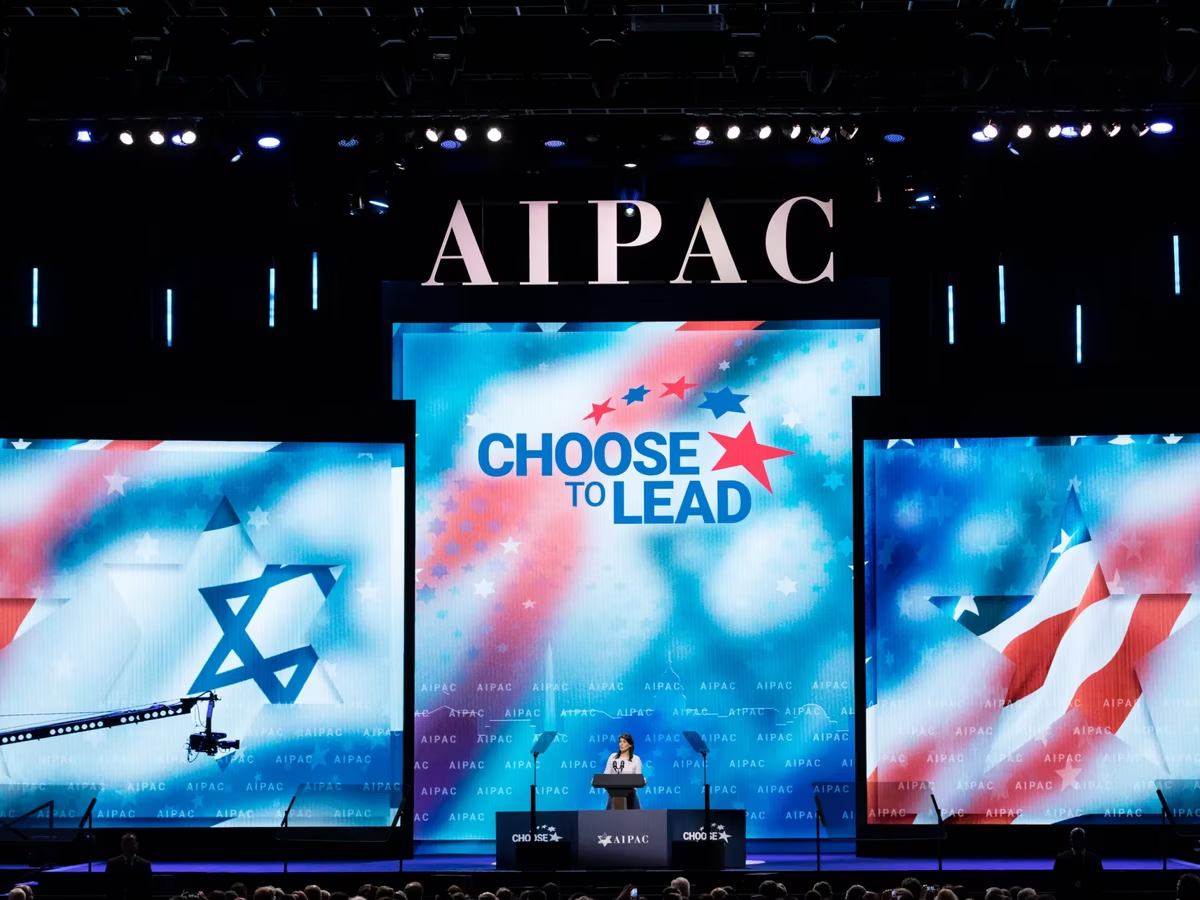







The American website 'Intercept' discussed the transformations facing the pro-Israel lobby in the United States, primarily the American Israel Public Affairs Committee (AIPAC), amid rising public anger over Israel's war on Gaza and its political repercussions on the American elections.
It noted that the growing support for Gaza forced 'AIPAC' to abandon its confrontational public campaigns from previous elections, replacing them with a more cautious approach that allows it to financially support its candidates through intermediaries and indirect funding networks, to maintain its influence in Congress.
The report mentioned that AIPAC waged an unprecedented public campaign during the 2024 election cycle to prove its influence, spending more than $100 million to oust critics of Israel from Congress, and credited itself with supporting 361 pro-Israel candidates who won in hundreds of electoral races.
This success was met with rising 'public disgust' over the genocide in Gaza, according to political affairs correspondent Akila Lacy.
This led to a widespread backlash in American politics, where a growing movement seeks to eliminate AIPAC's influence and push anti-AIPAC candidates into Congress, provided they pledge to reject support from the pro-Israel lobby, according to Intercept.
According to the report, AIPAC appears more cautious ahead of the 2026 midterm elections, having retreated from the aggressive public strategy it adopted in the previous cycle.
Former Democratic Representative Mary Newman, who was ousted in 2022 with help from pro-Israel donors, said 'AIPAC fully realizes that its reputation is at rock bottom,' as reported by the site.
For his part, Hamed Bendas, communications director at the 'Middle East Understanding Policy Project,' said that 'there is an increase in the number of Democrats who disavow AIPAC money because it has become an electoral burden.'
He added that 'it is unclear whether they will maintain this standard by rejecting support from other organizations, primarily the Democratic Majority for Israel, which adopts political agendas similar to AIPAC, especially regarding more weapons for Israel.'
The site warned that AIPAC's public retreat does not mean losing its influence in upcoming elections, as it continues to work behind the scenes to support its candidates.
It explained that AIPAC resorted in previous election cycles to indirect support methods, funding the candidates it supports through alternative channels to distance its name and criticisms from the campaigns, according to the report.
Recently -the report continues- donors linked to the pro-Israel lobby have funded electoral campaigns in various districts without officially announcing it.
Former Representative Newman mentioned that AIPAC is withdrawing its name from the forefront and passing funding through other committees and individual donors, allowing candidates to claim that the support came from independent donors, avoiding any direct link to the pro-Israel lobby.
The report described these moves as the latest in a series of AIPAC's attempts to adapt to the rising hostility toward Israel in recent years, thus returning to the traditional method it operated with before its direct intervention in the 2022 elections.
Over more than half a century, AIPAC built its influence quietly within Congress and Washington through political pressure, presenting itself as a source of information for Congress members, organizing trips to Israel, and expanding its network of regional activists, without directly entering electoral campaigns.
This strategy succeeded for a long time in establishing bipartisan consensus on supporting Israel, and AIPAC had previously affirmed that it would not launch a political action committee, according to the report.
This changed -according to Intercept- with the increasing number of candidates who began running in elections in the late last decade based on criticizing unconditional American military support for Israel.
At that point, AIPAC began direct spending on electoral campaigns, starting with funding ads for the 'Democratic Majority for Israel' organization, which attacked Bernie Sanders during the 2020 presidential primaries, according to the site.
Intercept's report concluded that AIPAC is not withdrawing from the scene, but repositioning, reviving its traditional methods that relied on indirect influence for decades, in an attempt to maintain its influence in a political environment that has become more hostile toward it than ever.
AIPAC fully realizes that its reputation is at rock bottom.

Share your opinion
The pro-Israel lobby changes its tactics in America after rising public anger