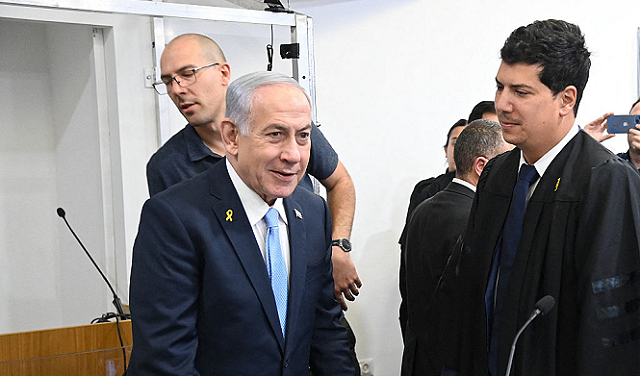







In a carefully orchestrated scene, Israeli Prime Minister Benjamin Netanyahu departed Ben Gurion Airport heading to Florida on Sunday, where he meets US President Donald Trump at Mar-a-Lago resort, in a visit that appears on the surface to be routine diplomacy, but in essence carries a lot of political maneuvers and attempts to buy time. Netanyahu's choice to travel without journalistic accompaniment, and his refusal to make any statements before departure, cannot be separated from his awareness of the sensitivity of the moment, nor from his desire to manage messages away from the spotlight, especially amid increasing American pressures to push him towards the second phase of the ceasefire in Gaza.
This summit, the fifth between the two men since Trump's return to the White House in his second term (January 20, 2025), comes at a time when Washington is trying to establish a new political and security path for Gaza, based on forming a technocratic Palestinian government, and deploying an international stabilization force, in exchange for a gradual Israeli withdrawal from the sector. However, Netanyahu, known for his mastery of procrastination policy, treats these proposals as more of an internal political burden than a strategic opportunity, which makes him inclined to keep them in the open discussion circle without clear commitment to them.
So far, Israel and Hamas have not officially signed the second phase of the agreement, amid mutual accusations of violating the first phase. It is true that Hamas has not yet returned the body of one of the hostages, but in return, Israel refuses to open the Rafah crossing in both directions, content with allowing only exit movement. This disrupted balance in implementing commitments reflects Netanyahu's attempt to maintain field pressure cards, and using humanitarian details as negotiation tools, not as legal or ethical obligations.
In this context, Netanyahu seems keen to redirect the compass of discussions with Trump towards broader regional files, headed by Iran and Hezbollah. Israel promotes fears that Tehran is rebuilding and expanding its ballistic missile program after the Twelve Days War last June, and also threatens to resume war with Hezbollah if the Lebanese government does not commit to disarming it according to the American timeline. However, this escalatory language serves, practically, one goal: justifying the disruption of any serious American pressure on the Gaza file under the pretext of broader security priorities.
Notably, Netanyahu's agenda in Florida seems limited to the point of raising questions. In addition to his meeting with Trump and Secretary of State Marco Rubio, the Israeli Prime Minister does not have intensive political appointments, but allocates time to meet evangelical leaders and activities with Jewish and community figures. This choice is not a mere protocol detail, but reflects his constant pursuit to strengthen his supportive base inside the United States, and circumvent any official pressures through investment in religious and political influence networks.
In conclusion, Netanyahu's visit seems closer to a calculated political maneuver than a genuine attempt to advance the settlement path. He seeks to present himself as a partner to Washington, without offering the required concessions, and uses escalation with Iran and Hezbollah as a pretext to keep Gaza in a state of "non-decision," where there is neither comprehensive war nor real peace. This gray area is the ideal environment for Netanyahu, as it allows him to escape internal and external obligations at once.
What Netanyahu is doing is not just crisis management, but a deliberate reproduction of instability. He realizes that transitioning to the second phase of the ceasefire means opening a political discussion about Gaza's future, a discussion that threatens the cohesion of his right-wing coalition. Therefore, he prefers to keep the agreement suspended, using mutual violations as a pretext, while placing full responsibility on the other side before the international community.
In contrast, Trump seems ready to turn a blind eye to these maneuvers as long as they do not directly clash with his broader agenda. The personal relationship with Netanyahu, and internal electoral considerations, make American pressure limited in scope. And the result is that Gaza remains hostage to a tug-of-war game, where humanitarian and security files are used as bargaining chips, not as an issue requiring an urgent and fair solution.



Share your opinion
Netanyahu in Florida: Diplomacy of Silence and a Maneuver to Buy Time to Escape Gaza Obligations