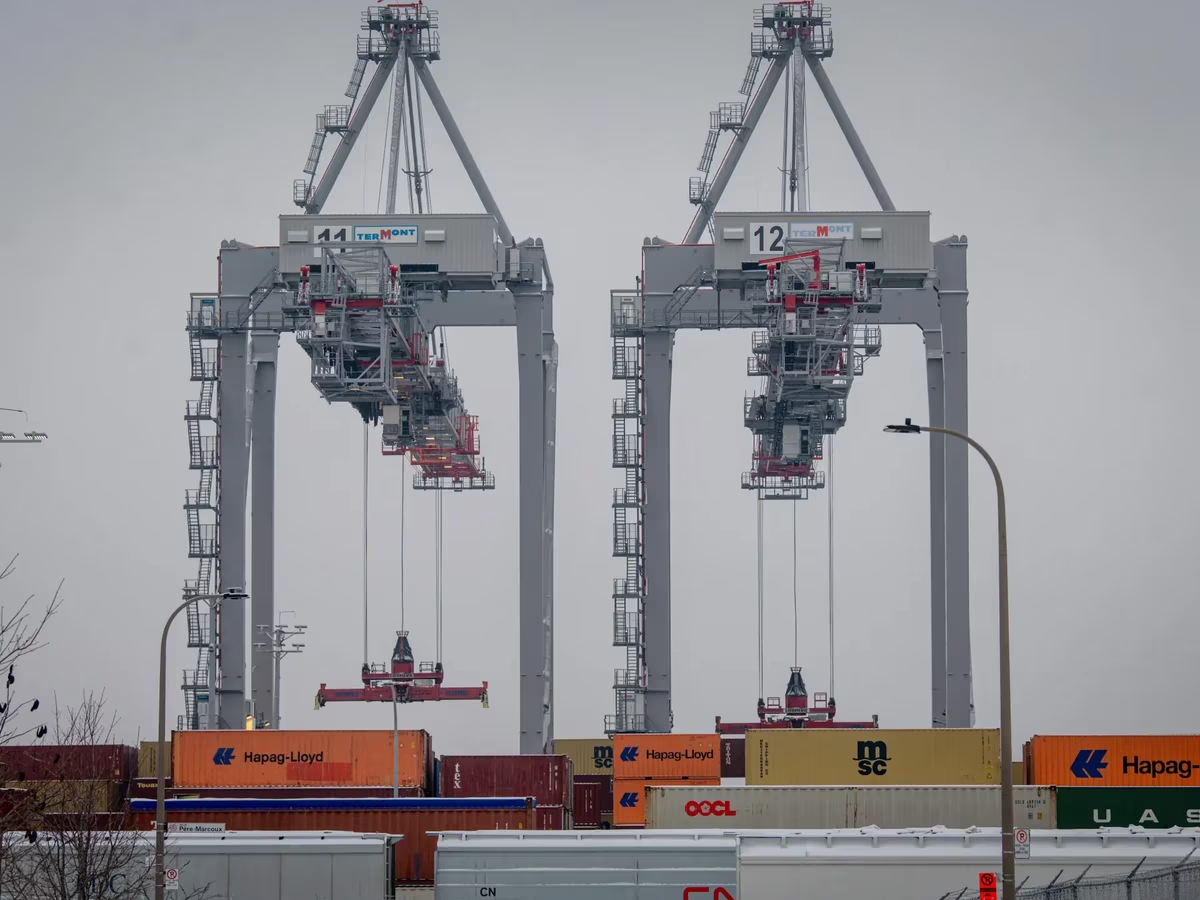







As the global trade system concludes one of its most transformative years in a century, 2026 enters laden with additional risks threatening stability and growth, amid rising protectionism, reshaping of supply chains, and shaking of major trade agreements, according to an extensive analysis.
Despite the relative resilience of global goods trade during 2025, underlying indicators reveal increasing imbalances that could make 2026 another year of turmoil, especially with the start of the review of the North American Free Trade Agreement, the ongoing repercussions of the tariffs imposed by US President Donald Trump, and the absence of clear enforcement mechanisms in several recent trade understandings.
Data on maritime transport—cited by shipping expert John McCown—indicates that global container volumes rose by 2.1% in October compared to the previous year, reflecting apparent resilience in international trade.
However, this picture hides sharp disparities, as the United States recorded an 8% contraction in imports, compared to strong growth in Africa, the Middle East, Latin America, and India.
McCown wrote that "global supply chains have actually begun to adapt and reshape trade patterns," considering that the escalation of tariffs seen in 2025 may make 2026 "the year of tariff repercussions," with their effects transitioning from numbers to the actual structure of trade.
Among the most prominent anticipated milestones of 2026 is the start of the United States, Canada, and Mexico reviewing the "North American Free Trade Agreement" that came into effect in 2020.
US Trade Representative Jamieson Greer said this review "takes the three countries to new territories," noting that more than 1,500 submissions were received during the public comment period.
Greer explained that "many supported the agreement and called for its extension, but the majority also demanded its improvement," implicitly warning that any amendment might come at the expense of another party, at a time when Canadian and Mexican industries are suffering from US tariffs.
Tensions are increasing with Canada, after Washington ended trade talks with it in October in response to media campaigns opposing tariffs.
Shipping experts predict that 2026 will face two potential shocks in supply chains:
The first involves the gradual return of ships to the Red Sea and the Suez Canal after the decline in Houthi attacks, which could lead—according to Lars Jensen of Vespucci Maritime—to "flooding the market with additional shipping capacity" and "massive congestion in European ports."
As for the second shock, it may be driven by demand, as any strong acceleration in the US economy, as expected by the Trump administration, could unleash a wave of restocking inventories that exceeds the shipping sector's absorption capacity, reviving the logistical bottlenecks witnessed during the coronavirus pandemic.
It warns that many of the trade deals boasted by the White House during 2025 are not traditional binding agreements, but political understandings lacking clear enforcement mechanisms.
Moreover, the trade truce with China does not exceed one year, leaving the world's largest unbalanced trade relationship without a fundamental solution.
This fragility has begun to appear, with Chinese pressures on countries like Malaysia and Cambodia due to agreements with Washington, stalled negotiations with the European Union and India, amid US threats to retaliate against what it considers "excessive regulation" of American technology.
The uncertainty increases with anticipation of the US Supreme Court's decision on the legality of the "reciprocal" tariffs imposed by Trump, and if the administration loses the case, the issue of refunding billions of dollars in tariffs to American importers may arise, despite officials' skepticism about the practical feasibility of that.
Kevin Hassett, Director of the National Economic Council, said that imposing broad refunds "is administratively unlikely," while betting markets estimate the probability of Trump losing the case at around 75%, meaning the administration will resort to other tools to impose tariffs.
In this context, it concluded that 2026 does not seem closer to calm, but rather is a candidate to be another year of redrawing global trade, in an environment where traditional rules erode, and politics advances over market logic.
As the global trade system concludes one of its most transformative years in a century, 2026 enters laden with additional risks threatening stability and growth.





Share your opinion
2026.. The New Year of Turmoil in Global Trade