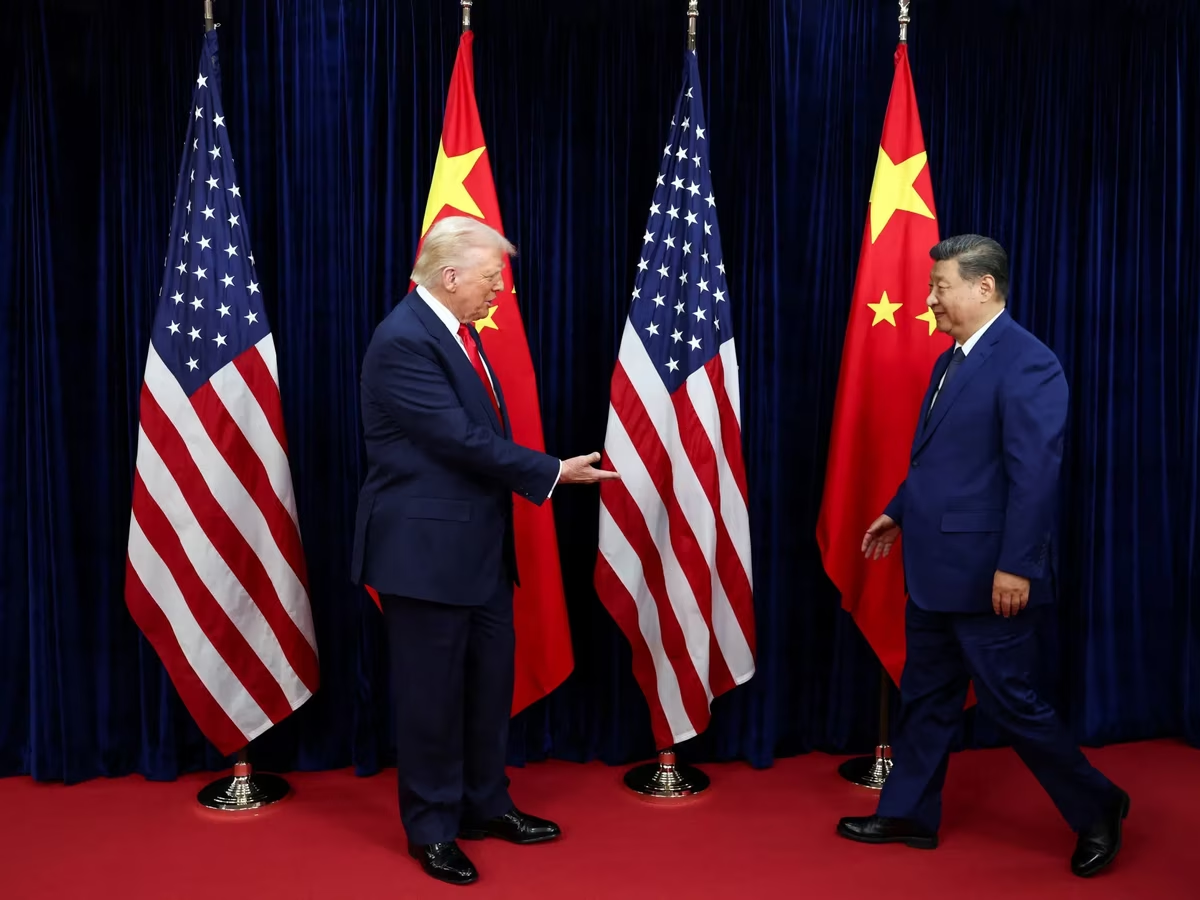







At the height of the trade escalation between Washington and Beijing in April last year, amid the exchange of tariffs and sanctions, the scene seemed as if China was holding 'weak cards,' as described by US Treasury Secretary Scott Bessent when he said that China 'is playing two cards of the two denomination.' However, the following months showed that the bet was reversed.
After successive waves of US tariffs—starting at 10%, then 20%, then jumping to 145% before returning to 10% again—the administration of President Donald Trump announced at the end of October the conclusion of an agreement described as a 'huge victory.'
However, Bloomberg's report sees that the agreement essentially restored the situation to what it was before, and even included an important US concession represented in the retreat from expanding the list of Chinese companies subject to export controls, a tool that was previously considered non-negotiable.
According to Bloomberg, China not only absorbed the pressures but emerged from the confrontation with its strengths becoming more evident. And Lizzy Seeley Lee, a researcher at the Asia Society Policy Institute, says that 'China is no longer just a fast follower, but has become a different model of development that may be more sustainable, and perhaps more realistic.'
Rare earth metals represent Beijing's most important pressure card against US industries (Reuters)
And it has long been believed that China's growth miracle carries structural fragility within it, which was fueled by repeated predictions of an imminent collapse, but Bloomberg points out that this view has become 'exhausting' in the face of the reality that China is achieving strong performance in a large number of fronts at the same time.
The most prominent of these fronts is China's near-total control over rare earth metals supply chains, which are essential materials in the production of strong magnets, phone screens, digital signals, and hundreds of industrial and military applications.
And Bloomberg explains that the restrictions imposed by Beijing on the export of these metals threaten vital US sectors, from electric cars and satellites to aviation and consumer electronics.
And Daniel Rosen, co-founder of the Rhodium Group, says that US attempts to build local capabilities in this field 'will take years to address the current excessive dependence on China.'
The United States also depends on China for components of about 700 drugs, a sensitivity that was not even raised at the table of the recent trade negotiations. And in October, China halted exports of computer chips produced by the company 'Nexperia' owned by it, causing a slowdown in production for major Japanese car companies, as an additional indication of Beijing's ability to cause widespread disruption when it wants.
In contrast, the US has limited pressure points, the most prominent of which is its dominance over advanced chips used in training artificial intelligence models, and Trump banned Nvidia from selling its latest chips—known as 'Blackwell'—to China.
However, Hongbin Li, a participant in managing the Stanford Center for China's Economy, sees that Beijing is still in a better position, saying: 'Can we live without medicines or rare metals? No. Can the Chinese live without Nvidia chips? Yes, they can.'
And Bloomberg notes that several Chinese companies have found ways to circumvent export restrictions, whether through smuggling networks or front companies, while major companies like 'Huawei' are working on developing local chips that are less advanced but sufficient to produce competitive products.
As for clean energy, data indicates that China is building solar energy equivalent to twice what the US and Europe are building together, produces 70% of the world's electric cars, and leads in battery technologies. At this year's Shanghai Auto Show, BYD displayed a battery that 'charges almost completely in 5 minutes.'
And in 2024, China installed a number of industrial robots exceeding what the rest of the world installed collectively, while DJI dominates 70% of the commercial drone market, with a clear superiority in military applications compared to the United States.
Artificial intelligence patents reflect China's expansion in future industries (Shutterstock)
Despite this progress, Bloomberg does not overlook the deep challenges facing China, from a real estate crisis that wasted trillions of dollars, to deflationary pressures, and an aging population that will lose the country a quarter of its workforce in 25 years.
It also warns of the risk of falling into the 'middle-income trap,' which the new five-year plan of the Chinese Communist Party seeks to overcome by focusing on 'future industries,' such as space and quantum computing.
But the conclusion—that Bloomberg's report reaches—is that betting on weakening China or waiting for its collapse is no longer realistic. China, as the report says, 'is a strong and determined adversary to expand its advantages,' while the US desire to 'defeat it' seems less aligned with the changing global reality.
And the report concludes by saying that reassessing China's position in the international system has become a necessity, 'not out of admiration for its model, but because betting on its fall simply will not succeed.'
China is no longer just a fast follower, but has become a different model of development that may be more sustainable, and perhaps more realistic.



Share your opinion
China.. From 'Weak Cards' to an Unbeatable Power