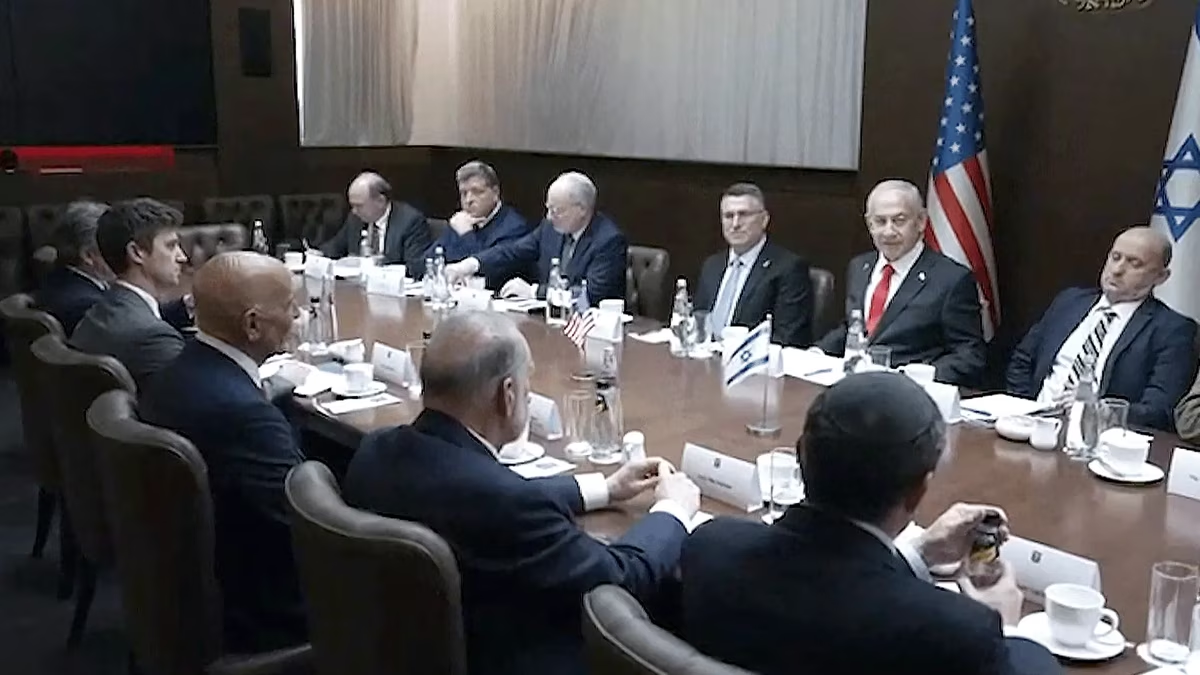







The agenda of US President Donald Trump to reorganize the region's files seems stuck at a central knot where Gaza, Syria, and Turkey intersect, where Washington seeks a pragmatic approach based on regional partnership, while Benjamin Netanyahu's government insists on a narrow security definition that rejects any influential Turkish role.
This divergence is no longer a passing tactical disagreement, but has transformed—as reflected in the episode of the program Beyond the News—into an early test of Trump's ability to impose his regional vision in the face of Netanyahu's repeated "noes," which he presents under the title of Israel's independent security decision-making.
The visit of US envoy Tom Brake to Tel Aviv, and the strong-toned American messages that accompanied it, revealed that Washington does not view the three files—Gaza, Syria, and Lebanon—as separate paths, but as a single package that requires a cohesive regional approach, in which Turkey has a pivotal role.
In the American vision, Ankara is no longer just a side actor, but a necessary pillar for succeeding in the "day after" arrangements in Gaza, and building long-term stability in Syria, as clearly expressed by former US State Department official Thomas Warrick, when he pointed out that Washington sees partnership with Turkey as an indispensable security and political entry point.
But this approach directly clashes with Netanyahu's vision, who sees any Turkish involvement as a dual threat: first, because it gives the Islamic Resistance Movement (Hamas) indirect political cover, and second, because it limits Israel's freedom to impose unilateral security facts, whether in Gaza or southern Syria.
The researcher specializing in Israeli affairs, Adel Shadid, considered in his talk to the program Beyond the News that the Israeli attack on Tom Brake, accusing him of turning into a "lawyer for Turkey," cannot be separated from the essence of the disagreement, for the issue—according to his reading—is not personal, but relates to a deep contradiction in the philosophy of managing the region.
For Israel, as Shadid explains, is still captive to the logic of security subjugation, and sees that the "new Syria" should be managed with the same equation previously used with the Iranian presence, while the Trump administration believes that any stability in Syria without Turkish partnership is a strategic illusion.
This contradiction also extends to Gaza, where Washington bets on forming a "multilateral executive force," which Turkey gives regional legitimacy and operational capacity to deal with the complex reality in the sector, while Tel Aviv rejects this formula entirely.
Professor of International Conflicts at the Doha Institute for Graduate Studies, Dr. Ibrahim Fraihat, sees that Trump's insistence on involving Tom Brake in this mission reflects unprecedented American seriousness, especially after the US President himself set a declared timeline for forming the executive force.
From this perspective, Turkey's participation—according to Fraihat's analysis—is an American necessity, not a political luxury, as it gives the proposed arrangements Arab and Islamic acceptance, and opens an indirect channel with Hamas, which reduces the chances of security explosion in the post-war phase.
However, this American bet clashes with Netanyahu's internal calculations, where the Israeli Prime Minister employs the discourse of "challenging" Washington in an electoral context, through which he seeks to restore his image as a leader capable of saying "no" to the American ally.
This explains—according to Adel Shadid's reading—the insistence of Netanyahu on exaggerating the slogan of "independent security decision," despite the fact that realities indicate that Israel is still moving within a strict American ceiling, especially since October 7, 2023.
And in the Syrian file, the rift deepens further, as Washington proceeds on an accelerated path of rapprochement with Damascus, which included lifting sanctions and expanding security coordination against ISIS, while Israel sees in this path a direct threat to its ability to control southern Syria.
Here, Thomas Warrick clearly points out that the Trump administration considers integrating Syria into its Arab environment a "historic opportunity," and that this goal requires curbing Israeli movements that may undermine this path, which puts Netanyahu in a difficult equation.
As for Lebanon, the scene appears less confrontational, as both sides—the American and Israeli—agree on the goal of weakening Hezbollah, but they differ on the tools and time frame, where Washington tends to manage pressure, while Tel Aviv pushes towards harsher options.
This difference in approaches reinforces the impression that the Trump administration is trying to redefine Israel's role in the region, from a dominant partner to a player within a broader system, a transformation that Netanyahu does not seem ready to accept easily.
In conclusion, the disagreement does not revolve around Turkey itself, but around who has the right to draw maps of influence and arrange the "day after" in Gaza and Syria, for while Washington sees regional partnership as the least costly path, Tel Aviv insists that security is only managed by the lone fist.
This clash, even if it seems rhythm-controlled so far, is likely to escalate with the approaching meeting between Trump and Netanyahu in the White House, where the US President's ability to turn his regional vision from ideas on paper into political realities will be tested, in the face of an Israeli Prime Minister who still bets on a policy of rejection and delay.
This divergence is no longer a passing tactical disagreement, but has transformed into an early test of Trump's ability to impose his regional vision in the face of Netanyahu's repeated "noes."

Share your opinion
American-Israeli Disagreement Over Turkey's Role in Gaza, Syria, and Lebanon