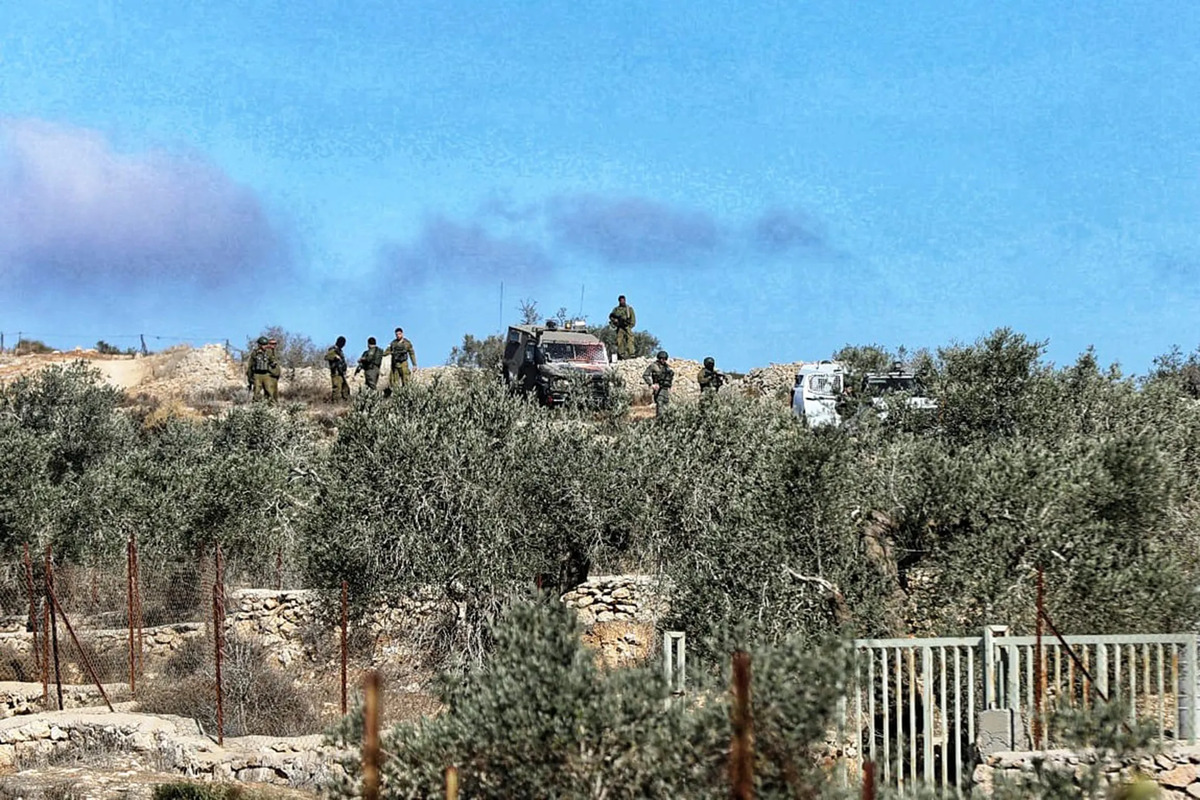







Ramallah - About 25 years ago, Fathi Hamdan (62 years old) from the village of Deir Jarir east of Ramallah in the West Bank received a military notification preventing him from accessing his land located adjacent to the "Kochav Hashachar" settlement, under the pretext that it is a "closed area for security reasons." Since that day, he has not set foot on its soil, while settlers have been cultivating it and reaping its benefits.
Agriculture was the primary source of income in Deir Jarir, accounting for over 60%, especially before the first intifada in 1987, as the land was utilized for growing various crops. However, this reality changed after the occupation authorities confiscated large areas of land from the town and neighboring villages.
Today, after a quarter of a century since the first confiscation decision, the occupation returns to give that control a "new legal character," under the name of "the buffer zone," in a step considered a practical extension of the old confiscation policy, but this time it comes as part of a broader plan aimed at delineating and expanding the boundaries of settlements at the expense of the surrounding Palestinian villages.
Fathi and his uncle own 4 dunams out of a total of 29.68 dunams (one dunam equals one thousand square meters), which were declared confiscated from the villages of Kafr Malik and Deir Jarir, as part of an occupation decision that stipulated the establishment of a "buffer zone" around the "Kochav Hashachar" settlement, issued on October 27 last month.
The second order targeted - according to the texts of the decision - the confiscation of an area of 12,612 dunams of Deir Jarir land, to create a security road linking the settlement to Route 449.
Hamdan tells Al Jazeera Net that "the area mentioned in the military order today is 29 dunams, but the actual confiscated area is much larger, and this area in particular was, at one time, the food basket for all the residents of Deir Jarir."
Israeli concerns in this context, the settlement affairs specialist Suhail Khaliliya clarifies that what is known as "buffer zones" is a relatively new term in form, but it is deeply rooted in substance within an old Israeli policy aimed at expanding the influence of settlements under the guise of "security fortification."
This policy became clearly evident after October 7, 2023, when Israeli fears escalated about the possibility of a repeat scenario of settlement incursions in the West Bank, prompting the government to adopt new security plans that include establishing buffer zones around settlements, according to Khaliliya.
However, the essence of these plans - as he says - goes beyond the declared security dimension, "as they effectively draw future borders for the settlements and grant them a much wider area of influence than their current urban boundaries, opening the door for new settlement expansion under the guise of security necessities."
For his part, political analyst Suleiman Basharat sees that this policy aligns with what the occupation calls the "natural expansion" of settlements, which is an old strategy aimed at ensuring open spaces around them, presented outwardly as "security areas," but in essence, they are designated for expanding control and preparing the land for future settlement expansion operations.
Basharat adds that over the years, the occupation has used multiple designations for land confiscation, including "archaeological areas," "nature reserves," or "security roads," all of which serve one goal: to control as much Palestinian land as possible.
Basharat emphasizes that the actual goal of this policy is twofold: "On one hand, the occupation seeks to create geographical gaps between Palestinian villages and settlements to reduce friction, and on the other hand, it grants itself flexible space for creeping annexation, so that the confiscated lands turn into new settlement influence areas."
Disassembling Palestinian geography, Basharat warns that this approach leads to the disintegration of Palestinian geography, turning villages and cities into isolated islands, connected only by limited roads under occupation control. He adds that "thousands of farmers have lost their ability to access their lands, especially during the olive seasons, leading to a decline in agriculture as a primary source of income and an increase in internal displacement rates towards cities."
Abd Qabaja, the director of the media department at the Wall and Settlement Resistance Commission, clarified that the occupation authorities recently seized about 73 dunams of citizens' lands in the Ramallah and Al-Bireh governorate through 5 military orders issued under the name of "orders of seizure."
He added that the area of land covered by the military orders related

Share your opinion
Israel legalizes control over land in the West Bank through buffer zones.