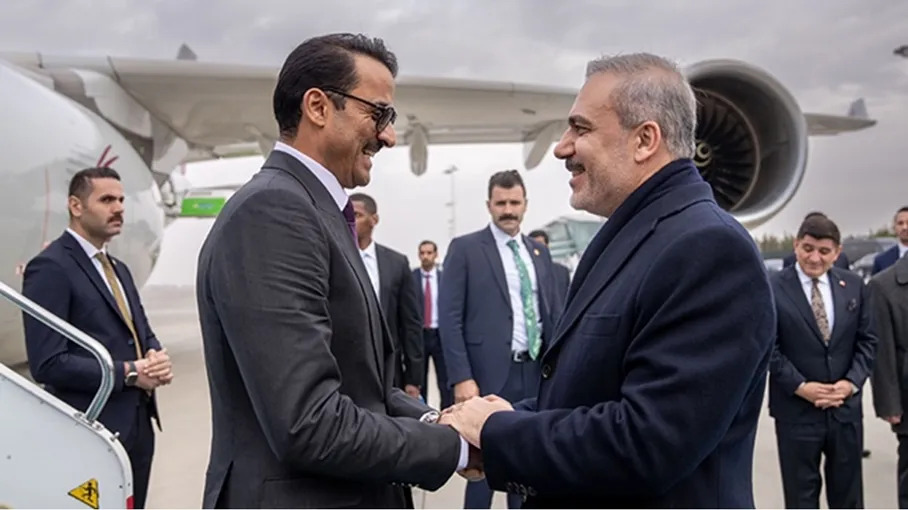







The Israeli warnings regarding the United States' choice of Turkey as a pivotal factor in implementing the ceasefire in Gaza continue, claiming it poses a strategic threat to the occupying state that transcends the borders of the enclave, and because this step legitimizes Turkish ambitions for dominance in the region, placing the occupation and its partners in the region before a direct challenge.
Professor Kobi Michael, a researcher at the Israeli Institute for National Security Studies (ICGS) and an expert in security and intelligence studies, stated that "the first phase of the 21-point plan proposed by U.S. President Donald Trump is feasible after the agreements reached through Turkish-Qatari-Egyptian mediation, and it seems that within the framework of the pressure exerted by the three mediators on Hamas, Turkey played the most influential and significant role."
He added in an article published by Channel 12, translated by "Arabi21," that "this step initiated by Trump, which led to Turkey and Qatar's commitment to implement the plan, is based on forcing Hamas to agree to it, focusing on the first phase, and making the necessary efforts, which include the return of hostages alive and deploying army forces along the yellow line, which practically means the end of the war that Trump appeared determined to conclude after it lasted for two years."
He clarified that "Trump emphasized the necessity of ending the war either because he concluded that its continuation was futile, even in the face of Israeli interests, or due to the fear, exacerbated after the attack on the Qatari capital Doha, of harm to important American interests in the region due to serious deterioration, which could primarily thwart his plan to design a new regional structure based on expanding normalization agreements."
Michael pointed out that "Trump effectively imposed the principles of his plan on all parties, leaving the implementation details for later negotiations, and he recognized the importance of Turkey and Qatar for their influence over Hamas, which is why he chose to place them at the forefront and tasked them with convincing its leaders, and with this choice, he opened the door for their participation in implementing the plan, which means an active, and possibly extensive, presence in the Gaza Strip, and an important role in the reconstruction process, including ensuring the proper functioning of the upcoming system led by Tony Blair, and participating in the international stabilization force."
He affirmed that "at the same time, there are doubts that Trump has considered the grave implications of this step concerning the interests of the two mediators in the region in general, and the challenge faced by Israel and pragmatic countries, focusing on Egypt and Saudi Arabia, as Turkey and Qatar support the Muslim Brotherhood, including Hamas, and are supposed to work to protect their vital interests."
He claimed that "it should be taken into account that Doha and Ankara will make an effort to maintain Hamas's influence and status as an important and influential player on the Palestinian scene, and to prepare the conditions for its subsequent control over the entire region, as an alternative to the Palestinian Authority, not as a partner in it."
He added that "for Turkey, this is a more significant event, as President Recep Tayyip Erdoğan does not hide its ambitions for dominance, and consolidating the Turks' grip on the region and increasing their influence there poses a real threat, like clouds, to the occupation, Egypt, Saudi Arabia, and the UAE. His intervention, which will deepen in Gaza, including his actual presence there, alongside the increasing intervention in Syria and the close rapprochement with Trump, will allow him to promote several other important regional steps, which would close the door on Israel and its partners in the region, while simultaneously threatening the vital interests of Cyprus and Greece."
He indicated that "besides the potential threat arising from Turkey, one can also observe in the recent operations related to it an opportunity, as its desire to expand its intervention in the Gaza Strip requires Israel's approval and cooperation, and the special and close relationship between Tel Aviv and Washington, built on the close personal connection between Prime Minister Benjamin Netanyahu and President Donald Trump, allows for close coordination and American participation in easing tensions in relations along the Tel Aviv-Ankara axis."
He concluded by saying that "this increasing Israeli concern over the growing Turkish and Qatari influence in the Palestinian file does not hide the fact that the Israelis have a vital interest in improving relations with the Turks, and Trump's decision to involve them in the Palestinian scene could provide an opportunity for change."
One can conclude from these Israeli fears the possibility that Israel might find ways to cooperate with Saudi Arabia and Egypt to create an axis capable of curbing or mitigating Turkish and Qatari influence in the Palestinian arena, and convincing the U.S. administration in the White House to prioritize Israeli and regional interests over those of Turkey and Qatar, which is not guaranteed to happen with Trump, who has
Share your opinion
The occupation is concerned about the United States imposing a Turkish and Qatari presence in Gaza.