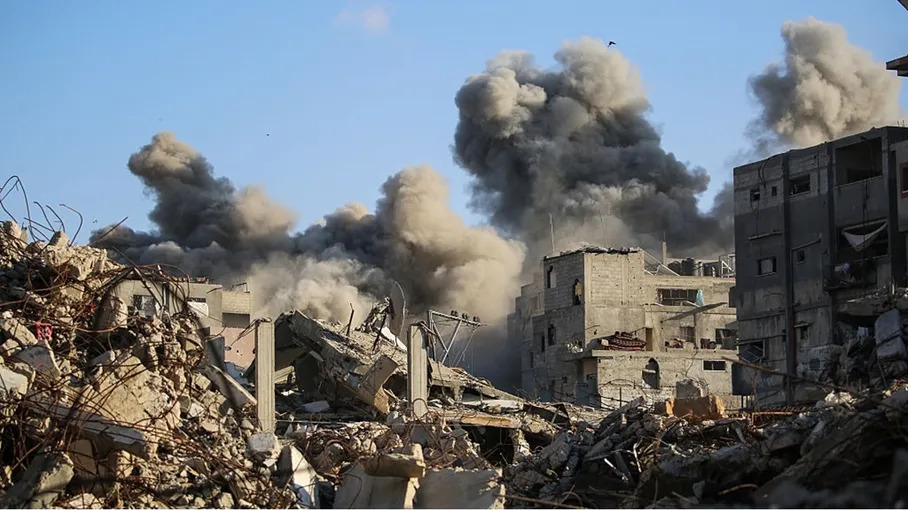







The intensive Israeli airstrikes carried out by the occupation army last Sunday in various areas of the Gaza Strip, resulting in dozens of martyrs and injuries, have raised fears of a potential collapse of the ceasefire agreement and the return of the specter of war to the Strip, which has endured a war of extermination for two years.
Observers believe that the scale of the Israeli bombardment exceeds claims of "responding to what happened in Rafah," which remains under complete control of the occupation army, especially in light of Hamas's quick efforts to affirm its commitment to the ceasefire agreement, and the arrival of American officials to the region to solidify the agreement.
Political analyst Ibrahim Al-Madhoun explained that the return of intensive Israeli airstrikes to the Gaza Strip last Sunday falls within the context of the occupation's attempts to undermine the ceasefire agreement, believing that "the Palestinian resistance is concerned with solidifying the agreement."
Al-Madhoun added that "the resistance wants to protect its people from the war of extermination that the occupation has waged for two years, and there has been no regional or international capacity to stop it," emphasizing that what the occupation is doing constitutes killing, not fighting.
He noted that the recent Israeli airstrikes aim to establish a new engagement equation that allows for bombardment, killing, and destruction while maintaining a presence in the Gaza Strip, but the resistance will not accept this equation, despite its desire to spare the Palestinian people from a return to extermination.
He pointed out that the arrival of an official Hamas delegation to Cairo is part of efforts to mobilize mediators to compel the occupation to adhere to the ceasefire agreement and fulfill its commitments to end the war and prevent its return to Gaza.
In his assessment of the possibility of a return to war, writer and political analyst Wissam Afifa ruled out this scenario, stating: "All indicators and assessments confirm that Trump's plan aims to end the war and not just to implement the first phase of the plan."
Afifa mentioned that "the significant international and regional effort has come to end the war, and even on the Israeli side, Netanyahu is conveying to the Israeli public and his voters that what he has achieved is an accomplishment, and thus this achievement should not turn against him."
He noted that "Trump is celebrating this significant achievement like never before, coming from the White House to the region, elated by this achievement, and it is unreasonable to talk about a major achievement and then turn against it after the first phase."
He emphasized that "the large celebration and political demonstration in Sharm El-Sheikh confirmed the necessity of a ceasefire in Gaza, and all these data confirm that there is a real path to end the war and not just to settle for the first phase of Trump's plan."
According to the "New York Times," the White House is working to maintain the stability of the peace agreement in Gaza, amid growing fears that Israeli Prime Minister Benjamin Netanyahu may dismantle the agreement brokered by the U.S. administration.
In this context, the Hebrew newspaper "Yedioth Ahronoth" reported that U.S. President's envoys Steve Witkoff and Jared Kushner discussed with Israeli military officials ways to maintain the ceasefire agreement in Gaza and implement its second phase.
The newspaper noted that the meeting held at the Israeli Ministry of Defense brought together the American envoys, the head of the military intelligence division "Aman," Shlomi Bender, and the head of the planning division in the army, Eyal Hareli, to discuss intelligence matters and decisions related to the next day in Gaza.
The newspaper quoted unnamed Israeli security sources stating that the American delegation was keen during the meeting to "plug the gaps" in preparation for the second phase of the agreement, which includes the introduction of a foreign force and the disarmament of Palestinian factions.
For its part, the "Times" reported that senior officials indicated that Witkoff and Kushner realize that the situation is "extremely sensitive," and that the agreement they brokered may collapse, so their current goal is to stabilize the region, ensure the delivery of humanitarian aid to Gaza, and recover the bodies of Israeli prisoners.
The newspaper pointed out that Witkoff and Kushner are also addressing issues that remained open in the original agreement, such as establishing a stabilization force led by Egypt and starting the process of disarming Hamas, which has not yet been given a timeline, as confirmed by Trump, who stated last Sunday that "there is no definitive timeline" for disarming Hamas.
Trump emphasized that the implementation of the ceasefire agreement in Gaza depends on the developments in the field and political situations during the upcoming phase,






Share your opinion
Intensive Israeli airstrikes in Gaza.. A sign of collapse or the establishment of equations?