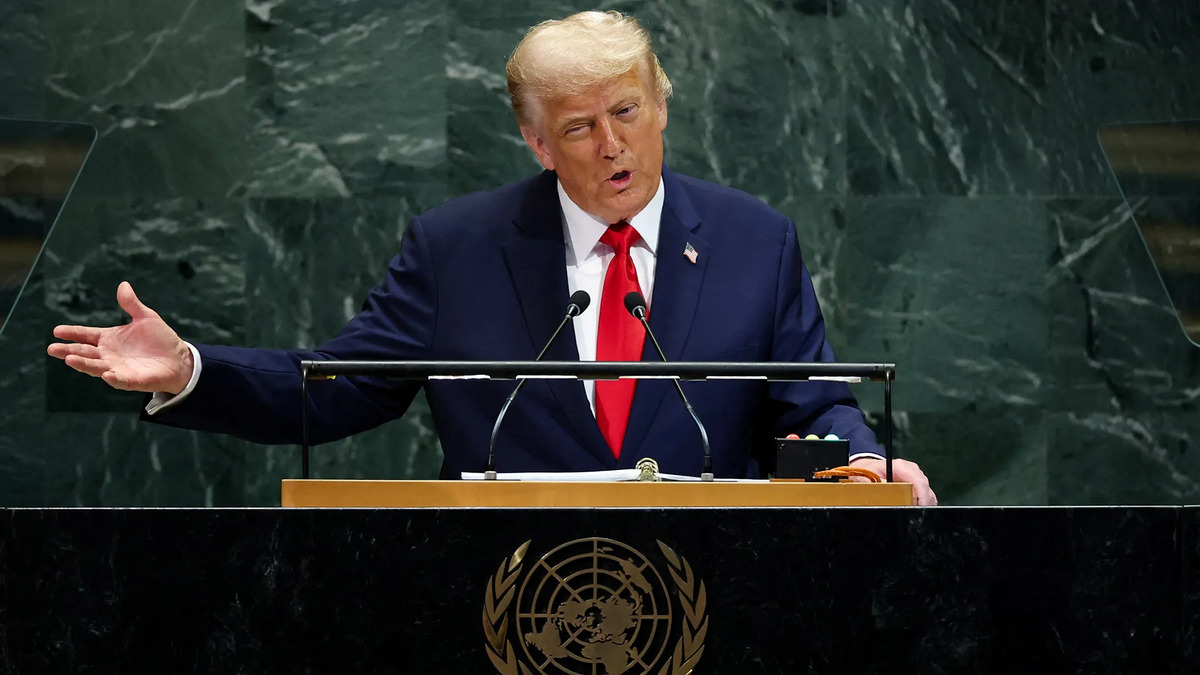







The 21-point plan by U.S. President Donald Trump to resolve the Gaza crisis and the Palestinian issue is generating mixed reactions among political and strategic affairs experts.
While Arab and Muslim leaders express cautious optimism, analysts warn against repeating previous scenarios where Trump reversed his positions under the influence of Israeli Prime Minister Benjamin Netanyahu, who is wanted by the International Criminal Court.
The U.S. president met with leaders of Arab and Islamic countries at the United Nations to present his plan regarding Gaza, describing the meeting as very important and emphasizing his desire to end the war and recover hostages.
Although the broad outlines of the U.S. proposal did not include detailed specifics, the American news site Politico confirmed that Trump promised Arab leaders not to allow Israel to annex the West Bank.
In this context, the declared U.S. intent aligns with a cautiously optimistic Arab stance, as the Emir of Qatar, Sheikh Tamim bin Hamad Al Thani, pointed out that the situation in Gaza is extremely dire, adding, "We are here to do everything we can to end the war and bring back the captives."
In the same vein, the Emir of Qatar addressed the U.S. president, affirming, "We rely on President Trump's leadership to put an end to the war in Gaza."
These positions are reflected in the joint statement issued by the participating countries, which emphasized the necessity of stopping the war and releasing prisoners as a first step towards a just and lasting peace, indicating a common ground for cooperation between the U.S. administration and Arab and Islamic countries on this sensitive issue.
Strategic expert in the Republican Party, Jean Card, confirmed that the coming days will reveal more details about the plan, noting that Trump added a new element by pledging not to allow Israel to annex the West Bank.
However, Card pointed out that Trump is known for frequently changing his opinions, but she clarified that what can be inferred is understanding how he views matters concerning Gaza and the future solution.
In another assessment of Trump's ambitions, Card explained that the U.S. president seeks to achieve a historic accomplishment that surpasses the Abraham Accords, asserting that he is a dreamer in different ways and believes in peace despite his image as a strong person.
She noted that Trump is proud of the Abraham Accords and wants to add a new legacy, but she considered the vision impossible despite having no doubt about his dedication.
Based on this analysis, Card predicted that Trump's goal for the upcoming meeting with Netanyahu is to persuade him to agree to the plan, as he wants to emerge as the hero who achieved peace.
However, she anticipated that Netanyahu would not yield, which could cause frustration for Trump, who does not back down or surrender.
Conversely, researcher and political analyst Dr. Osama Abu Rish pointed out that any statement issued by the U.S. president is a cause for optimism, but he questioned whether this optimism would translate into practical action.
In this context, Abu Rish reminded of what happened last July when the level of optimism reached the belief that the Israeli aggression had come to an end, but the result was Trump reversing his positions and placing the responsibility back on Hamas.
Nevertheless, Abu Rish confirmed that the leaked items from Trump's plan appear mostly positive, especially regarding stopping the aggression, reconstruction, humanitarian aid, and the role of Arab Islamic forces and the Palestinian Authority.
He also praised the conditions set by Arab and Muslim leaders to prevent annexation, displacement, and new settlement activities.
However, this positive assessment does not hide some reservations, as Abu Rish warned of the contradictory messages coming from the U.S. administration, pointing to past experiences with Trump, who presents one position and its opposite.
He added that all these matters are subject to Trump's mood and Netanyahu's ability to maneuver and manipulate.
In analyzing the political context in which the U.S. administration operates, Abu Rish pointed to a series of pressures facing Trump, ranging from his obsession with the Nobel Peace Prize to the pressure from the "MAGA" movement that demands he puts America first instead of Israel.
On the international front, he highlighted the growing diplomatic isolation with European countries recognizing the Palestinian state, leaving America isolated from three-quarters of the international community.
Moreover, Abu Rish added that Trump has given Netanyahu all possible support in terms of weapons and diplomatic backing without achieving a decisive victory, which has translated Israeli isolation into American isolation.
Regarding the Israeli side of the equation, Israeli affairs expert Dr. Mohannad Mustafa clarified that Netanyahu's acceptance of the plan is linked to the extent of serious American pressure on him.



Share your opinion
Trump's plan for Gaza amid Netanyahu's maneuvers and doubts about implementation