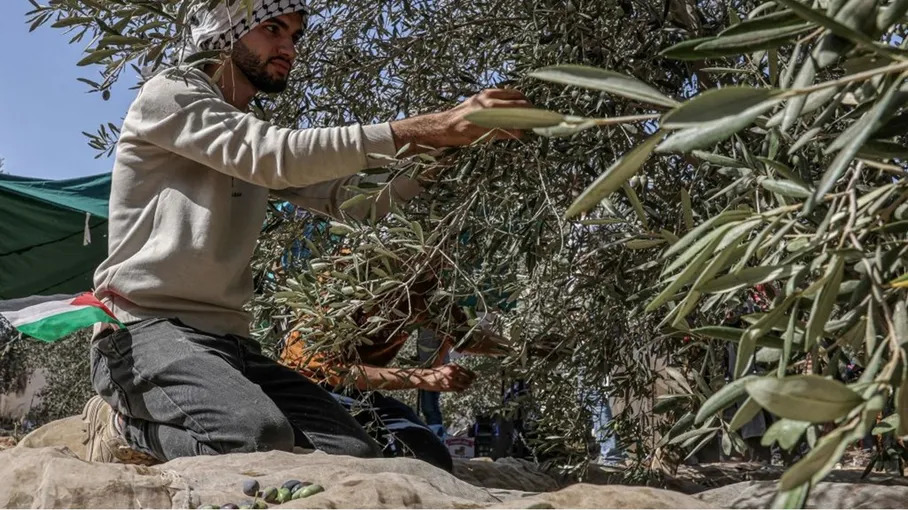







The popular rituals have disappeared from the olive harvest season in the Gaza Strip for the third consecutive year, after the ongoing war caused the destruction of vast areas of fruitful fields, depriving thousands of farmers of the abundant livelihood they eagerly awaited at this time every year.
The occupation forces destroyed large areas of fields planted with fruitful olive trees, especially in the eastern regions of the Gaza Strip, while the seasonal presses did not escape the systematic Israeli destruction. Just as they were preparing at this time to operate their machines and massive stone mills to press the olive oil coming from the nearby fields, their owners found themselves today amidst displacement and homelessness, due to the widespread destruction in the sector, which affected their presses and facilities.
A deep sadness overwhelms Haj Hassan Hamdan, after losing his farm filled with olive trees in the Al-Qarara area east of Khan Younis, following its destruction by the occupation and the uprooting of its fruitful and ancient trees.
Hamdan says in a special interview that the rituals of harvesting the olive crop and pressing its oil have disappeared for the third consecutive year due to the ongoing aggression, adding: "My family used to gather at this time every year to pick the fruits; we awaited this time eagerly, but the war deprived us of celebrating the season after destroying everything we own."
Haj Hassan recalls, with tears nearly escaping his eyes, saying: "The season was a heritage and an identity for us, a clear expression of our connection to our land and our deep roots in it (...) For an entire week, the children, grandchildren, and relatives would gather to celebrate this occasion that we inherited from our ancestors. We would go early in the morning, have our breakfast, and then head out to harvest the olives, amidst an atmosphere of joy and happiness. When we finish gathering, we send a large portion of it to a nearby press to extract the pure oil known for its high quality, and then we save another part for home pickling."
Despite the good financial returns from the olive crop, this was not our main motivation. The olive harvest season became an opportunity to renew the expression of family bonds, attachment to the land, and a chance to teach the young ones the value of the land and encourage them to hold onto it after us.
Youssef Al-Zuraihi was not in a better situation than Haj Hamdan; they shared the pain and suffering of losing their farms and their annual source of joy under the treads of the occupation's tanks, which wreaked havoc and destruction in the farms and fields until they were destroyed, leaving them as remnants.
Al-Zuraihi says in a special interview that he is living a deep sadness these days, remembering his small farm filled with olive trees, which was destroyed by the occupation at the beginning of the war when it invaded the Hajar Al-Dik area, southeast of Gaza City.
Al-Zuraihi recalls, saying that his farm was not large; it contained a few dozen fruitful olive trees, but what pains him is the extinguishing of the season's flame that he had been accustomed to reviving for twenty years with special family rituals and an atmosphere of joy and happiness, starting in the morning and ending at sunset over several days.
The area of land planted with olives in the Gaza Strip before the war began about two years ago is estimated at around 44,000 dunams, including 35,000 dunams of fruitful trees and 9,000 dunams of non-fruitful trees.
According to figures from the Ministry of Agriculture in Gaza before the war that began in October 2023, Gaza produced about 35,000 tons of olives annually, all of which were for local use, including 4,000 tons designated for home pickling or factories, and 31,000 tons that were pressed in olive presses, but these quantities are subject to annual fluctuations based on production size.
There are about 40 olive oil extraction presses distributed across the Gaza Strip, including 32 modern (automatic) presses, 6 traditional (semi-automatic) presses, and 2 manual presses that rely on old stone.
The profession of olive pressing and oil extraction in the Gaza Strip becomes active after September 20 of each year, as farmers await light rain showers known as "the rains of the cross," but the peak of the season occurs around mid-October each year.
The Gaza Strip relies primarily on the agricultural sector to provide food for more than 2.4 million people living in all provinces; however, the disruption of this sector has negatively affected economic activity in terms of buying, selling, and livestock, especially in the animal and fish sectors.
A report from the Palestinian Ministry of Agriculture stated that the occupation forces deliberately destroyed all agricultural lands in the Gaza

Share your opinion
September in Gaza without olives.. Farmers harvest pain after the destruction of fields and trees.