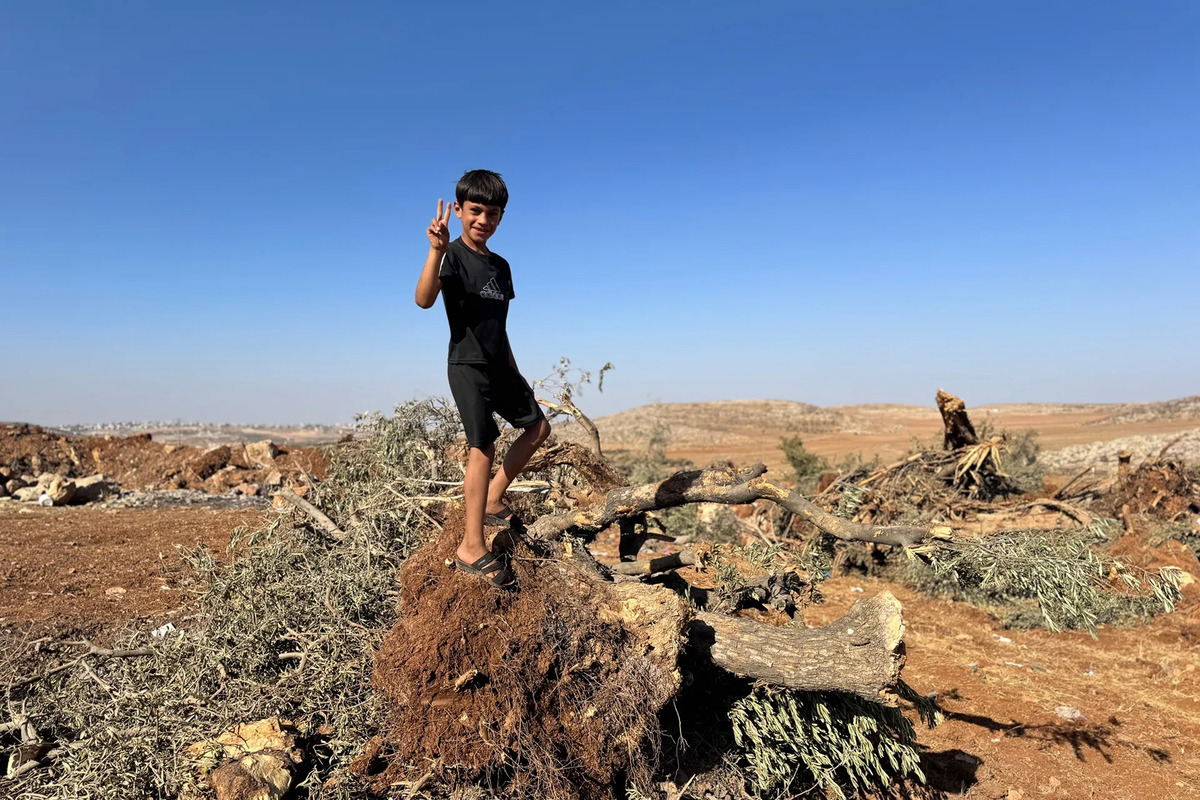







The loss suffered by the Palestinians from the village of al-Mughayer, northeast of Ramallah, was devastating when the occupation bulldozers came in late August and destroyed thousands of olive trees, depriving dozens of families of their livelihood and one of the most important factors for their steadfastness and resilience.
In the darkness of night, the efforts of five years put in by Palestinian Nabil al-Nawaj'a were lost when he saw the fruits of 150 grapevines, which were uprooted by settlers from their roots near the municipality of Yatta, south of Hebron, last month.
What happened in al-Mughayer, although shocking in its scale, is happening every day in the occupied West Bank as part of a genocide being perpetrated by the occupation army since 1967 against trees and agricultural fields, considering them one of the most prominent factors for the Palestinians' stability in their land.
According to experts, millions of Palestinian trees in the West Bank, especially olive trees, have been destroyed for ideological motives and security pretexts.
A monthly report by the Palestinian Wall and Settlement Resistance Commission indicates that settler attacks, with the help of the occupation army, resulted in the uprooting, destruction, and poisoning of 11,700 trees in the occupied West Bank during August, including 11,599 olive trees.
Most of these were in the Ramallah and Al-Bireh governorate (10,081 trees), Nablus (658 trees), Jenin (400 trees), followed by Salfit (221 trees) and Bethlehem (140 trees).
According to the commission's reports, the occupation army and settlers have destroyed a total of 126,739 trees since 2017, while official Palestinian data indicates that about 2.5 million trees have been uprooted, about two-thirds of which are olive trees.
In recent years, the tree uprooting operations have been as follows: 2017 (3,260 trees), 2018 (7,000 trees), 2019 (5,019 trees), 2020 (16,507 trees), 2021 (22,108 trees), 2022 (10,291 trees), 2023 (21,731 trees), 2024 (14,212 trees), 2025 (26,611 trees, including 11,700 trees during August).
According to settlement researcher Rajeh Talhama, the occupation authorities promote security justifications or military pretexts or claims of building roads and infrastructure to uproot thousands of trees, while settlers commit their crimes to pressure Palestinian residents to displace them.
Talhama adds that most of the tree uprooting operations this year were carried out 'under the pretext of military necessity,' and legal justifications were provided or the army commander deemed it a military necessity, including ancient olive trees.
He continued that among the justifications announced was that the presence of trees poses a threat to the security of the occupation, resulting in the uprooting of thousands of them, the latest being in the village of al-Mughayer, northeast of Ramallah.
In parallel with the efforts to displace and forcibly transfer Palestinian citizens in the West Bank alongside the genocide in the Gaza Strip, Talhama noted the presence of operations to replace trees with alternatives.
He clarified that settlers and the army uproot Palestinian trees such as grapes, olives, and almonds, and in return, they plant the needs of the settlements with the same varieties.
He pointed to the role of pastoral settlement in destroying trees 'as herds of sheep and cows are released into Palestinian fields to eat the leaves, leading to their damage.'
He mentioned that 40 pastoral outposts perform this role in the Hebron governorate alone, and similar attacks are repeated in other governorates of the occupied West Bank.
In exchange for controlling the land under various titles and providing food security for the settlements, Palestinians are pursued in their daily sustenance, according to Talhama, who emphasized the importance of agriculture in the lives of Palestinians as a cultural heritage and a factor for stabilizing citizens in their lands throughout the ages.
Licensed institutions, for his part, says Hassan Breijieh, director of the International Law Department at the Wall and Settlement Resistance Commission, that the occupation and settlers do not view trees merely as enemies, but that the 'cultivated land irritates them, and they seek to control it.'
He explained that barren land or land that is cultivated seasonally is easier to control through an old Ottoman law that allows the seizure of uncultivated land and its conversion into state land, or a military order is issued to confiscate it, even though the occupation itself




Share your opinion
Genocide of a different kind.. Why does the occupation target the trees of the West Bank?