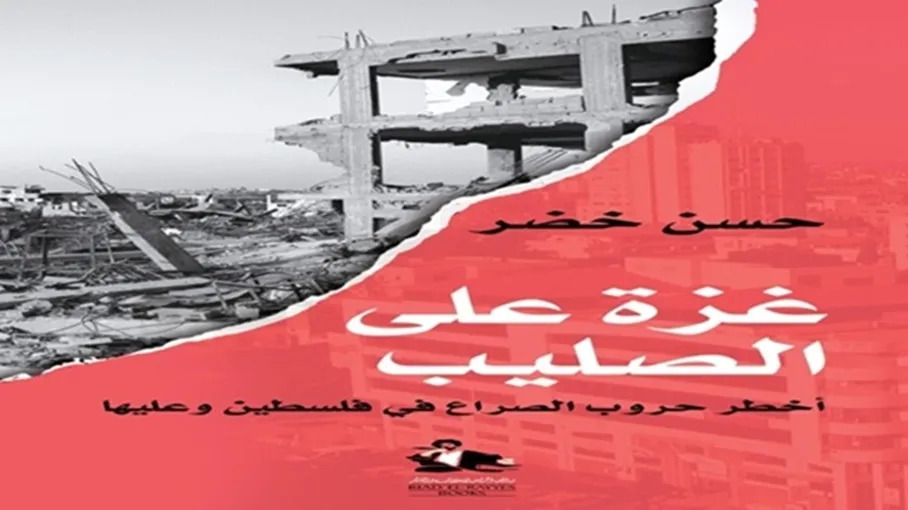







In his book "Gaza on the Cross," Palestinian writer Hassan Khadr presents a deep analysis of the Israeli war on Gaza, seeking to understand the implications of this war from a perspective that goes beyond daily events. Khadr discusses in his book how this war is not merely a military conflict, but part of a larger narrative war, where the occupation seeks to impose its own narrative.
Khadr emphasizes that judging the war in terms of gain and loss at the present time is impossible as long as the fighting continues. He points out that the Palestinians, who are the victims, must avoid adopting a narrative that places the responsibility for what is happening on them, which is what the "powerful" seek to justify their crimes.
Khadr describes the events of October 7 as an unprecedented event, where the weakness of the occupying state was revealed in front of an armed organization, leading to significant embarrassment for it. He considers this event a historical humiliation for the occupying state, which believed it was invincible.
Khadr notes that the occupation realized after the "deluge" that the apartheid system imposed on the Palestinians was no longer sufficient, and that radical steps must be taken, such as the displacement of populations and the destruction of their means of livelihood. These options have become part of the agenda as a result of the current war.
Khadr also addresses how this war comes in the context of failed American wars aimed at re-engineering the regional system after the events of September 11. He points out that these wars have led to the dismantling of states and the fragmentation of societies, creating a state of chaos in the region.
Khadr asserts that the unprecedented Israeli violence in the war on Gaza is not only motivated by revenge but also to emphasize the occupation's ability to impose a regional security system that marginalizes the Palestinian issue.
Khadr discusses the importance of the case brought by South Africa against the occupation before the International Court of Justice, considering it a historic event that opens new horizons for the Palestinians. This event reminds them of the importance of cultural, political, and diplomatic activism.
Khadr reviews how the Israeli narrative has attempted to reduce the causes of the war to a conflict between two states, which overlooks the objective realities of the occupation and the suffering of Palestinian refugees. He points out that the biased Western reactions in favor of the occupation reflect hidden desires among some Arab elites.
Regarding the "next day" scenario of the war, Khadr sees that the declared goals do not match the actual results, opening the door to multiple possibilities. He notes that the idea of the occupation has been significantly damaged, and the Palestinian issue has become a central issue in the twenty-first century.
The wars of decolonization are not measured by the firepower of the colonizer and the colonized, but by what has accumulated or diminished from the moral balance.

Share your opinion
Gaza War.. The Collapse of the Israeli Narrative and the Rise of the Palestinian Issue.. A New Book