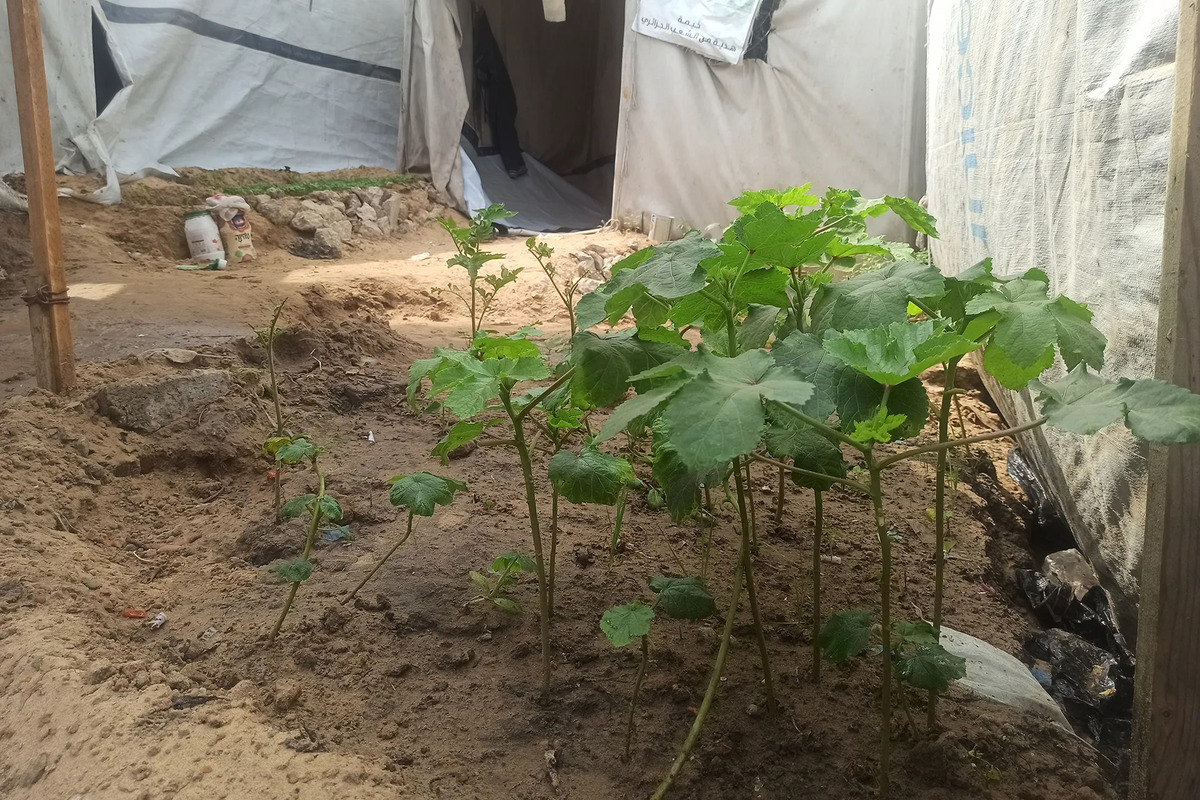







Adel Al-Jabali, displaced from the city of Rafah, never thought that the day he left his home would carry seeds in his pocket instead of keys. The day of departure was heavy, dust filled the sky, and the sound of shelling followed him even as he crossed the crowded streets. He took with him his memories and his nine family members, leaving behind a small garden that filled their home with the scent of mint and fresh tomatoes.
In the new displacement camp in the Mawasi area of Khan Younis, Adel stood in front of a barren piece of land, surrounded by tents on all sides, wondering, "Can life return here, even with a single vegetable seed?" From the first day, he decided to start from scratch. He had no agricultural tools or enough seeds, but his will was present.
He collected empty aid boxes and filled them with soil, planting what remained of the dry seeds he had kept before. He knew it was a gamble, but his sense of responsibility towards his children pushed him to continue. Amid the tents, green seedlings of okra and arugula sprouted, planted by a Palestinian displaced person.
The area was not large, only 70 meters around the tent, but over time it transformed into a small green patch amidst the white desert of stretched fabric. He planted molokhia, potatoes, tomatoes, eggplants, cucumbers, green peppers, and even some corn, arugula, and parsley.
Securing seeds was another dilemma. The markets were nearly empty, and what was available was sold at prices beyond his means. He resorted to drying some ripe vegetables to obtain their seeds. He recycled plastic bottles and tin cans to make small pots that could be easily transported if he had to flee again.
He also planted flowers and cacti, their bright colors wiping away some of the sadness from the faces of the children passing by. Even his wife, who had been suffering from depression since they lost their home, found in this green spot something resembling therapy.
Water was another challenge; after the networks were destroyed, Adel had to walk long distances carrying buckets to water his plants, sometimes mixing vegetable wash water with rainwater. As for fertilizers, they were a distant dream, as their absence delayed the ripening of the fruits and made the harvest of lower quality.
However, he feels that this small garden is not just a source of food, but a message of resilience saying that a Palestinian can grow life even in the heart of destruction. The scene in the west of the Gaza Strip was different before the war. Fields of tomatoes, cucumbers, and potatoes stretched to the horizon, and greenhouses reflected sunlight over lush plants.
But today, thousands of tents have replaced them, extending like a vast fabric city, covering what remains of the green. The war of extermination systematically devoured agriculture. According to the Food and Agriculture Organization (FAO), only 4.6% of the Gaza Strip's land was arable last March, while more than 90% of the areas were out of service.
The displacement of hundreds of thousands to these lands caused them to lose their function as the food basket for the region. With the halt of production, vegetable prices in the markets soared to unprecedented levels, making the purchase of a kilogram of tomatoes or cucumbers a luxury that most residents could not afford.
On a gray morning, Hossam Al-Buhaysi (37 years old) set out on a quest for cheap vegetables. He thought that the greenhouses in the Mawasi area of southern Gaza were still producing what could sustain his family, but the reality was shocking. When he arrived, he found himself in front of a sea of displaced persons' tents.
The greenhouses he had frequented for years were destroyed by the occupation or neglected until they became lifeless structures. Al-Buhaysi stood in shock, remembering the days when he would enter these greenhouses, smell the fresh tomatoes, and buy what he needed at a reasonable price.
Now, he found nothing but white fabrics fluttering in the air and children playing on land that was once fertile. He says, "I came to check on the greenhouses, and suddenly I found a country without crops; the occupation destroyed the majority of the agriculture, and instead of fertile land, I found people and tents."
In a small tent in the southern sector, farmer Mahmoud Hijazi, who owned 5 acres of tomatoes in modern greenhouses near the Mawasi area of Rafah, speaks in a hoarse voice about the day the Israeli bulldozers came and leveled everything to the ground.
His project, built over decades of effort, collapsed. He stored in his tent


Share your opinion
When Gaza's food basket turns into extended tents for the displaced.