






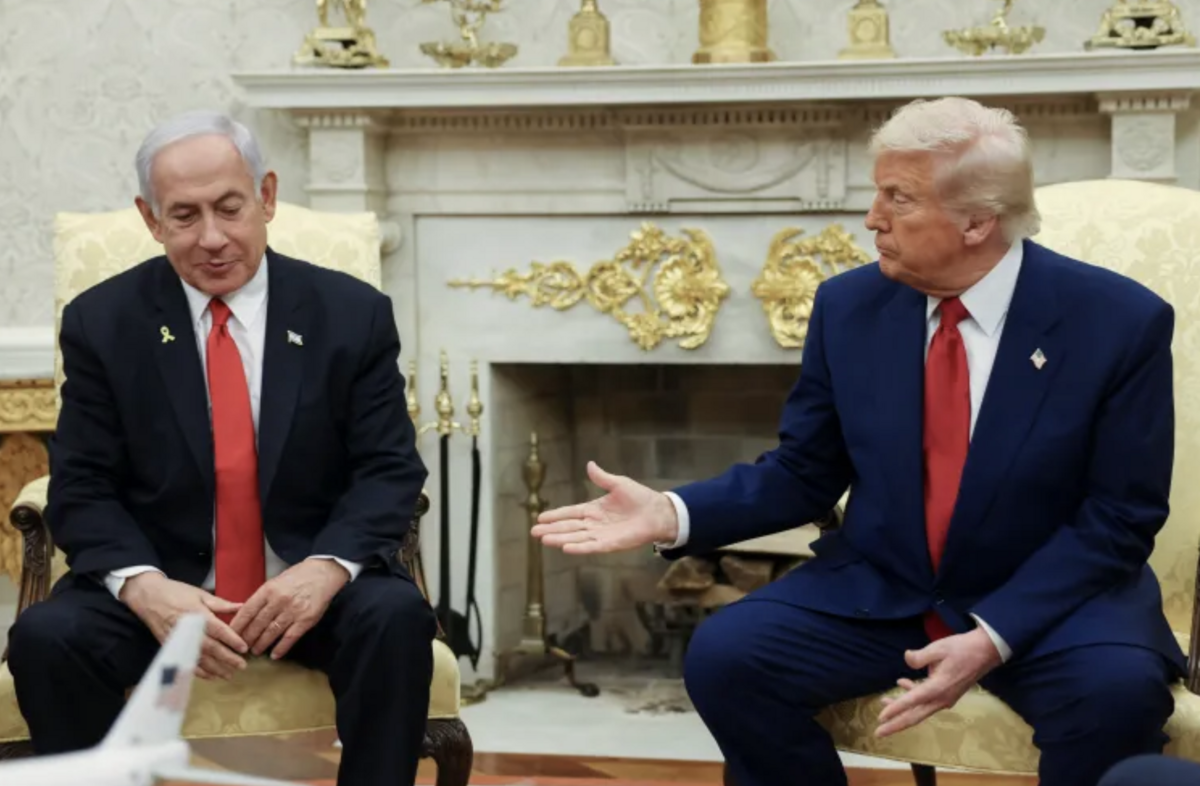
Haaretz reported that images of Israel's starvation campaign in the Gaza Strip, which reached US President Donald Trump via Fox News, forced Israeli Prime Minister Benjamin Netanyahu to reverse the policy his government had pursued over the past several months.
In an article on Israel's current situation, the newspaper's prominent military analyst, Amos Harel, said that Netanyahu has succumbed to American and international pressure, most notably from President Trump, who can no longer ignore the images of starving children, leading to a sharp shift in Israeli policy toward the Gaza Strip.
He pointed out that the government, which until recently insisted on maintaining complete control over aid and preventing its entry except through military distribution centers under its supervision, was recently forced to open humanitarian corridors, allow airdrops of aid, and begin coordinating with international organizations such as the United Nations and the Jordanian and Egyptian Red Crescents.
Harel asserts that this shift in Israel's position, even if tactical, reflects a disastrous failure in the policy Israel has been promoting over the past months as a means of pressuring Hamas. However, the policy has ended in a humanitarian catastrophe that has shaken Israel's image globally and prompted even its closest allies to take action.
In an attempt to explain the US president's position, which has remained aligned with Israeli policies, Harel says, "In recent days, Trump has seemed confused and incoherent in his stance on the war on Gaza. At one point, he threatens Hamas, saying its leaders 'want death,' and at another, he demands that Netanyahu stop the humanitarian catastrophe in the Strip. However, he can no longer ignore the horrific images of starving children in Gaza."
"Although Trump is known for his impatience with intelligence reports, he is deeply influenced by what is shown on his favorite network, Fox News," he says. "When the network broadcast gruesome images from Gaza, he began to intervene directly, sending messages to Netanyahu demanding urgent action."
contradictory statements
The military analyst believes that Netanyahu believed, after the Knesset's summer session ended, that he was safe from internal pressures and that his government had secured its survival at least until the end of October. However, developments in the Gaza Strip, particularly the famine that had begun to take on a catastrophic character, turned the tables on him.
He explains that Netanyahu makes many contradictory statements to various parties. He reassured extremist Finance Minister Bezalel Smotrich, who had threatened to withdraw from the coalition in protest over Israeli facilitation of aid deliveries to Gaza, that military victory was imminent. At the same time, he gave the families of the captives limited hope of a deal that would include the release of half of the living hostages (at least 10) and some of the bodies (approximately 15).
Harel highlights the contradiction in Netanyahu's promises to his far-right partners that these concessions are temporary, and that he will soon, after "appeasing Trump," return to launching a decisive attack on Hamas. He asks, "Is it possible for Israel to flood Gaza with aid on the one hand while planning a military offensive on the other?"
Harel points out that this contradiction reflects the fragility of the Israeli position, as the government continues to act as if it controls the course of events, while regional and international realities force it to take hasty steps.
He also points to the diplomatic collapse Israel is facing after Britain and France announced their intention to recognize a Palestinian state at the UN General Assembly meeting next September. He considers this a qualitative shift in Western positions due to the Israeli government's disregard for months of international warnings of an impending famine, a claim even confirmed by some retired generals and government ministers.
Has Israeli policy changed?
The military analyst attempts to analyze the Israeli government's current situation, discussing the position of the Israeli Chief of Staff, Eyal Zamir, who says he supports the prisoner exchange deal and believes the army is capable of containing the threat emanating from Gaza without completely crushing Hamas.
Harel points out that some within the army leadership believe that the experience of southern Lebanon with Hezbollah—which remains stronger than Hamas despite its recent defeat—can be replicated in Gaza: a military presence, with targeted attacks, without full control of the Strip.
If the army's vision is not taken into account, according to Harel, Zamir prefers to pursue a strategy of attrition to besiege a quarter of the Gaza Strip, where Hamas's remaining power is concentrated. Harel also cites a deliberate leak earlier this month about the army's intention to call up reserve fighters for 74 days, as a sign of the high human cost of any comprehensive ground invasion of Gaza.
Harel, on the other hand, highlights the contradictions within this government, which are deepening its crisis. Far-right parties within the government, such as those led by Smotrich and Itamar Ben-Gvir, continue to adjust the war's objectives and timing to serve long-term agendas. He comments, "They came to displace and settle, and they will stay for the eternal war."
He believes that the war on Gaza has become a cover for annexation policies in the West Bank and the relaunch of plans for a judicial coup.

Share your opinion
Haaretz: The starvation policy is collapsing, and Netanyahu is yielding to American and international pressure.