






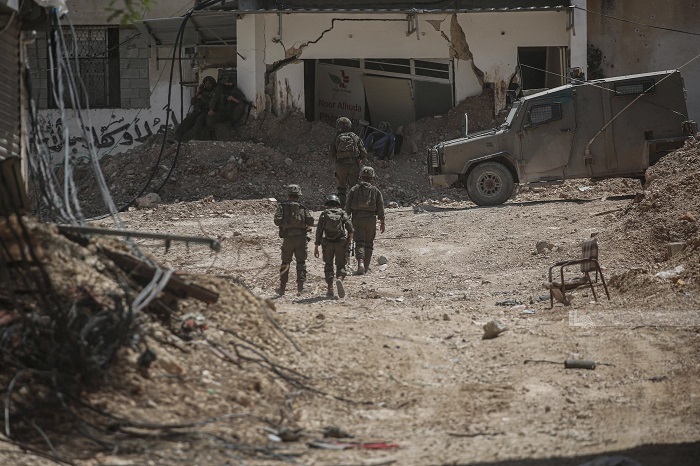
The Israeli occupation forces continued their aggression on the city of Tulkarm and its camp for the 154th consecutive day, and on the Nour Shams camp for the 141st day, amid military reinforcements and ongoing escalation.
According to local sources, the city and its suburbs witnessed intensive movements by occupation forces and infantry units on Sunday, who were stationed on the main street of the Aktaba suburb east of Tulkarm. They set up a flying checkpoint, stopped and searched vehicles, checked the identities of their passengers, and detained a number of vehicles.
The occupation forces also raided the Dhnaba suburb east of the city, amid extensive searches, and detained a number of young men after raiding their homes, for long hours and taking them with them, before releasing them later. Among them were identified: Amr Abbas, the brothers Yazan, Muhammad, and Zein Al-Qassem, and Mahmoud Nabhan Odeh.
Meanwhile, the occupation forces continue to impose a tight siege on the Tulkarm and Nur Shams refugee camps and their surroundings, with infantry units and military vehicles deployed in alleys and entrances, preventing residents from reaching their homes or checking on their property, amid direct gunfire targeting anyone approaching the area.
Over the past week, Nour Shams camp witnessed the widespread demolition of dozens of buildings and residential units, completely destroying them. The neighborhoods of Al-Manshiya, Al-Maslakh, Al-Iyada, and Al-Masjid were also affected.
Over the course of two consecutive weeks, more than 50 buildings were demolished in Tulkarm camp, affecting the neighborhoods of Balawneh, Akasha, Al-Nadi, Al-Sawalmeh, Al-Hammam, Al-Madaris, and their surroundings.
This ongoing escalation comes as part of a plan announced by the occupation authorities last May to demolish 106 buildings in both camps, including 58 buildings in Tulkarm camp alone, comprising more than 250 housing units and dozens of commercial establishments, in addition to 48 buildings in Nour Shams camp, under the pretext of opening roads and changing geographical features.
The escalation has led to the forced displacement of more than 5,000 families from the two camps, representing over 25,000 citizens. It has also led to the complete destruction of more than 500 homes and the partial damage of 2,573 others. Meanwhile, the entrances to the two camps remain blocked with barriers, transforming them into almost lifeless areas.
In this context, the occupation forces continue their crippling measures at the city's entrances, especially the Anab military checkpoint east of Tulkarm, which they close almost constantly, preventing vehicles from passing. They also periodically set up a flying checkpoint at the Jabara Bridge near the city's southern entrance, exacerbating the residents' suffering.
Meanwhile, the occupation forces continue to transform Nablus Street into a military barracks, continuing their seizure of a number of residential buildings there, as well as parts of the city's northern neighborhood, specifically the one opposite Tulkarm refugee camp, after forcibly evacuating its residents. Some of these neighborhoods have been under occupation control for more than four months, accompanied by the deployment of heavy machinery and bulldozers in the surrounding areas.
This street, which serves as a link between the Tulkarm and Nur Shams refugee camps, has also suffered significant damage due to earth mounds placed by the occupation forces several months ago. The occupation forces also maintain a heavy presence, erecting flying and surprise checkpoints, which impede vehicle movement and exacerbate the suffering of civilians.
The ongoing aggression has so far resulted in the deaths of 13 civilians, including a child and two women, one of whom was eight months pregnant. Dozens of people have been injured and arrested, and widespread destruction has affected infrastructure, homes, shops, and vehicles.


Share your opinion
The occupation continues its aggression on the city of Tulkarm and its two camps for the 154th day.