






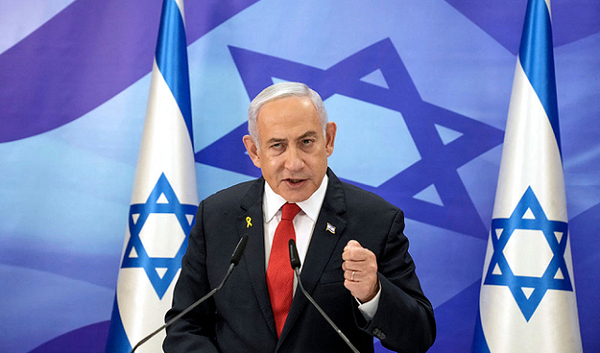
Israeli Prime Minister Benjamin Netanyahu's appointment of David Zinni as the new head of the Shin Bet security service on Thursday sparked widespread controversy in Israeli political and security circles, particularly within the military leadership, which was not previously informed of the move.
IDF Chief of Staff Eyal Zamir was surprised by the announcement of the appointment, which was made without coordination with him. He was notified only three minutes before an official statement from Netanyahu's office was issued, a move that military officials considered an unprecedented violation of norms.
Following this, Zamir held a private meeting with Zinni this morning, which Israeli media described as a "clarification meeting," amid reports that direct communication channels had been opened between Netanyahu and Zinni in recent days without the knowledge of the Chief of Staff.
Military sources stressed that the appointment of a currently serving officer to head the Shin Bet required the approval of the Chief of Staff. According to a military source, the decision was "made behind the back of the Chief of Staff," which was interpreted as a deliberate overreach by Netanyahu.
Following the explanatory meeting, the army issued a statement stating that Zamir met with Zini, and during the meeting, they agreed to end the latter's military service in the coming days. The statement emphasized that "the Chief of Staff clarifies that any communication between army officers and the political leadership requires prior approval from the Chief of Staff."
Political and electoral calculations
In this context, Amos Harel, a military analyst for Haaretz, believed that the surprise announcement of Zinni's appointment was intended to achieve two political goals for Netanyahu: escalating his campaign against the Supreme Court and the attorney general, on the one hand, and appeasing his right-wing base, on the other. He described the move as an attempt to score "two points at once."
Harel noted that the appointment came one day after the Supreme Court ruled that the dismissal of current Shin Bet chief Ronen Bar was unlawful and tainted by a potential conflict of interest, and also after the Attorney General announced that Netanyahu was not authorized to appoint a successor.
According to Harel, Zinni, who had never held senior intelligence or administrative positions, expressed hardline positions during internal army leadership meetings during the war, preferring "defeating Hamas" to concluding a prisoner exchange deal. He added, "Zinni is known as a brave field officer, but he lacks the professional qualifications required to head the Shin Bet. He is viewed as a tough-minded figure who does not tolerate complexity."
Harel believed that the appointment could serve the Israeli right's agenda in the upcoming elections, given attempts by those close to Netanyahu to influence the integrity of the electoral process, particularly through potential plans to exclude Arab parties or discourage Palestinian citizens of Israel from voting. He emphasized that "the head of the Shin Bet lacks a firm institutional commitment that would prevent him from intervening or turn a blind eye to these practices, especially given his presumed loyalty to Netanyahu."
Harel noted that Zinni, a settler in the occupied Golan Heights, holds clear ideological leanings linked to the religious-nationalist movement, raising questions about his suitability to lead a sensitive security agency like the Shin Bet. He said Zinni is a "black and white man," adopting strict positions and living by religious edicts issued by his rabbis, without showing flexibility or doubt.
Harel cast doubt on Zinni's ability to extricate the Shin Bet from its "deep crisis," noting that "the agency has witnessed massive upheavals recently, most notably the October 7 fiasco." He considered that "it is unlikely that Zinni's appointment, under these circumstances, will contribute to the restoration of the Shin Bet." He added that "it is doubtful that he is the person capable of preserving what remains of Israeli democracy at a time when Netanyahu and his entourage are waging an open war on its institutions."
Absolute loyalty to Netanyahu
Yoav Limor, a military analyst for the Israeli newspaper Israel Hayom, considered the appointment to reflect a bias toward Netanyahu's personal and political interests at the expense of the state's, writing: "Zinni lacks any experience in managing complex agencies or expertise in the world of intelligence. There is only one thing that qualifies him to head the Shin Bet: his absolute loyalty to Netanyahu."
Limor added that Netanyahu's entourage had previously attempted to push Zinni to become Chief of Staff, and when that failed, they sought to move him to head the Shin Bet as a "safe and secure" option in light of the sensitive issues surrounding Netanyahu, such as the prisoner exchange deal and investigations into Netanyahu's associates.
Limor considered this appointment to indicate a dangerous shift in the Shin Bet's role from an independent security agency to a tool in the hands of the prime minister. He noted that Zinni, during the presentation of the war plans to army commanders, opposed prioritizing the return of prisoners, preferring to focus on "crushing Hamas," which, according to Limor, portends serious repercussions for the fate of prisoners held in Gaza.
He concluded by saying, "This is an unreasonable appointment by all standards. It was made despite a Supreme Court ruling and in clear violation of the Attorney General's instructions. The result is a further erosion of state institutions," amid warnings that the appointment could drag Israel into a new and worsening constitutional crisis.
ongoing governance crisis
Yedioth Ahronoth political analyst Nahum Barnea viewed the appointment from the perspective of Israel's ongoing governance crisis, writing that Netanyahu is acting in the style of Donald Trump and wishes he had similar powers to fire and appoint officials without oversight.
Barnea said that Netanyahu's decision to appoint Zinni, despite the court's ruling, represents a blatant disregard for the law and inflames a constitutional crisis that the court had begun to calm.
He pointed out that the Shin Bet is engaged in investigations targeting people close to Netanyahu, and that the court deemed this sufficient reason to prevent him from appointing a new head of the agency. He said, "Everyone is in a conflict of interest now, and what is required is the appointment of a professional and impartial figure as soon as possible."
Barnea concluded by warning that continuing on this path could deepen the rift within the security and judicial institutions and erode public confidence in them.
Netanyahu defends Zinni's appointment: "It's a top security need."
Following Zamir's meeting with Zinni this morning, the Prime Minister's Office issued a statement emphasizing that "the prime minister is responsible for the nation's security, especially during a multi-front war," and stating that "it is inappropriate to simply appoint an acting head of the Shin Bet in the midst of a war."
The statement read, "This is a top-tier security need, and any delay threatens the security of the state and the safety of our soldiers." It added that the current Shin Bet chief, Bar, "will end his duties on June 15, and an orderly handover must be completed before that date."
The statement added, "Zini's appointment will be made in accordance with the law, in two stages: First, the appointment will be presented to the Grunis High-Level Appointments Committee for integrity review, and second, it will be submitted for government approval after the committee's approval."
Regarding the investigations into Netanyahu's associates, the statement noted that they are "being conducted by the Shin Bet and the Israel Police, and are subject to the supervision and oversight of the Attorney General," stressing that "the appointed head of the Shin Bet has no influence over these investigations."
The statement added: "However, to prevent any confusion regarding these investigations, the Prime Minister clarifies that the appointed head of the Shin Bet will not participate in them in any way." The statement concluded by noting that the appointment "is being made for the sake of state security, and in accordance with Section 3(a) of the Shin Bet Law, which stipulates that the head of the agency is appointed by the government upon the proposal of its head."




Share your opinion
Israeli Analysis: Netanyahu Appoints Zinni as Shin Bet Chief to Serve His Political Calculations