






News report
The Associated Press reported Thursday that three of Israel's allies this week used words like "repugnant" and "brutal" to describe Israel's actions in Gaza.
The leaders of Britain, France, and Canada—staunch defenders of Israel's right to respond to Hamas after its October 2023 attack—are now expressing their dismay at the rising civilian death toll in Gaza and the months-long blockade of supplies that has led to warnings of impending famine.
According to experts, although their rhetoric is remarkably strong, it does not mean taking strict measures.
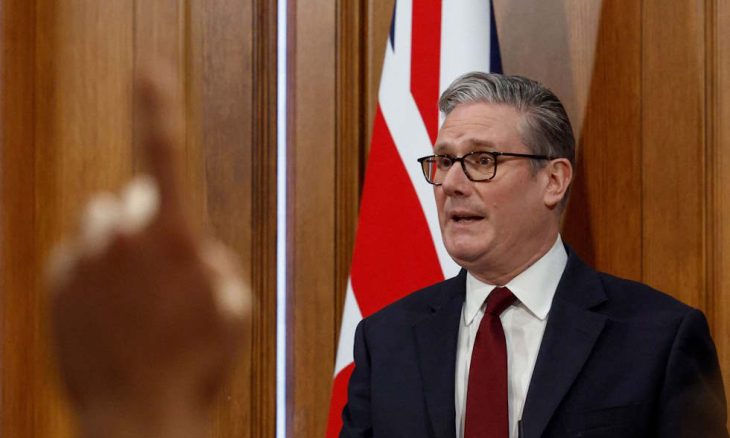
British Prime Minister Keir Starmer, French President Emmanuel Macron, and Canadian Prime Minister Mark Carney described the renewed Israeli assault on Gaza after a two-month ceasefire as "totally disproportionate." They threatened to take "concrete action" if Prime Minister Benjamin Netanyahu's government did not halt the offensive and lift restrictions on humanitarian aid.
They also condemned some of the language used by members of the Israeli government, which suggested that destroying Gaza would force Palestinians to leave, describing it as "repugnant."
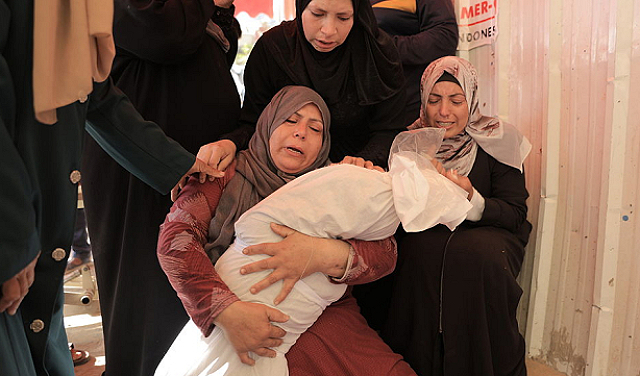
Starmer said he was "horrified" by Israel's escalation of the conflict, which has left more than 53,000 dead in Gaza, more than half of them women and children, according to local health officials, whose tally does not differentiate between combatants and civilians.
British Foreign Secretary David Lammy described Israel's actions in obstructing aid to Gaza and renewing its military offensive as "barbaric," while another British minister, Jenny Chapman, called the move "repugnant." French Foreign Minister Jean-Noël Barrot said Israel's "blind violence" had turned the Palestinian territories into "a place of death."
Longtime US allies have increasingly united since President Donald Trump shook up the global order by imposing sweeping tariffs, disparaging the European Union—of which France is a key member—and expressing his desire to make Canada the 51st US state, experts say.
Bronwyn Maddox, director of the London-based Chatham House think tank, said anger over the war in Gaza was growing - including from some officials in the United States, Israel's strongest backer.
The statement by Britain, Canada, and France may have been "politically accelerated by a perception that the United States is changing slightly, and that Donald Trump himself has become more stringent toward Israel, particularly in demanding that it allow in more aid," according to the agency.
There are doubts that these countries will follow up their words with concrete actions.
Britain has suspended trade agreement talks with Israel and recalled its ambassador to the UK, Tzipi Hotovely, in an attempt to intensify pressure on the Netanyahu government. The UK has also imposed sanctions on three settlers in the West Bank, two illegal outposts, and two organizations that "support violence against the Palestinian community."
Maddox said the limited sanctions announced by the UK would have little impact and were "at the bottom of the scale of possible steps."
Canada and France have not announced any specific new measures.
Carney's office, which visited Trump at the White House, said the government is "evaluating its options in consultation with its partners." Last year, Ottawa imposed sanctions on extremist settlers in the West Bank and suspended arms exports to Israel.
Leaders had to carefully balance their words and actions in the face of competing pressures. No one described Israel's actions as genocide, despite strong pressure from Palestinian supporters to do so.
The agency says, "Macron must balance the feelings and anger that the war has aroused in France's Jewish and Muslim communities, both of which are the largest in Western Europe." David Rigolet-Rose, a researcher at the French Institute for Strategic Analysis, said that France is trying to maintain a balance between the two communities, but is sometimes in a precarious equilibrium.
He said that since October 7, "this oscillation between the two parties has been interpreted as a search for a balance point that is difficult to find."
France also sees itself as a defender of international law, and it has become difficult for the government to ignore accusations of Israel's conduct in Gaza, especially given its pressure on Russia to respect international law in Ukraine, according to experts.
Starmer, a former human rights lawyer, claims to place great importance on respect for international law.
Starmer's Labour Party has faced pressure from Muslim voters, who have long supported the party in large numbers. Labour lost several seats in last year's national elections to pro-Palestinian independent candidates, after Starmer initially refused to call for an immediate ceasefire in Gaza.
The Financial Times reported that the United Kingdom is considering imposing a travel ban and asset freeze on two far-right members of Netanyahu's government: Finance Minister Bezalel Smotrich and National Security Minister Itamar Ben-Gvir.
Starmer's spokesman, Dave Paris, did not comment on the report, but said: "We always review our sanctions regime," according to the newspaper.
The targeted sanctions imposed by Britain, such as its suspension of trade talks with Israel, are largely symbolic. The larger European Union is also reviewing its long-standing trade agreement with Israel.
"This will not change Netanyahu's policy, but the entire European Union is signaling some form of challenge to the Israeli government," French analyst Rigolet Rose told the newspaper.
But the 27-member European Union is far from united. Germany, a staunch ally of Israel, has not joined its neighbors in escalating criticism. It has stuck to the line of recognizing Israel's right to self-defense, criticizing its behavior in Gaza, and pressing for humanitarian aid. But it has avoided harsh rhetoric.
Former French Prime Minister Dominique de Villepin said the three countries' statement, with its strong language and few actions, demonstrates international impotence in the face of Israel's actions. He called for the suspension of European trade agreements with Israel, the imposition of an arms embargo, and the filing of charges against Israeli political and military leaders at the International Criminal Court.
"What will it take for European and Western leaders to take practical action? There are war crimes, crimes against humanity, and there is a risk of genocide. We cannot wait," he told France Info radio.

Share your opinion
Israel's allies are making strong rhetoric on Gaza, but action so far has been limited.