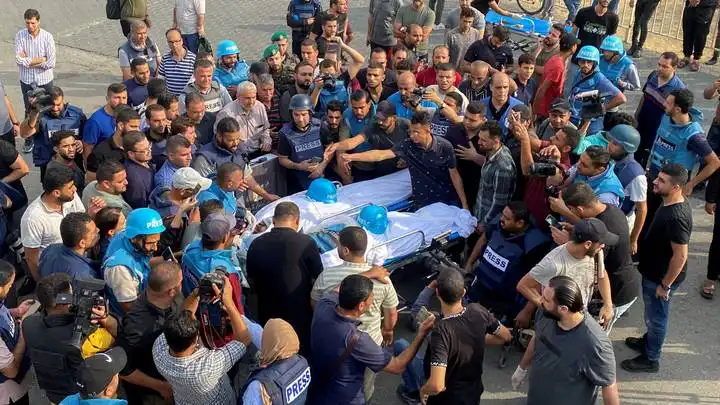







On a new morning heavy with the smell of gunpowder and blood, Palestinians woke up yesterday, Sunday, to a new tragedy after Israel targeted five journalists with its war machine at once. Despite this, the scene was not unfamiliar to Gaza, as the occupation has become accustomed to killing journalists in the Strip since the beginning of its war on it 19 months ago.
These five journalists were not just numbers added to the growing list of martyrs. They were witnesses to the massacres and narrators of the stories of the exhausted people under the rubble, while at the same time, like them, trying to save themselves and their families, day by day.
Al Jazeera's correspondent reported that Israeli airstrikes targeted, at dawn on Sunday, journalists Aziz al-Hajjar, Abdul Rahman al-Abdallah, Nour Qandil, her husband, journalist Khaled Abu Seif, and Ahmed al-Zinati, resulting in their deaths along with several members of their families.
journalist engineer
Journalist Ahmed Al-Zinati (35 years old) was an ambitious young man who defied the conditions of the siege and unemployment, and moved from his primary specialization in civil engineering to the world of journalism, after also obtaining a master's degree in business administration with distinction, ranking first in his class.

His close friend, Siraj Abu Hamam, recounts that after the doors to engineering jobs were closed to him due to the blockade, Al-Zinati turned to journalism, working with several organizations, including the Siraj Media Network.
He also wrote for foreign blogs and websites, most notably Tumbler, documenting with audio and video all the humanitarian crises and daily stories of struggle in the Gaza Strip. His blog, which is followed by thousands of people around the world, was a mirror that conveyed the suffering of the people of Gaza in other languages.
Recently, he focused on documenting the famine and humanitarian catastrophe in Gaza, and was deeply affected by the massacres and bombing. He could not bear the news of bloodshed and destruction, and his main concern was to stop this cascade of genocide, Abu Hamam says.
In the first month of the war, Al-Zainati's house in Khan Yunis was subjected to heavy shelling, which led to the martyrdom of his two children, Musa and Khaled, and the serious injury of his wife, while his son, Mohammed, survived. Just four months ago, he was blessed with a new child, whom he named "Khaled" after his lost child. Then, the occupation raids returned again, killing Ahmed, his wife, the pharmacist "Nour Al-Huda Al-Madhoun", and their infant, Khaled.
Abu Hamam says, "Ahmed was a model of hard work and was preparing to earn a doctorate." Mahmoud Al-Aila, another friend of Ahmed's, recounts, "The martyr was keen to expose the occupation's crimes through his work in monitoring and analysis," adding, "He was adept at analyzing open sources and was adept at collecting and dismantling evidence."
The couple and their baby girl
Journalist Nour Qandil and her husband, journalist Khaled Abu Seif, have set an example of professional and marital partnership. Both studied journalism and worked together as a team, filming, editing, and producing documentaries as freelance journalists, covering and documenting human stories for various media outlets.

Muhammad Qandil says that his sister Nour was energetic, passionate, and ambitious, tireless. In addition to her work as a freelance photographer and video editor, she worked in the media and public relations department at Yaffa Hospital in Deir al-Balah until her martyrdom.
Nour and Khaled welcomed their only child four months ago, naming her "September of Peace," coinciding with the negotiations that led to the latest ceasefire in January.
According to Mohammed, the couple were preparing to launch a media project on social media platforms and had recently purchased a laptop to use for editing. However, the Israeli bombing did not allow them time, and they were martyred along with their little girl, burying with them a dream that never saw the light of day.
A friend of the martyr, journalist Diana Al-Maghribi, recounts that she was an active and calm coordinator for the "Al-Thuraya" Media and Communications Café (a non-governmental organization) since 2017. She was ranked first in her class in media studies at the Palestine Technical College, and was known for her "politeness, elegance, and quiet accomplishments," as well as her "deep interest in national issues and resistance."
Journalist and relief worker
Journalist Basil Al-Saqa talks about his friend, the late journalist Abdul Rahman Al-Abadlah, who was born in 1994 and held a diploma in journalism. He said that he worked as a freelance photojournalist and founded an online platform called "Hona Al-Watan," through which he published news, reports, and documentary material.

Al-Abdallah was married and had four children. Despite receiving threats from Israeli intelligence to stop publishing, he continued his work without hesitation. He was targeted by shelling near his home in the town of Al-Qarara, north of Khan Yunis.
Abdul Rahman was not only a journalist, but also a humanitarian. He ran a camp for displaced people, providing them with a hospice, food parcels, and drinking water.
Aziz and family
At Al-Aqsa University, Aziz Al-Hajjar studied journalism and began his career there in 2015, alternating between official and freelance work. He worked for a period with Palestine TV and with various institutions as a freelance journalist.

His friend, Tariq Al-Daqs, says that Aziz was passionate about uncovering the truth and exposing the crimes of the occupation. In addition to his journalistic work, he produced dramatic works for Al-Aqsa TV.
Aziz's martyrdom was horrific. He was killed along with his wife and two of his three children, while his youngest daughter was seriously injured.
Trial of the perpetrators
For his part, Tahseen Al-Astal, deputy head of the Palestinian Journalists Syndicate, said that the massacres against journalists have become systematic, and that the occupation is killing them without deterrence or international accountability.
He stressed that the union has communicated with the International Federation of Journalists and all international parties, demanding the implementation of UN Security Council Resolution 2222, issued in 2015, which stipulates the protection of journalists and the prosecution of occupation leaders before the International Criminal Court.
According to the Syndicate's statistics, the number of journalists killed in the war on Gaza has risen to 217, most of whom were performing their professional duties in a last-ditch effort to convey their people's voice to the world.
Share your opinion
Stories of 5 journalists killed by the occupation in Gaza in one day