






The story of traditional Palestinian glass is one of the very old stories. The glass industry began in Palestine since the era of the Romans and was prevalent in the era of the Phoenicians and continued to this day. It is considered one of the most important and prominent traditional crafts that are on the verge of extinction despite their scarcity and beauty. You can find an analogue with its own beauty that cannot be canceled, as it is an integral part of the Palestinian heritage throughout the geography.
Despite the lack of those who study this type of art, “the art of glass making,” and they are few, there are still conscious youth who are fully aware of the importance of this traditional craft and how to build on it and develop it with the methods of development and new technology and introduce the spirit of modernity to it, as well as work to embody reality in it through the creation of pieces of art Tell stories and embody social issues.
Abeer's story with glass
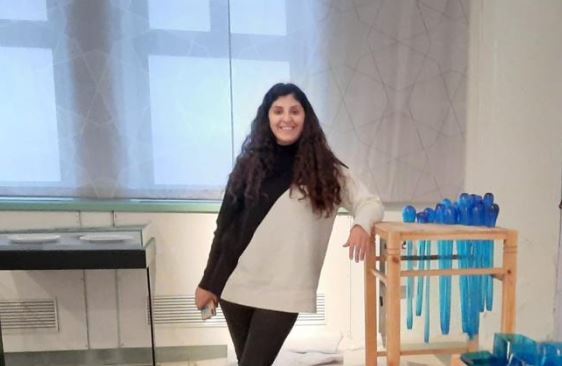
The young woman, Abeer Al-Najjar, preferred to be distinguished in choosing her profession, which despite its difficulty and the hardship and effort it bears to work in it, she made it professional and created a distinctive art by making glass manually, through the “Blazing” glass industry project, to restore interest in this industry that declined a long time ago to stand in front of the furnace And she makes creations of glass in her attempts to revive the art of forming glass in Palestine, and to work on teaching and spreading this craft because of her admiration and strong love for this art.
The young woman, Abeer, says: My primary goal is primarily to raise community awareness of the importance of craft work and to save the profession of hand-made glass art from extinction, which was confined to the city of Hebron. This is what prompted me to learn it, as I studied and learned glass design and art education at a specialized academy in the occupied city of Jerusalem, in order to revive this art and work in it tirelessly.
Abeer adds: This type of industry is in addition to being a traditional industry, as it is an environmentally friendly industry. I design and make special designs out of glass by working with hot glass and not drawing on the glass. As for the furnaces for the manufacture of "melting" glass, the glass begins to melt at a temperature of 1500-2000, and after that I start pulling (glass) out of it, and as for standing in front of the very hot furnace, I am very happy, especially since I hold a solid material and convert it into a soft material that I bend with my hands to shape What I want to get out of it is a masterpiece that dazzles the viewers because of its intense beauty. Despite the fatigue in this profession, the result is worth it.
Her love of working in the glass industry
The glass industry is considered one of the ancient crafts that are inherited by generations, generation after generation, and since people knew how to make glass, they resorted to using it as well as an artistic material. Glass is called art glass.
And about the requirements of this profession, Abeer says: Perhaps one of the most important requirements for working in the glass profession is enduring the hardship of working in front of melting furnaces and providing the creative and artistic spirit that qualifies the worker in this field to acquire molding skills, but unfortunately there is not enough demand to learn this craft, as the number of artists working in it It does not exceed fifteen of those who learn it, and a large part of them are still studying and have not graduated yet, perhaps because this industry is no longer as widespread as before, and most prefer to go to other professions that may be less difficult and more profitable.
And she continues: What I love most about this work is that it is environmentally friendly, as I recycle the glass pieces that I sell, such as broken utensils. I use them by melting them, reshaping them, and adapting them to produce and manufacture a completely new masterpiece. There are pieces that need to work on a very short time, such as five minutes, and other pieces that need work. It has to complete it for five months of continuous work without fatigue, and the most important thing in this work is extreme caution when dealing with heat and furnaces, as well as when blowing, as the temperature may exceed a thousand, and we must exploit this high temperature to shape the glass as we want, and I do not depend only on selling individual pieces as well I do designs for artists.
ambition
When a person knows his true passion, his life turns into a world of pleasure and happiness. Passion is a person’s guide to what he loves, and with it alone he can draw his life as he wants. Behind every successful project is the belief of its owner that it is a door to learning and growth. She believes that working in the glass industry means that things It is constantly changing and evolving, and we must develop ourselves and engage in a work environment that encourages innovation and diligence and encourage others to do what we do.
And about her ambition, the artist Al-Najjar says: I aspire through my project to revive this craft and restore interest in the art of glass to the country because glass was invented in this land, and I seek to develop it through the use of modern and contemporary technologies. The existence of many innovative methods and mechanisms, science is developing, and tools and equipment are changing, so that the artist can express himself through his work with glass, as well as he can highlight societal issues through it, as I work to exploit this material and reduce its properties such as fracture and transparency, and I seek to generate a new generation that learns He loves the art of glass so that this material can come back and live again.
And she continued: I also aspire in the near future to be part of the “Blazing” glass industry project, a small school to teach the art of glass and ceramics using modern technologies and forming them in different forms in design and recycling to produce different arts. Many stem from it, especially since its importance lies in the fact that it is an ancient craft that must be inherited from generation to generation, with the introduction of the spirit of modernity and era in it.
transparent
The artist, Abeer Al-Najjar, who creates stories with her fingers from glass and discusses societal issues that she presents through the art she practices. The issue of violence against women had a prominent role in her work to shed light on it through the “Transparent” project. Art and artists trying to process it and deliver it to the world.
She says: I made different pieces of glass as part of the "Transparent" project to express through it an important issue concerning women, which is the phenomenon of violence against women. He seeks to see its details, instead of discussing them in a systematic, organized and appropriate manner. Therefore, this work was to shed light on the issue and the phenomenon of violence against women in general, and to perpetuate the memory of women who were killed in violent incidents, whether in the Palestinian interior, the West Bank, and Gaza. I have produced pieces of art It aims to raise awareness of the issue of violence against women, and the name of the work was chosen "Transparent" to indicate that our societies ignore this issue, and treat it as invisible.
This is the story of the artist, Abeer Al-Najjar, with traditional Palestinian glass. This craft has existed for thousands of years, and was monopolized by men only because of the hardship and effort it requires. Although it is still practiced to this day, it is threatened with fading, and Abeer seeks to revive this type of art with modern methods and methods. tirelessly, to restore luster to glass and tell the story of Palestine through it.
شارك برأيك
Abeer Al-Najjar.. With her fingers, she revives the art of making glass