





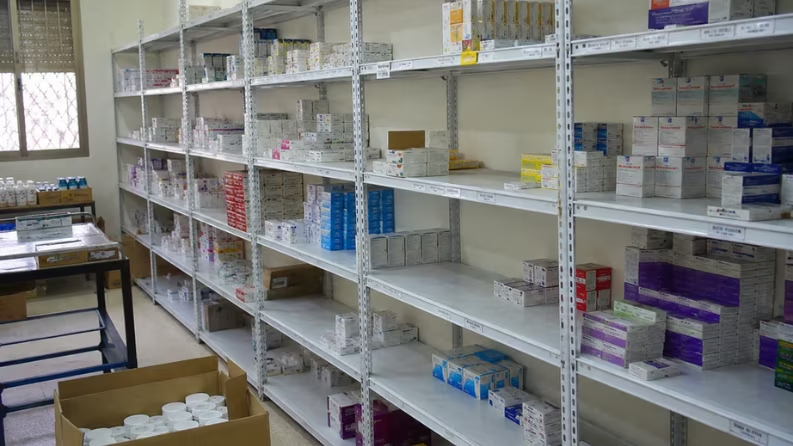
Dr. Muhammad Abu Al-Rub: Financial deficit and health sector strike directly reflected on patients' lives, and efforts are being made to secure urgent support payments. Dr. Yousef Al-Takruri: The continuation of the current situation will lead to a wider collapse of the governmental, private, and non-governmental health sectors, even with temporary solutions. Dr. Ahmed Alian: The syndicate contacted the Union of Arab Pharmacists to explain the extent of the crisis and request support, especially for medicines designated for cancer and dialysis patients. Dr. Muhannad Habash: The pharmaceutical sector faces unprecedented challenges threatening its ability to continue providing medicines and treatments, even with temporary solutions. Dr. Mu'ayyad Afaneh: Technical and temporary solutions are no longer sufficient due to the depth and prolonged nature of the crisis, and limited financial resources restrict addressing the escalating debt gap. Dr. Thabet Abu Al-Rous: The Ministry of Health's debt to pharmaceutical companies and suppliers reaches about 1.3 billion shekels, which has limited their ability to bear further burdens. Firas Jaber: Health has not received the attention it deserves within government spending priorities or its ranking in the general budget, remaining in lower ranks compared to other sectors. Ramallah - Exclusive to "Al-Quds" - The Palestinian health system faces an escalating crisis with the widening scope of shortages in medicines and medical supplies, despite the Ministries of Health and Finance announcing the completion of urgent arrangements to ensure the supply of medicines and medical supplies, at a time when warnings are increasing about the repercussions of this shortage on the ability of hospitals and health institutions to continue providing services to patients. Officials, specialists, and economic experts, in separate conversations with "Al-Quds," indicate that hospitals and healthcare facilities are experiencing unprecedented financial and operational pressures due to the accumulation of financial dues and the decline in the ability to purchase medicines and medical consumables, which has led to the reduction of some treatment services and the delay in providing others, amidst indicators of a decline in the drug inventory of essential and vital items needed by various medical departments. They believe that the current crisis goes beyond being a temporary funding problem, as it is linked to the accumulation of extended financial burdens over years, exacerbated by the continued withholding of clearance funds and the decline in available resources for the health sector. In light of limited alternatives, calls are rising for urgent intervention to provide the necessary liquidity and ensure the continuity of drug supply and protect the health sector from further deterioration. One of the most dangerous financial challenges. The Director of the Government Communication Center, Dr. Muhammad Abu Al-Rub, confirms that the crisis of withholding clearance funds represents one of the most dangerous financial challenges facing the government, explaining that it constitutes about 68% of the total revenues of the Ministry of Finance, pointing out that its continued withholding, as well as Israeli closures and preventing workers from reaching their jobs, directly reflected on a decline in economic performance by up to 30% of the GDP. He explains that this critical financial situation has led to a reduction in the government's ability to operate to only about 10% of its actual or potential revenues, due to the continued policy of full withholding of clearance funds, which has put various vital sectors under unprecedented financial pressures. Abu Al-Rub points out that the health sector is one of the most affected sectors by this crisis, as the government annually spends approximately 700 million shekels on medicines and medical consumables, in addition to about one billion shekels allocated for medical transfers to private hospitals and the private sector within Palestine. According to Abu Al-Rub, the Ministry of Health also bears salaries and operating expenses estimated at about 970 million shekels, making the total annual health expenditure close to the current size of local revenues, which illustrates the depth of the suffocating financial crisis. Abu Al-Rub explains that this financial deficit and the health sector strike directly reflected on patients' lives, through drug shortages and service disruptions, in addition to intermittent strikes by medical syndicates during the past period, which led to the postponement of thousands of surgical operations, including critical cases, and the transfer of many cases that could have been treated in government hospitals to the private sector, which doubled the cost of medical transfers. The government is making continuous efforts. Abu Al-Rub confirms that the government is making continuous efforts, in cooperation with international partners, to secure urgent payments to support the health sector, in addition to today's meeting, Tuesday, of the Minister of Finance with medicine suppliers and providers to reach understandings that ensure the provision of urgent medical supplies. Abu Al-Rub indicates that the government will hold a press conference today, Tuesday, with the diplomatic corps and foreign media, with the aim of highlighting the repercussions of the clearance crisis, and pressing for the release of the withheld funds, and holding the international community accountable for the serious consequences of the continuation of the crisis affecting the health, education, and social services sectors. The health sector is in a dangerous stage. The head of the Union of Palestinian Private and Non-Governmental Hospitals, Dr. Yousef Al-Takruri, warns that the Palestinian health sector is going through its most dangerous stage in years, in light of an escalating financial crisis that has led to a severe shortage of medicines and medical supplies and the disruption of some vital services, stressing that the crisis is no longer limited to providing medicines only, but has become threatening the continuity of hospitals' work and their ability to provide healthcare to patients. Al-Takruri explains that the roots of the crisis date back to previous years, specifically since the Corona pandemic in 2020, when hospitals continued to provide their services despite the exceptional circumstances and the irregularity of their due financial payments. Hospital crisis. Al-Takruri points out that hospitals gradually recovered from the repercussions of the pandemic, but faced a more complex crisis after October 7, 2023, with the continued decline in government revenues and the lack of necessary liquidity to pay financial obligations to the health sector. Al-Takruri notes that private and non-governmental hospitals have responded over the past years to the Ministry of Health's vision aimed at localizing medical services within Palestine, by attracting medical competencies, establishing new departments, and purchasing advanced equipment to reduce the need for treatment abroad, but the continued withholding of clearance funds and the decline in international and Arab support led to a severe shortage of government financial resources, which directly reflected on the government's ability to pay hospitals' dues. Large debt. Al-Takruri explains that the amount of debt owed to private and non-governmental hospitals has exceeded 2.7 billion shekels, which is a dangerous figure, pointing out that many hospitals are unable to pay their employees' salaries, with accumulated employee dues for periods ranging between 12 and 18 months. Hospitals, according to Al-Takruri, also faced successive crises represented by bounced checks due to lack of liquidity, and extensive borrowing from banks until reaching the maximum allowed limits, while banks are now refusing to grant additional loans to the sector. Reduction in receiving referred patients. Al-Takruri confirms that some hospitals were forced during the past period to stop or reduce receiving patients referred by the Ministry of Health, explaining that this decision was not a protest measure, but a direct result of the lack of necessary capabilities to continue. Al-Takruri points out that patients referred by the Ministry of Health represent the largest proportion of cases requiring advanced and costly treatments, such as cancer treatment, heart battery implantation and regulation, cardiac and cerebral catheterization, and radiation and nuclear treatments, services that depend almost entirely on government medical transfers. Depletion of medicines and consumables in hospitals. Al-Takruri notes that the shortage is no longer limited to funding, but has extended to medicines, medical consumables, and spare parts needed for equipment maintenance. Al-Takruri confirms that the depletion of some cancer drugs from a number of hospitals prompted health institutions to suffice with completing the treatment of current patients and not accepting new cases. Other hospitals, according to Al-Takruri, suffer from a shortage of catheter supplies and heart batteries, while major medical devices have broken down due to the inability to purchase spare parts or perform necessary maintenance. Al-Takruri confirms that hospitals have exhausted all available options to face the crisis, starting from the depletion of medicine and supply stocks, through purchasing with deferred checks and borrowing from banks, up to the maximum limits, and working with the minimum available capabilities, but these solutions are no longer sufficient with the continuation and exacerbation of the crisis. Indicators of health system collapse. Al-Takruri warns that indicators of the health system's collapse have already begun to appear with some hospitals going out of service or reducing their operations, stressing that the continuation of the current situation will lead to a wider collapse of the governmental, private, and non-governmental health sectors together, even with temporary solutions, because the scale of the crisis is deeper. Al-Takruri emphasizes that the only available solution is to provide urgent financial resources, either through the release of clearance funds or through emergency external support, in addition to addressing the crisis of medicine suppliers who, in turn, face debts exceeding 1.3 billion shekels, which has led to the disruption of the entire drug supply chain. Loss of resilience factors. Al-Takruri confirms that hospitals are still doing their best to serve patients, but they have reached a stage where the factors of resilience are no longer available, offering his apologies to citizens for any services that were forcibly stopped due to the suffocating financial conditions experienced by the private sector. Al-Takruri stresses that private and non-governmental hospitals are national institutions committed to their humanitarian mission, but the decisions taken are not a choice, but came after exhausting all solutions. Overlapping crises. The Deputy Head of the Pharmacists' Syndicate and Acting Head of the Pharmacists' Syndicate in Palestine, Dr. Ahmed Alian, explains that the current drug crisis overlaps with the repercussions of ongoing partial strikes in the health sector, which include specific working days for doctors and pharmacists, which affected the ease of citizens' access to health services and medicines, especially since a wide segment of citizens rely on government health insurance to receive treatment, which exacerbates the suffering of patients in light of the financial crisis facing the Palestinian Authority. Continuous shortage of medicines in Ministry of Health warehouses. Alian points out that the most pressing problem is the continuous shortage of medicines within the Ministry of Health's warehouses due to the ministry's inability to pay its financial obligations to suppliers and pharmaceutical factories, stressing that citizens are facing increasing difficulty in finding their medicines, while some are forced to search for them in private pharmacies, an option not available to the majority of patients due to difficult economic conditions. Alian explains that the most affected groups by the crisis are patients who depend on biological drugs used in the treatment of cancer, autoimmune diseases, and chronic skin diseases, noting that the prices of these drugs are very high, with some costing thousands of shekels per dose, which limits their ability to purchase them from private pharmacies, especially in light of the economic crisis and delayed salary payments, which threatens the continuity of their treatment. Shortage of dialysis drugs. Alian points out a shortage of some drugs related to dialysis patients, indicating that private pharmacies receive frequent inquiries about these drugs, but their high prices prevent most patients from being able to purchase them. Alian confirms that solving the crisis requires addressing its financial roots by starting to pay the dues of suppliers, local pharmaceutical factories, and importing companies, explaining that many suppliers are facing severe financial distress due to the accumulation of debts owed to them by the Ministry of Health, which has reflected on their ability to continue supplying. Importance of fulfilling obligations. Alian points out that the Pharmacists' Syndicate, in cooperation with suppliers and the Federation of Industries, issued joint statements calling on the government to fulfill its financial obligations to maintain the continuity of the pharmaceutical sector and prevent the collapse of factories and warehouses that constitute a fundamental pillar in providing medicines to the Palestinian market. Regarding the conditions of pharmacists working in the government sector, Alian explains that the syndicate supports their demands for full salaries that ensure a decent life, pointing out that about 330 pharmacists work in the Ministry of Health and face increasing living burdens. Alian confirms that the Pharmacists' Syndicate contacted the Union of Arab Pharmacists to explain the extent of the crisis and request possible support, especially regarding medicines designated for cancer and dialysis patients. Alian explains that the crisis is still ongoing without clear indications of an imminent solution, even if there are temporary or partial solutions, calling for concerted governmental, societal, and private sector efforts to avoid further deterioration and ensure the continued access of medicines and treatments to patients. Unprecedented existential challenges. The Executive Director of the Palestinian Pharmaceutical Suppliers Union, Dr. Muhannad Habash, warns of the exacerbation of the drug crisis in Palestine due to the continued accumulation of debts and financial dues owed by the Ministries of Health and Finance to pharmaceutical companies, factories, and warehouses, stressing that the pharmaceutical sector faces unprecedented existential challenges threatening its ability to continue providing medicines and treatments to both government and private markets, even if there are temporary solutions. Habash explains that the crisis is no longer limited to delayed payment of financial dues, but has turned into a deep structural crisis affecting all links of the pharmaceutical health system, pointing out that companies continued over the past years to supply the Ministry of Health and military medical services with medicines and medical supplies despite not receiving their dues, which led to the accumulation of debt and the health sector reaching a stage where companies are unable to continue importing, manufacturing, and supplying. Lack of serious treatment exacerbated the crisis. Habash explains that the financial crisis between the government and medicine suppliers is not new, but the lack of serious treatment and the accumulation of debts have brought the health sector to a critical stage, noting that adopting different spending priorities and not allocating regular monthly payments to the pharmaceutical sector directly contributed to exacerbating the problem. He points out that the agreement reached in 2023 to pay about 30 million shekels monthly helped stabilize the debt size for a limited period, before payments declined and became irregular and decreased to about 15 million shekels monthly without a clear commitment, which led to the widening of the debt gap and the exacerbation of the shortage of essential medicines. Withholding of clearance funds and lack of financial planning. Habash points out that the withholding of clearance funds by Israel is one of the main causes of the crisis, but the lack of prior financial planning and the failure to allocate real appropriations to cover annual drug tenders exacerbated the existing situation. Regarding the extent of the shortage, Habash confirms that the crisis affected most types of medicines and medical consumables, explaining that Ministry of Health data indicate the depletion of dozens of vital items, including 50 types of cancer drugs, 79 types of laboratory materials, and 250 types of specialized medical supplies used in surgical operations and dialysis, and that 180 types out of 520 types on the essential medicines list have zero balances. Companies' inability to compensate for the shortage. Habash confirms that the current danger lies not only in the depletion of stock, but in the inability of companies to compensate for the shortage through import or manufacturing due to the financial crisis, which threatens Palestinian drug security and endangers the lives of thousands of patients in light of limited available alternatives. Habash stresses that the only solution is to provide urgent financial liquidity and pay part of the accumulated dues to enable companies to resume purchasing and importing operations, and despite the announcement by the Ministries of Health and Finance of providing a financial payment, the crisis is deeper than that. National conference to discuss the crisis. Habash calls for a national conference involving all relevant parties to discuss the crisis and develop practical solutions that ensure the sustainability of the health and pharmaceutical sectors, stressing that maintaining the availability of medicine is a shared national responsibility that requires urgent government intervention to ensure the continued access of treatment to patients and prevent the collapse of one of the most vital sectors in Palestinian life. Clearance crisis and deepening the crisis. The economic expert, Dr. Mu'ayyad Afaneh, confirms that Israel's continued withholding of clearance funds has cast a heavy shadow on the Palestinian government's ability to fulfill its financial obligations, foremost among them paying the dues of medicine and medical supply providers and healthcare providers, which contributed to deepening the crisis facing the Palestinian health sector and reaching unprecedented levels. He explains that the withholding of clearance revenues led to a sharp decline in the financial resources available to the government, after the public treasury lost about 68% of its revenues, as a result of the accumulation of funds withheld by Israel, which amounted to about 5.7 billion dollars. Afaneh points out that this reality created a deep structural financial crisis that reflected on various sectors, foremost among them the health sector, which is one of the biggest sufferers from the liquidity crisis. Accumulation of government arrears. Afaneh explains that the accumulation of government arrears reached critical levels amounting to about 1.3 billion dollars, of which the health sector constitutes a major part, noting that more than 430 million dollars, equivalent to about 1.3 billion shekels, are owed to medicine and medical supply providers, which weakened the government's ability to purchase medicines and secure essential medical needs for citizens. Afaneh confirms that the accumulated debt of the Ministry of Health has had direct effects on the relationship with pharmaceutical companies, suppliers, and healthcare providers, both inside and outside Palestine, as these entities face increasing financial pressures due to delayed payment of their dues, which reflects on their ability to continue supplying and providing the required health services. The increase in the volume of debts, according to Afaneh, also affects companies' ability to cover their operating expenses and pay their employees' salaries, which threatens the continuity of services and medical supplies. Technical and temporary solutions are no longer sufficient. Regarding the exits from the crisis, Afaneh stresses that technical and temporary solutions are no longer sufficient in light of the depth and prolonged nature of the crisis, confirming that the limited financial resources available to the Ministry of Finance due to the Israeli financial blockade make it difficult to address the escalating debt gap. Afaneh calls for urgent international action that includes the international community, sister and friendly countries, and international health institutions to provide emergency financial support that ensures the payment of dues to pharmaceutical companies and healthcare providers, thereby contributing to protecting the health sector from collapse and ensuring the continued provision of treatment services, especially for poor and marginalized groups who primarily rely on government health sector services. 47 billion shekels in PA debt. The economic expert and analyst, Dr. Thabet Abu Al-Rous, warns of the exacerbation of the drug crisis in Palestine due to the continued withholding of clearance funds and the accumulation of public debt, stressing that the health sector is facing unprecedented challenges that may reflect on the Ministry of Health's ability to provide medicines and pay its obligations to suppliers and supply companies. Abu Al-Rous explains that the Palestinian Authority's debt to all sectors has exceeded 47 billion shekels, while the value of withheld clearance funds, according to Palestinian statements, is about 15 billion shekels, which deprives the public treasury of a main financial source it relied on to fulfill its operational and service obligations. He points out that the 2026 budget was officially described as an "existential budget," in light of the government working with very limited financial capabilities that do not exceed about 10% of its actual needs, explaining that the health sector and drug purchases were given priority within this budget, but the suffocating financial crisis limited the government's ability to implement its obligations. Abu Al-Rous explains that the Ministry of Health's debt to pharmaceutical companies and suppliers reaches about 1.3 billion shekels, noting that drug supply companies, as part of the private sector, are no longer able to bear further financial burdens or continue to finance drug supply at the previous pace. Dues of hundreds of millions of dollars. Abu Al-Rous confirms that a large part of the supply companies relied over the past years on borrowing from the banking sector to meet government tenders and provide medicines and medical supplies, but their ability to borrow has reached its maximum limits, which threatens the continuity of supply operations and puts the health system in a real crisis. Abu Al-Rous explains that debt has become the most influential factor in the relationship between the Ministry of Health and the private sector, pointing out that some companies talk about dues reaching hundreds of millions of dollars, which reflects on their cash flows and their ability to continue despite recording accounting profits. Abu Al-Rous notes that the danger is not limited to hospitals or health institutions only, but extends to companies producing and importing medicines, especially in light of the rising prices of some treatments and the increased demand for medicines due to population growth and the spread of diseases and viruses. In-kind aid in the form of medicines. Abu Al-Rous believes that addressing the crisis requires simultaneous political and financial action, starting with pressure to resume European and international support for the Palestinian budget, and accelerating diplomatic efforts aimed at resolving the clearance crisis, stressing that the private sector is no longer able to bear additional burdens. Abu Al-Rous suggests turning to European and Arab countries, Gulf states, and China to obtain direct aid in the form of medicines and medical supplies, which would alleviate the financial burden on the Ministry of Health and ensure the continuity of health services, considering that this option may constitute one of the practical paths to deal with the crisis in light of the continued current financial and political pressures. Clearance funds and development policies. The founder and specialized researcher in social and economic issues at the Social and Economic Policy Observatory (Al-Marsad), Firas Jaber, believes that the drug crisis in Palestine is due to two main factors: the continued withholding of clearance funds by the Israeli occupation, in addition to the financial and developmental policies pursued by successive Palestinian governments towards the health sector in recent years. Jaber explains that the withholding of clearance funds led to the exacerbation of the financial crisis suffered by the Palestinian Authority, which directly reflected on the Ministry of Health's ability to fulfill its obligations to medicine suppliers and companies supplying the health sector. Jaber points out that the accumulation of debts owed by the Ministry of Health, which exceeded one billion shekels, prompted a number of suppliers to refrain from supplying the Ministry of Health's warehouses with medicines, which contributed to the widening of drug shortage gaps and the escalation of the crisis. Jaber explains that the second factor is related to the Palestinian Authority's incorrect policies towards the health sector, both at the developmental and financial levels, explaining that successive governments did not work sufficiently to localize health services or encourage local drug production as much as possible, which kept the sector heavily dependent on imports and external funding. Health has not received the attention it deserves. Jaber confirms that health has not received the attention it deserves within government spending priorities, or its ranking in the general budget, as it remained in lower ranks compared to other sectors, despite the fact that treatment and medicine needs cannot be postponed or treated as expenses that can be delayed. Jaber believes that allocating more resources to the health sector would have mitigated the effects of the crisis even under conditions of austerity and emergency. Jaber points out that the Palestinian Authority's ability to borrow has reached its maximum limits, whether through borrowing from banks or the pension fund or by burdening suppliers with accumulated debts, considering that part of the solution is related to political and diplomatic action to restore clearance funds as a right of the Palestinian people. Lack of pressure to release clearance funds. Jaber confirms that the absence of an organized international campaign to pressure the occupation to release clearance funds is one of the reasons for the continuation of the crisis, considering that there is a clear government shortcoming in this file. Jaber points to the continuation of some non-essential spending at a time when the health sector faces a severe crisis, which reflects a defect in the prioritization of government priorities. Jaber emphasizes the absence of a clear government program to attract Arab financial or in-kind support for the pharmaceutical sector, considering that official performance is still closer to daily business management than to implementing a serious plan to address accumulated crises, foremost among them the drug crisis and the Palestinian health sector.

الثّلاثاء 09 يونيو 2026 11:43 صباحًا - بتوقيت القدس
The Drug Crisis: Financial Hardship Threatens the Health System and Treatment Services
شارك برأيك
The Drug Crisis: Financial Hardship Threatens the Health System and Treatment Services