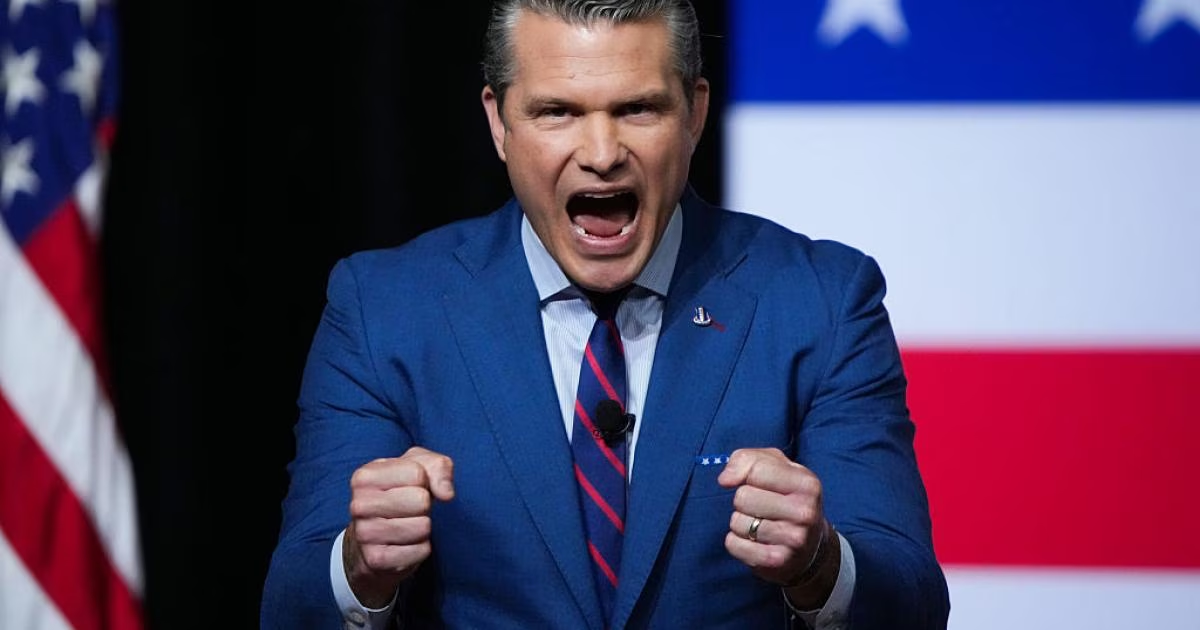







Pete Hegseth stands out as one of the most controversial figures in President Donald Trump's second administration, having transitioned from media screens to leading the world's most powerful army. With a physical build reflecting his background as a former basketball player, Hegseth embodies Trump's new vision for the military establishment, which has abandoned the name 'Defense' to reclaim the title 'Department of War'.
Hegseth was born in Minnesota in 1980, served in the National Guard as a major, and participated in military missions in Iraq, Afghanistan, and Guantanamo. This relatively limited field experience did not prevent him from ascending to the top of the military hierarchy, relying on his absolute loyalty to Trump and his continuous appearances as an analyst on Fox News.
Hegseth's appointment faced fierce resistance in the US Senate, with the decision passing by only one vote, cast by Vice President J.D. Vance. Objections focused on his lack of sufficient administrative experience to lead millions of service members, in addition to previous accusations related to his personal conduct and his stances on women in the military.
Hegseth bears symbols on his body reflecting his deep ideological convictions, most notably the 'Deus Vult' or 'God Wills It' tattoo, a slogan historically associated with the Crusades. He also recently appeared with a tattoo of the word 'infidel' in Arabic, raising widespread questions about the nature of the doctrine he is trying to instill in the ranks of the US armed forces.
Since taking office, the 'War Secretary' has embarked on a wide-ranging purge within the Pentagon, including the dismissal of senior military leaders, most notably General Charles Brown. These moves, according to informed sources, aim to get rid of leaders who adopt 'diversity and inclusion' policies and replace them with leaders who pledge personal loyalty to the President.
The change was not limited to names but extended to the visual and verbal identity of the institution, as Trump signed an executive order to reinstate the name 'Department of War,' which was adopted before 1947. Hegseth considered this change to send a strong deterrent message to the world, affirming that the United States is prepared to adopt an offensive approach to protect its interests.
Hegseth issued strict orders to reduce the number of generals and admirals by up to 20%, considering that the inflation of senior ranks hinders combat effectiveness. He also emphasized formal discipline, demanding military leaders maintain physical fitness and shave their beards, in an attempt to restore what he described as the traditional 'warrior spirit'.
Hegseth's religious leanings raise concerns in international circles, especially with his extensive use of evangelical rhetoric during military operations against Iran. The Secretary called on the American people to pray for victory 'in the name of Jesus Christ,' which critics considered a departure from the secular traditions of the US military and marginalization of its members from other religions.
Pope Leo XIV criticized this trend without directly naming Hegseth, warning against distorting the Christian message and using it to justify dominance and wars. The Pope affirmed in his sermons that invoking the name of Christ in the context of armed conflicts is completely unacceptable and contradicts the essence of faith, which calls for peace.
On the security front, Hegseth faced sharp criticism after reports confirmed he leaked sensitive military information through unsecured messaging applications. The Pentagon's oversight body revealed that he discussed details of airstrikes on Yemen via the 'Signal' app, exposing forces involved in operations to serious security risks.
This administrative turmoil coincided with the dismissal of National Security Advisor Mike Waltz, who was involved in leaking live intelligence information to journalists via chat groups. These incidents reflect a state of indiscipline within Trump's inner circle, despite their public emphasis on the need to adhere to strict military rules.
Amid escalating tensions with Iran, Hegseth took a surprising step by requesting the resignation of the Chief of Staff of the Army, General Randy George. Observers described this timing as very poor, as the dismissal comes at a time when the military institution needs stability and unity to make crucial strategic decisions.
Analysts believe that Hegseth's 'reward and punishment' policy based on political loyalty may weaken the US military's efficiency in the long run. The dismissal of experienced leaders such as Admiral Lisa Franchetti and Admiral Linda Fagan reflects a desire to break institutional constraints in favor of absolute executive authority.
His project to restructure the US military under the name 'Department of War' remains a true test of the ability of American institutions to withstand radical changes. While the Secretary boasts of his tattoos and hardline rhetoric, international circles await the repercussions of this offensive doctrine on global security stability in the coming years.
My main mission is to restore the warrior culture to the Pentagon and cleanse the institution of the woke ideologies that have weakened our fighting power.
شارك برأيك
Pete Hegseth.. The 'War Secretary' Reshaping US Military Doctrine with Crusader Tattoos