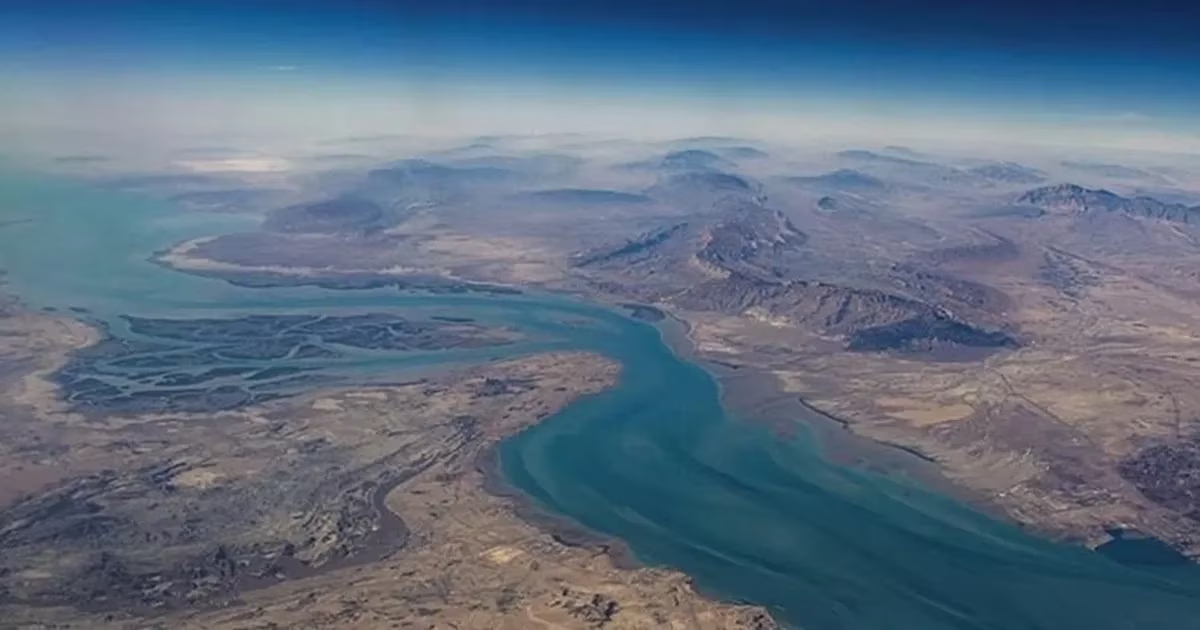







Tensions are escalating in the Strait of Hormuz, placing China in a unique strategic position that allows it to expand its economic and political influence on the international stage. International press reports indicate that Beijing is closely monitoring the movements of the United States and Iran, transforming the crisis from a potential military conflict into a geopolitical opportunity to strengthen its global standing.
Observers believe that history is repeating itself, as the current crisis in the Strait of Hormuz resembles the Suez Crisis in the 1950s, which marked a turning point in the decline of the British Empire. Just as Britain lost its military and financial superiority then, some believe that American hegemony may face a real test against China's growing rise.
Although Chinese President Xi Jinping recognizes that war could destabilize export markets, he sees it as a means to undermine Western superiority. China seeks to present itself as a balanced and responsible great power, calling for a ceasefire and criticizing what it describes as American hegemony, thereby enhancing its credibility among developing nations.
Economically, the continuous threat to traditional oil supplies contributes to accelerating the global shift towards clean energy and electric vehicles, a sector almost entirely dominated by China. This has been clearly reflected in financial markets, where shares of Chinese electric vehicle companies like 'BYD' jumped by 18%, while their Western competitors experienced a sharp decline.
Beijing holds a strategic bargaining chip in its control over approximately 80% of tungsten production and refining, a vital and indispensable element in the manufacturing of missiles and advanced weapons. China has imposed strict restrictions on the export of this metal, putting American and European military industries in a real predicament due to the increasing shortage of raw materials.
On the ground, the United States has begun moving military assets and strategic resources from the Far East towards the Arabian Gulf to counter Iranian threats. This military movement gives China more room to maneuver in its regional vicinity and alleviates the pressure that American forces were exerting on its eastern borders and the South China Sea.
Chinese academic sources confirm that any decline in the American military presence in the Asia-Pacific region directly benefits Beijing. Experts believe that Washington's preoccupation with Middle Eastern crises provides China with a golden opportunity to impose a new reality in areas it considers within its traditional sphere of influence.
China possesses a high capacity to absorb energy supply shocks thanks to its massive crude oil reserves, which have been bolstered over the past three years. Estimates suggest that these reserves, despite their secrecy, are sufficient to cover the country's consumption for six months, protecting its economy from sharp price fluctuations.
Beijing also relies on diversifying its supply sources by increasing imports from Russia and Iran, exploiting Western sanctions imposed on both countries. This energy alliance enhances China's strategic independence and makes it the only party capable of exerting real pressure on Tehran to ensure navigation security when necessary.
China's ultimate goal is to break the dominance of the US dollar in international trade of raw materials and basic commodities. Beijing seeks to enforce the use of the Chinese Yuan in oil and gas deals, an approach it has already initiated with Russia, Brazil, and Argentina, and aspires to extend it to include Gulf countries in any future settlement.
China's success in imposing its local currency as an alternative to the dollar in the energy sector would be a devastating blow to the Washington-led global financial system. If Beijing can play the role of mediator in the Hormuz crisis, it will undoubtedly stipulate the conversion of commercial transactions to the Yuan, accelerating the decline of the American currency.
Compared to Britain in 1956, the United States today possesses immense technological and military superiority, in addition to the dominance of its financial bonds in international markets. However, the Chinese challenge does not rely on direct military confrontation, but rather on economic attrition and control over vital supply chains.
The question of whether the Hormuz crisis will lead to China's rise as the sole great geopolitical power remains dependent on the outcomes of the current conflict. But current indicators confirm that Beijing is the party most prepared to capitalize on these disturbances to achieve long-term gains at the expense of traditional Western influence.
In conclusion, it seems that the 'Third Gulf War' for the Trump administration may be the moment that reshapes the global balance of power. China is not merely observing; it is actively building a parallel system that ensures its economic and political sovereignty, exploiting every loophole left by American withdrawal or preoccupation in the region.
Any decline in the American presence in the Asia-Pacific region will inevitably benefit some party, and we can well imagine who that party is.
شارك برأيك
China, the Biggest Beneficiary of the Strait of Hormuz Crisis: 7 Reasons Boosting Beijing's Global Influence