







Washington – Said Arikat – 2/3/2026
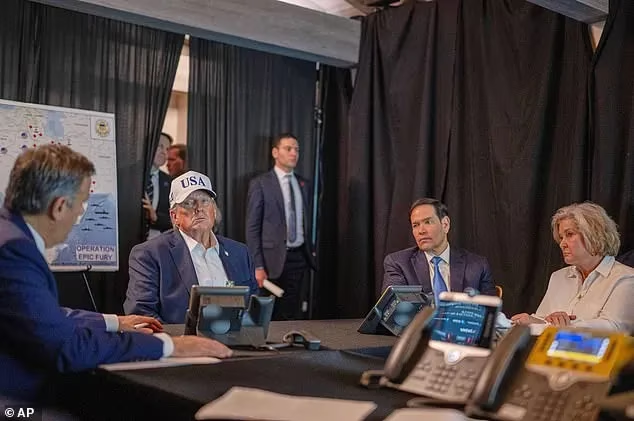
US President Donald Trump predicted that the war he launched against Iran would last "about four weeks," at a time when US and Israeli military operations are escalating and regional losses and risks are increasing, while the US administration remains unable to provide a clear vision for the end of the conflict or a verifiable definition of what it considers a "victory."
In an interview with the "Daily Mail" published on Sunday, Trump said that the timeline for the war was known from the beginning, adding: "The operation has always taken four weeks… Iran is a big country, and no matter how strong it is, it will take four weeks — or less." However, this time estimate, according to military analysts, reflects political confidence more than a solid field assessment, especially given the nature of modern wars, which rarely adhere to pre-announced timelines.
The United States and Israel continue to carry out intensive strikes targeting Iranian military sites and infrastructure, while Tehran responds by launching ballistic missiles and drones that have proven their ability to bypass some defense systems and cause direct impact inside Israel and target American bases in the region, indicating that the balance of deterrence has not yet been decided despite US military superiority.
The "Wall Street Journal" reported that Washington is rushing to deplete Iran's missile capability before facing an inverse challenge of declining interceptor missile stockpiles. US forces have used massive numbers of "THAAD," "Patriot," and "SM-" systems to defend Israel and its regional bases, in a financially and militarily costly defensive battle.
Experts point out that this equation reveals a recurring strategic imbalance in asymmetric wars: the world's greatest power finds itself forced to use expensive defense systems to intercept much cheaper offensive means. Over time, the attrition factor may turn into an element of internal political pressure, especially if no decisive progress is made to justify the continuation of operations to the American public.
In a development reflecting escalating risks, Trump acknowledged the killing of three American soldiers in an Iranian attack targeting a US base in Kuwait, the first human losses acknowledged by US Central Command since the start of the war. The President said: "They are great soldiers… We expect this to happen, unfortunately, and it may happen again," a statement critics considered an attempt to prepare public opinion for the possibility of a rising death toll.
In a later video statement, Trump explicitly acknowledged that more Americans might be killed before the war ends, saying: "This is the reality." This rhetoric reflects a significant shift from promises of quick decisive action to managing expectations of losses, a shift that often accompanies the early stages of wars when human costs begin to emerge.
Observers note that the US administration has not yet provided a coherent narrative explaining the urgency of starting the war or its ultimate goals. The President has not delivered a lengthy address to the nation, nor has he held a comprehensive press conference, while senior officials have been absent from major political programs, which reinforced the impression that the administration is seeking to avoid intense media scrutiny regarding the intelligence justifications that preceded the attack.
Critics say that this absence recalls previous patterns in US foreign policy, where military operations begin with urgent threat narratives before those narratives are later challenged or revised. With the absence of transparency, public debate is confined between supporting the armed forces and questioning the decisions of the political leadership, a delicate balance that often collapses as the war continues and its cost rises.
In the broader context, analysts believe that setting a timeline for the war may be primarily aimed at domestic political consumption, rather than being an accurate military estimate. Successive US administrations have often sought to reassure the public that interventions would be "short and limited," before turning into longer and more complex commitments as a result of escalation dynamics and mutual reactions.
Amid continued strikes and counterattacks, the current war appears closer to a gradual war of attrition than a swift campaign. Iran does not need to achieve direct military superiority as much as it needs to prolong the confrontation to raise its political and economic cost, while Washington bets that intense military pressure will force Tehran to back down before the conflict expands.
Between these two conflicting bets, Trump's estimate that the war will end in four weeks remains an early test of the administration's credibility, as the gap between political expectations and field reality has historically been one of the most prominent factors that reshaped American attitudes towards foreign wars — often too late.
شارك برأيك
Trump expects a four-week war with Iran amid growing questions about goals and strategy