







Washington – Said Arikat – 3/2/2026
News Analysis
As the war enters its third day, the image that accompanied the initial strike is rapidly fading. What was presented as a decisive military operation to prevent an imminent threat is turning into an open conflict, raising fundamental questions about the war's motives and whether the United States and Israel rushed into confrontation without a precise calculation of its long-term political and military repercussions.
The assassination of Iranian Supreme Leader Ali Khamenei in the opening strike is the most dramatic event in the war so far. However, eliminating the head of the regime does not necessarily mean its collapse, as some interpretations in Washington and Tel Aviv assume. Historical experiences indicate that targeting the supreme leadership often leads to a re-formation of power rather than its disintegration. Younger and more hardline leaders, perhaps from the ranks of the Revolutionary Guard, are likely to advance to the decision-making center, which could strengthen the security character of the Iranian regime and give the military establishment greater influence at the expense of traditional political and religious institutions. Thus, the assassination might turn into a factor of national mobilization, giving the regime new momentum instead of quickly overthrowing it.
Domestically in the US, the killing of three American soldiers immediately shifted the war from the external theater of operations to the internal political arena. Human casualties, even in early stages, change the nature of public debate and raise questions about the war's utility and ultimate goals. With no direct and immediate threat to American soil, some critics began to question whether the administration had entered a war of choice rather than strategic necessity.
President Donald Trump tried to contain concerns with statements saying that operations could end within "four weeks or less," asserting that the campaign was "ahead of schedule." Atlantic magazine also quoted him as saying that the Iranians were seeking negotiations and that Iranian military leaders wished to surrender. However, such statements reflect a political optimism familiar at the beginning of wars, where risk assessments are often downplayed to solidify domestic support. American history, from Iraq to Afghanistan, shows that wars that begin with short-term expectations rarely end according to announced schedules.
Israel, for its part, announced its intention to expand strikes, a move reflecting a firm conviction that military force can reshape the strategic environment in the region. But critics argue that this approach ignores decades of conflict lessons, where preemptive strikes have proven capable of postponing threats, not ending them. Indeed, continuous escalation increases the likelihood of additional regional parties becoming involved, which could turn a limited confrontation into a multi-front war difficult to contain.
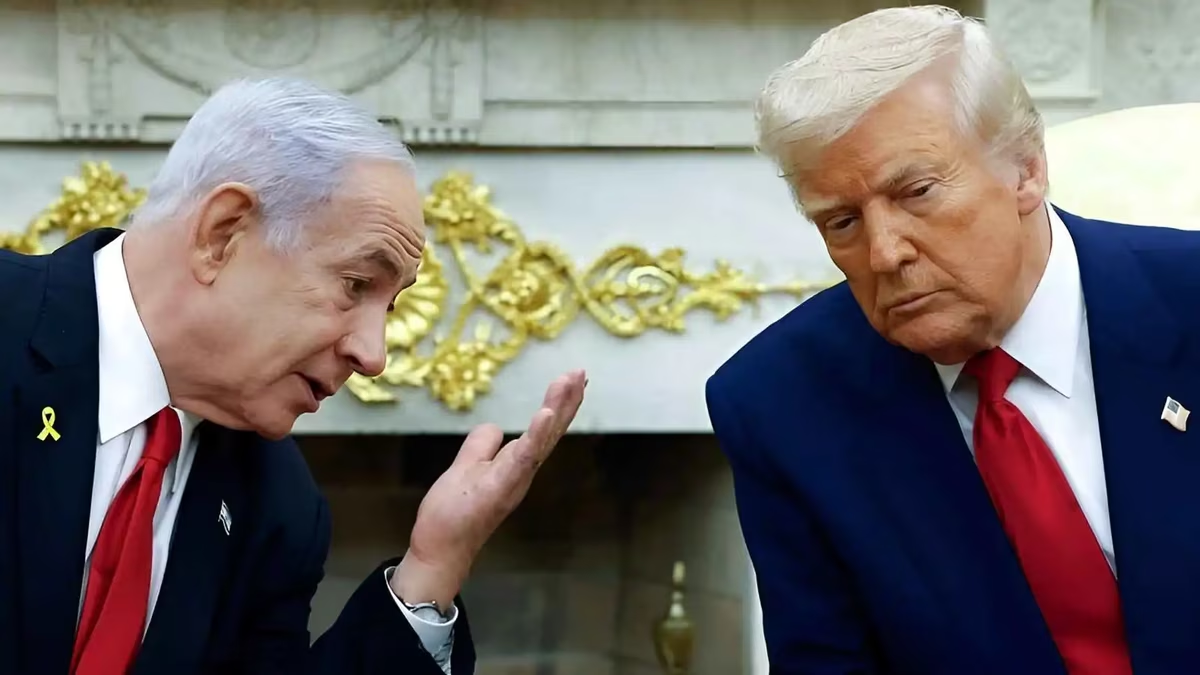
Trump chose to frame the war in moral language, presenting it as a necessity to protect Americans from a "dangerous" regime. However, this rhetoric, according to analysts, conceals a more complex reality of intense political pressure exerted by Benjamin Netanyahu to push Washington towards military confrontation. Turning the war into a moral issue gives it immediate political legitimacy, but it reduces the margin for diplomacy, as any subsequent retreat might appear as an abandonment of a moral principle rather than merely a strategic reassessment.
Here emerges the biggest dilemma: the absence of a clear vision for the day after. Wars aimed at changing or overthrowing regimes rarely achieve rapid stability. In the Iranian case, dismantling the traditional leadership might lead to the rise of more hardline and organized forces, creating a more hostile regime instead of a more moderate one. This possibility raises questions about whether Washington and Tel Aviv focused more on the moment of the strike than on considering its political outcomes.
The war also reveals that the decision for confrontation was not solely the product of American calculations, but rather the result of complex regional pressures converging. The strategic rapprochement between Israel and some Gulf powers concerned about Iranian influence contributed to creating a political climate that pushed towards the military option after years of hesitation. Critics point out that this pattern reflects a shift in American decision-making, where Washington sometimes becomes part of regional security agendas instead of being the party that defines them.
Militarily, officials expect the exchange of missile strikes to continue in the coming days, meaning that decisiveness will not be determined by the first strike but by each party's ability to withstand attrition. If Iran retains its ability to retaliate, the war could turn into a long confrontation that drains resources, destabilizes energy markets, and increases political pressures within the United States itself.
Just two days into the fighting, the question no longer seems to be how the war started, but why it started so quickly, and without extensive public debate about its alternatives. While Washington and Tel Aviv assert that the goal is to prevent nuclear proliferation, critics believe that the early resort to force may have accelerated the crisis instead of containing it. Between these two interpretations, the region enters a new phase that may reshape its balances for many years — a war that began with high confidence in decisiveness, but quickly reveals the limits of military power when used without a clear political vision for the end.
شارك برأيك
After Khamenei's Assassination: A War Without a Clear Plan Reveals Washington and Tel Aviv's Failed Bets