







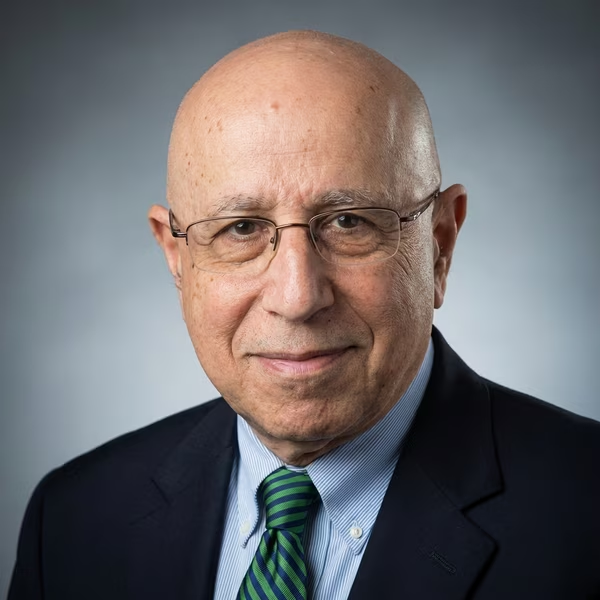
In a visit that raised deep political and ethical questions, former CIA Director General David Petraeus appeared at the Civil-Military Coordination Center (CMCC), run by the US Army in southern Israel, tasked with overseeing what is described as "ceasefire" arrangements in the Gaza Strip. The visit, revealed by diplomatic sources to "Drop Site," was not merely protocol but carried implications beyond security to the political, economic, and social re-engineering of Gaza.
Petraeus, one of the most prominent architects of the American "counter-insurgency" doctrine, praised in his speech the Israeli army's shift towards the "clear, hold, and build" model, the same model he applied in Iraq and Afghanistan, which involved dividing cities into "gated communities" subject to security surveillance and biometric identification systems. This praise came after his previous criticisms of Israel for not learning the lessons of the American occupation of Iraq.
Days before Petraeus's visit, the US Army had presented to the CMCC a vision for what was called the "first planned community for Gaza" in Rafah, a closed residential complex accommodating about 25,000 Palestinians, under full Israeli military control, and subject to a biometric entry system, "rehabilitation" programs, and strict control over aid and housing. According to informed sources, the project is seen as an experimental model for "New Gaza," funded by the UAE.
Petraeus's visit coincided with US President Donald Trump's announcement at the Davos Forum of a "Peace Council," where he presented Gaza not as a political or humanitarian issue, but as a "real estate" investment opportunity on the sea. His son-in-law Jared Kushner followed by announcing an economic development plan for Gaza, emphasizing "aligning security and governance frameworks" to attract investors, in a speech that clearly reveals the priority of capital over rights.
This scene recalls Petraeus's own history; the man led the "military surge" in Iraq in 2007, contributed to the militarization of society by arming militias, expanded secret night operations, and was a central player in America's hidden wars in the region. Today, the same logic returns, but with a facade of "reconstruction" and "governance."
Petraeus's interest in Gaza is inseparable from his current position as a partner and chairman of the Middle East Institute at "Kohlberg Kravis Roberts & Co. KKR," one of the largest American investment firms, with extensive investments in cybersecurity, digital identity, and defense, with direct ties to Israel. Here, security doctrine intersects with capital interests, and population control becomes a profit opportunity.
In his speech, Petraeus praised the CMCC's efforts in delivering aid, even though Israel still prevents essential materials and bans the work of dozens of organizations, which led European countries to withdraw their staff from the center. This contradiction reveals the center's function: managing the crisis, not solving it, and organizing the siege, not lifting it.
In the background, the Gaza gas file emerges as a potential financial lever for reconstruction, within a network of interests linking Israel, the UAE, and Western investment companies, within the broader framework of the Abraham Accords. Thus, Palestinian resources become a guarantee for projects over which Palestinians have no say.
Amjad Al-Shawa, head of the Palestinian NGO Network, criticized these proposals in a statement to "Drop Site," considering them a "beautiful image designed by artificial intelligence," which does not reflect reality and does not consult Palestinians, asking: Who will own the rebuilt Gaza? And who will serve whom?
Petraeus's visit – the general who quelled the resistance in Iraq – in this context, is not a fleeting event, but an indicator of the intersection of security and investment, where Gaza is redefined as a space for population control, an emerging market, and a laboratory for "soft war" doctrines, while Palestinians are reduced to a labor force or permanent residents in "gated communities."
According to many experts, what is proposed for Gaza is not reconstruction, but a forced reshaping of society under a single security-economic umbrella. The "gated communities" model does not address the roots of the conflict but transfers a failed experience from Iraq to a more fragile context. It is a project of mass control, managed by data and biometric cards, aiming to separate the population from politics, and transform rights into privileges conditioned by obedience.
Moreover, the discourse of US President Trump, his son-in-law, and Kushner reveals the new colonial mentality: land as an investment site, and population as a security variable. Political language is absent in favor of market language, and the national question is erased in favor of "governance" and "investment attractiveness." In this framework, Gaza becomes an experimental project for security capitalism, where profits take precedence over sovereignty, and forced stability over justice.
Human rights experts warn that the deeper danger in this approach lies in dressing up a prison as reconstruction. As Ghassan Abu-Sittah points out, Gaza is being transformed from an open-air prison into a high-tech closed prison, where the goal is not to liberate daily life but to manage and control it. It is an engineering of a future without a political horizon, where the body is managed instead of aspirations being protected, and suffering is transformed from a human wound into a resource for investment and control.
شارك برأيك
Petraeus Uses His Colonial Experience in Iraq to Turn the Gaza War into Millions of Dollars